



Solar panels 2/2
Solar panel technology in transition – are we in the middle of a new “HD DVD vs Blu-ray” race?
The solar industry is currently going through an exciting phase – much like when high-definition video took off and two competing technologies, HD DVD and Blu-ray, fought to become the industry standard. In the same way, we are now seeing two parallel technological advances in solar panels: back-contact technology and TOPCon technology. Both have their unique advantages, and both are attracting manufacturers and installers – but no one yet knows which will emerge as the long-term winner.
For you as an installer, this means facing a technology choice that could affect performance, appearance and future maintenance. Below, we look at the most common technologies today and take a closer look at what makes back-contact and TOPCon so exciting.
Back-contact technology
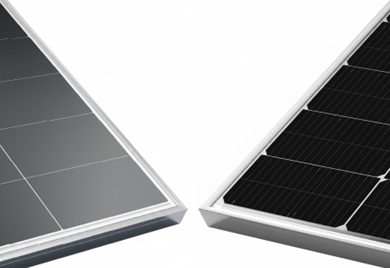
Back-contact technology is one of the hottest areas right now. All the electrical contacts are moved to the rear of the solar cell, creating a completely black, elegant surface with no visible conductors on the front. It is not just about looks – it also increases efficiency because more light reaches the cell. There are two leading manufacturers of this technology worldwide: Longi and Aiko. Their technologies differ slightly, but fundamentally, both make back-contact panels.
- ABC (All Back Contact) from AIKO: AIKO’s Gen 3 panels use an advanced back-contact solution that delivers record-high efficiency and excellent performance, even in low light. Read more: Aiko ABC Gen 3
- HPBC and HBC from Longi: Longi has developed its own variants, combining back-contact technology with passivation to reduce electrical losses and deliver both high efficiency and an attractive design. Read more: Longi Hi-MO X10 Artist
For installers, back-contact panels are often easier to handle and produce an aesthetically pleasing result, which is becoming increasingly important on residential rooftops.
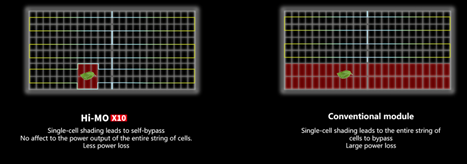
Partial shading management with BC technology from AIKO and LONGi.
Back-contact panels with partial shading optimisation are based on advanced semiconductor physics and innovative cell design. When a solar cell in such a panel is shaded, it can enter a so-called “soft breakdown” mode, meaning that the cell can still conduct current without being damaged. Back-contact cells have carefully designed interdigitated contacts, which means they require a lower voltage to operate efficiently even when shaded.
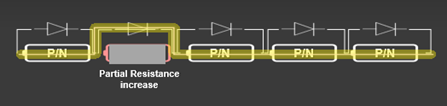
Unlike traditional panels, where a bypass diode disconnects one third of the panel when shaded (leading to significant power losses), back-contact technology can bypass individual shaded cells without affecting the entire string. This means that only a small part of the panel’s output is lost when a cell is shaded, and the bypass diode is activated only when several cells are shaded. This helps maintain higher overall efficiency even under partial shading.
In summary, partial shading optimisation in back-contact panels enables them to continue delivering high output even when some cells are shaded, thanks to the intelligent use of semiconductor physics and precision-designed contacts in the cells. This results in significantly lower power losses compared with traditional technology and makes the panels particularly well suited to installations where shading is difficult to avoid.
Longi TaiRay
TaiRay is Longi’s own type of silicon wafer, used in its solar cells. It is based on advanced technology and has been developed to deliver better performance and durability than traditional wafers. TaiRay wafers are used in the Hi-MO X10 series, among others, and are the result of many years of research and development.
Three advantages of TaiRay, according to Longi:
- High product concentration:
TaiRay wafers mean that more solar cells achieve high efficiency after manufacturing, which means more power can be obtained from each cell. - Cleaner materials and fewer defects:
New manufacturing processes reduce the amount of oxygen and other impurities in the silicon material, and result in fewer defects in the crystal structure. This leads to more efficient solar cells. - Improved strength:
TaiRay wafers are more resistant to breakage and have 16% higher flexural strength than traditional wafers, making them more robust and durable during handling and installation.

Aiko’s copper interconnections
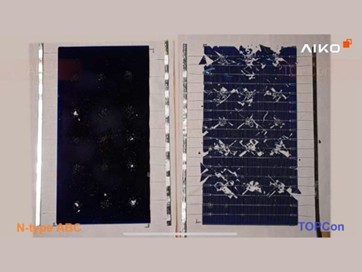
Aiko has developed its own copper-based interconnection for its ABC cells, replacing traditional silver metallisation. By using copper, which conducts electricity significantly better than silver paste, Aiko can increase cell efficiency and reduce energy losses. Copper is applied by electroplating, avoiding high temperatures and thereby reducing the risk of damage and contamination in the silicon. The result is more robust and durable solar cells with greater resistance to microcracks and environmental impacts. In addition, copper is both cheaper and more readily available than silver, making the technology more sustainable and future-proof
TOPCon – next-generation cell technology
TOPCon stands for “Tunnel Oxide Passivated Contact” and is the second major challenger. TOPCon builds on traditional monocrystalline cells but adds an extra layer of thin oxide and a passivated contact on the rear. The result? Higher efficiency, better performance at high temperatures and a longer lifespan.
Advantages of TOPCon:
- Higher efficiency than traditional PERC cells
- Better performance in hot conditions
- Less degradation over time
TOPCon is therefore a technology that extracts even more energy from every square metre – perfect when roof space is limited
HJT – Heterojunction technology
Another technology that is rapidly gaining ground is HJT (Heterojunction Technology). HJT combines two different types of silicon – amorphous and crystalline – in the same cell. This allows the cell to harness more of the sun’s energy and delivers very high efficiency, particularly in low light and at high temperatures. HJT cells also degrade slowly over time and can be manufactured using very thin wafers, saving materials and reducing environmental impact.
For installers, HJT panels are a premium choice for customers who want the very latest and best, especially in locations where light conditions vary considerably throughout the year.
Perovskite and tandem panels – the technology of the future?
One of the most talked-about innovations in solar cells is perovskite technology. Perovskite is a new material that can absorb light very efficiently and be produced using simple processes. So far, the technology is mainly at the research stage, but its potential is enormous – both in terms of efficiency and cost.
The really exciting development comes when perovskite is combined with traditional silicon solar cells in so-called tandem panels. This allows different parts of the solar spectrum to be harnessed, achieving efficiencies far beyond what is possible with silicon alone. Several manufacturers have already unveiled prototypes, and the first commercial tandem panels are expected within a few years.
For you as an installer, these are technologies to keep an eye on – they could revolutionise the market and open up entirely new applications and design possibilities.
Combinations of technologies
To show that things are a little more complex than this blog post has suggested, we also want to highlight how solar-panel manufacturers combine different technologies to achieve new levels of efficiency and energy-conversion efficiency. For example, the Longi Himo X10 is based on Longi’s HPBC technology (Hybrid Passivated Back Contact), which is simply a back-contact technology. Longi is now on its second generation, using so-called N-type (n-doped silicon with phosphorus, as opposed to p-type, which uses boron). Longi’s “Rolls-Royce” panel, the new LONGi EcoLife S10, is based on HBC technology (Heterojunction Back Contact), which combines HJT and back contact. This is how it achieves a full 510 W in a panel measuring 1800 mm x 1134 mm (see the datasheet HERE).
Summary
Solar-panel technology is advancing at a rapid pace, and we are in the midst of a technological shift in which back-contact and TOPCon are competing to become the industry standard of the future – much like HD DVD and Blu-ray once did in the world of film. At the same time, we are seeing exciting advances in HJT and perovskite/tandem technologies, which could further change the landscape. By understanding the differences between these technologies, you as an installer can choose the right panel for every project and offer your customer the best possible solution.
Would you like to learn more about the latest panels? Read more about Aiko ABC Gen 3 and Longi Hi-MO X10 Artist.
Need help finding the right solution?
We know it’s not always easy to know which product or solution is best. Whether you have questions about our range, need guidance or would like help finding a solution that suits your specific needs, we’re here for you. With our knowledge and experience, we’ll help you make the right choice.
Related posts
New rules for functional earthing
Solar energy systems with open architecture – the flexible energy solution of the future