



Smart meter, a smart electricity meter
Smart meter
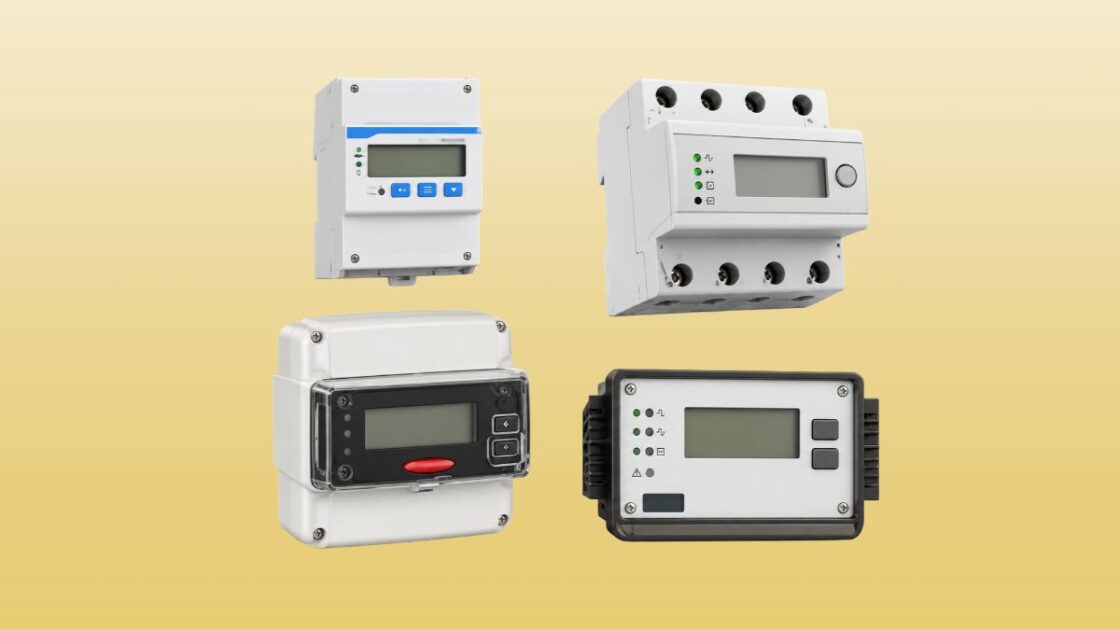
A smart meter is an external meter that connects to the inverter. With a smart meter, you can visualise high-resolution data both in the app and via a portal, and you can also control the inverter. Usually, you connect a smart meter from the same manufacturer as your inverter, but there are also third-party meters that work just as well. However, check compatibility before you buy!
Current transformers & Rogowski coils
If the inverter supports direct measurement, this is usually done up to 63 A. Above that, all inverters must have special current meters, also known as current transformers. These are clamped around the service cables and measure the current passing through the current transformer.
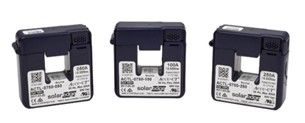
The measurement error of current transformers is proportional to the rated current. This means that, for the most accurate measurements, you should use transformers of an appropriate size. For example, 50A or 100A for a house.
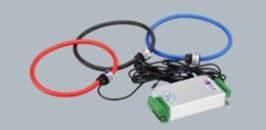
For higher currents, or if space is limited in the consumer unit, Rogowski coils may be the solution. They look like “bracelets” and clamp around the service cables. They are flexible and very easy to work with; the downside is that they require a separate 24V connection.
Connecting the smart meter
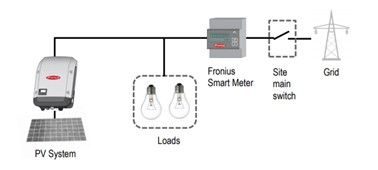
A smart meter is connected at the main distribution board, where it measures all the electricity flowing into and out of the property. If a smart meter is connected at a sub-distribution board, control will only be possible for that sub-distribution board, and production and consumption data for that point in the electricity network will be shown. It is preferable to connect the smart meter so that all consumption can be shown, even if this involves some extra cabling when the inverter and smart meter are not in the same location.
Also note that the smart meter should be connected so that all loads are between the smart meter and the inverter. This means that the inverter knows the production and export figures, and can therefore always calculate consumption.
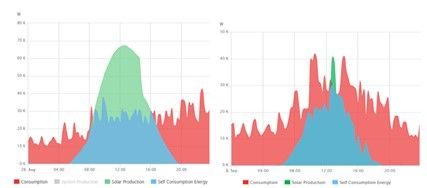
If a smart meter is installed, exports, consumption and self-consumption can be clearly viewed in graphs in the inverter’s portal. Not only does this provide a clear overview of your solar electricity and how it is used, it also gives you a new tool for analysing your consumption and the various loads in your property.
Controlling and limiting an inverter
A smart meter makes it possible to install a larger electrical system than the main fuse can handle.
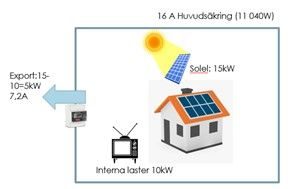
Let’s illustrate this with an example. A detached house has 17 kWp of solar panels, a 16 A main fuse and a 15 kW inverter. On a sunny summer morning, the inverter generates 15 kW of solar electricity. 10 kW is self-consumed by internal loads (such as charging an electric car, TV, heat pump, etc.). 5 kW is exported (15 kW − 10 kW = 5 kW).
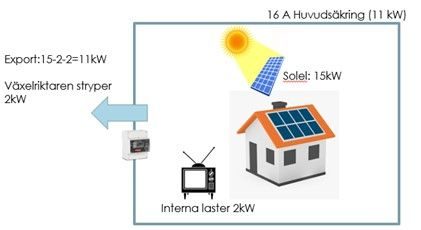
If the family leaves home (e.g. stops charging the electric car), the internal loads decrease. The smart meter then steps down the output power so that it can supply a maximum export of 16A/11kW while also meeting the internal loads, which are now 2kW. This means that the inverter’s output power is 13kW. In other words, even if it could potentially produce 15kW and there is enough sunshine to make 15kW possible, that power is not drawn. It is curtailed digitally by the inverter’s MPPT algorithm (note that it does not become heat).
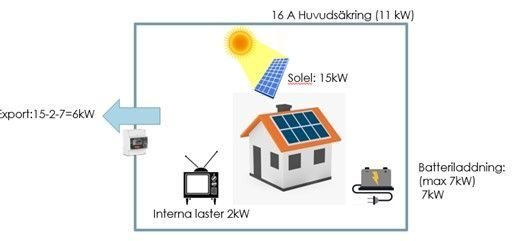
If you have a battery with spare capacity, in this example one that can charge at a maximum of 7 kW, the inverter can use the smart meter to control the system so that both internal loads are met and the battery can be charged. In this case, 6 kW is available for export (which is possible because the main fuse is rated at 16 A/11 kW).
In summary, the control system can be compared to driving a car:
- Without a smart meter – “dumb throttling” (a car without a steering wheel)
- With a smart meter – “smart control” (a car with a steering wheel)
- With a smart meter and battery – (a car with a steering wheel, accelerator and brake pedals)
Product-specific information
Fronius
Fronius has recently updated its smart meters to be compatible with the new Gen24. For information about GEN24, see post 7 on the Technical Blog.
| Article number | Description | Comment |
|---|---|---|
| 4300010044 | Fronius Smart Meter TS 65A-3 | |
| 4300010046 | Fronius Smart Meter TS 5kA-3 | Requires current transformers. |
| 4300011473 | Fronius Smart Meter 63A-3 | Being phased out |
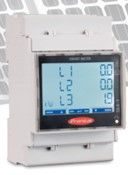
Fronius installation video: Link
Huawei
Huawei has a version of the smart meter that is directly compatible with Huawei inverters. A number of third-party inverters are also compatible (see the manual for an up-to-date list). The smart meter can be connected either directly to the inverter or to a smart logger.
| Part number | Description | Comment |
|---|---|---|
| DTSU66-H | Huawei Smart Power Sensor (Three Phase) | 250A transformers included |
SMA
SMA’s smart meter connects via an Ethernet cable, making installation easier. For integration and control in the smart home, Sunny Home Manager is recommended for residential use, and Data Manager M Powered by EnnexOS together with SMA Energy Meter for commercial applications.
| Item number | Description | Comment |
|---|---|---|
| EMETER-20 | SMA ENERGY METER | Being phased out |
| HM-20 | SMA SUNNY HOME MANAGER 2.0 | |
| EMETER-30 | SMA Energy Meter powered by ennexOS | |
| EDMM-10 | SMA Data Manager M powered by ennexOS | Supplied without a DC power supply. Use e.g. SMA CLCON-PWRSUPPLY (item no. CLCON-PWRSUPPLY) |
Links SMA (EnnexOS):
Unboxing and installation: Link
Commissioning: Link
Modbus device registration: Link
Power control: Link
Ferroamp
All Ferroamp systems are supplied with current transformers that connect directly to the EnergyHub. Please note that the Rogowski coils are only compatible with the Energy Hub XL. All Ferroamp EnergyHubs have the smart meter built in.
| Item number | Description | Current | Compatibility |
|---|---|---|---|
| PA00294 | CT 100A | 2-100A | EnergyHub Energy Hub XL |
| PA00295 | CT 160A | 8-160A | EnergyHub Energy Hub XL |
| PA00296 | CT 300A | 15-300A | EnergyHub Energy Hub XL |
| PA00965 | Rog 600A | 60-600A | Energy Hub XL |
| PA00965 | Rog 1200A | 120-1200A | Energy Hub XL |
| PA00967 | Rog 1800A | 180-1800A | Energy Hub XL |

SolarEdge
| Item number | Description | Comment |
|---|---|---|
| SE-MTR-3Y-400V-A | SolarEdge Smart Meter | New version since 2020 |
| SE-ACT-0750-50 | SolarEdge 50A Split-Core Current Transformer | 50A |
| SE-CTML-0350-070 | SolarEdge 70A Split-Core Current Transformer | 70A |
| SE-ACT-0750-100 | SolarEdge 100A Split-Core Current Transformer | 100A |
| SE-ACT-0750-250 | SolarEdge 250A Split-Core Current Transformer | 250A |
| SE-CTS-2000-1000 | SolarEdge 1000A Split-Core Current Transformer | 1000A |
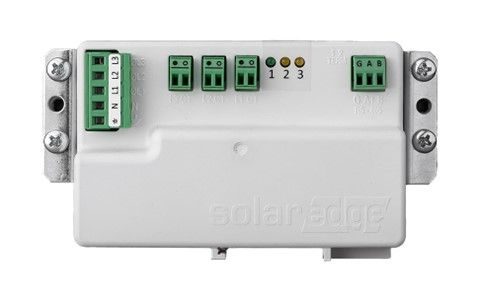
SolarEdge installation video: Link
Conclusions
A smart meter is a useful tool, both for increasing the amount of data available about your solar PV system and for monitoring consumption and generation in the same interface. It is also essential for battery installations and for future load control. Even if you are not ready to take the step of installing a battery today, the smart meter can collect important data to help size one in the future.
The smart meter’s ability to dynamically control the power output of solar PV systems can also enable larger installations than the main fuse can “handle”. This can increase self-consumption and also make larger installations possible with limited export while the grid operator upgrades the upstream grid.
The Technology Blog’s conclusion is, of course: everyone should have a smart meter! ?
Need help finding the right solution?
We know that it’s not always easy to know which product or solution is best for you. Whether you have questions about our range, need guidance or would like help finding a solution that suits your specific needs, we’re here for you. With our knowledge and experience, we’ll help you make the right choice.
Related posts

Island mode in practice
How do you install an earth electrode and set up off-grid operation – with Richard Nyberg