



Residual current device (RCD)
Introduction
In this blog post, we look at how residual current devices really work. There are many differing opinions about whether residual current devices should be used in a solar PV installation. This post will explain how an RCD works and in which cases an external RCD is needed. This covers all the manufacturers that Senergia is a reseller for: Fronius, SMA, Huawei, Ferroamp and SolarEdge.
What is a residual current device (RCD)?
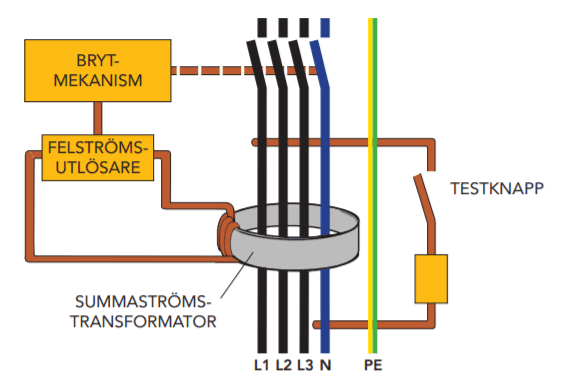
A residual current device (RCD) is an electrical device that measures leakage or fault currents to earth. Under normal circumstances, all the current flows through the phase conductors L1, L2 and L3 and returns through the closed circuit via the neutral conductor (N). If the balance between the current entering and leaving the summation current transformer is disrupted, a voltage is induced that triggers a tripping mechanism. All electrical appliances, from dishwashers to inverters, have a certain amount of leakage current, which is why it is important that an RCD responds to an actual fault and not to normal leakage current.
For personal protection, an RCD with a rating of no more than 30 mA (milliamps) may be used. For fire protection only, an RCD with a rating of no more than 300 mA should be chosen. RCDs are divided into two categories, A & B, for connection to AC networks. Type A responds to AC and pulsating DC, whereas a Type B RCD can handle higher DC currents. In a system with many converters, such as inverters and electric vehicle chargers, leakage currents are often higher than normal.
Because the DC components that leak onto the AC side in a solar PV application, Type B RCDs are advantageous due to their extra resistance to this DC leakage current. The leakage current also has the problem of saturating the iron core in the summation transformer (see image above). This makes it less sensitive or causes it to lose its function.
What do the installation regulations say?
712.532.101 - Where a residual current device is used for fault protection on the AC side, the requirements in section 712.530.3.101 shall apply.
712.530.3.101 Residual current devices - Where residual current devices are used to protect the circuit between the AC terminals of the solar PV inverter and the distribution board, they shall be type B in accordance with SS-EN 62423 or SS-EN 60947-2 unless
- the inverter has at least basic insulation between the DC and AC sides, or
- the installation is designed so that at least basic insulation is achieved between the inverter and the residual current device by using an isolating transformer, or
- the inverter does not require type B residual current device protection according to the manufacturer's instructions.
Special requirements for agricultural installations (Brandskyddsföreningen)
According to the Electrical Installation Regulations, residual current devices (RCDs) must be installed as general fire protection for agricultural installations. The entire installation must therefore be protected by RCDs with a rated residual operating current of no more than 300 mA, including the main circuits.
If there is equipment that collectively generates more than 6 mA of DC, the existing RCDs throughout the entire installation must be replaced with Type B devices.
What do the manufacturers say?
Before we look at what the manufacturers say, it is important to explain why their instructions are so important. This is because the manufacturer's instructions take precedence over the electrical installation regulations. So, when asking whether an RCD is needed, the answer is often: what does the manufacturer say, or are you installing in an agricultural building? The same applies to the question of Type A or Type B: what does the manufacturer say?
Ferroamp
Residual current devices (RCDs) are normally unable to interrupt DC, so they cannot be used in DC networks. For this reason, all installations must be carried out as fixed installations, and accessible parts must be earthed or separated by double or reinforced insulation.
However, an installation with an EnergyHub can be fitted with a Type B, 300 mA RCD on the AC side for fire protection where this is prescribed. This assumes that there is no equipment on the DC side that could cause leakage currents leading to nuisance tripping. Ferroamp's SSO and ESO produce negligible leakage currents and can be used in combination with a 300 mA RCD on the AC side. The larger the DC network and the more devices connected to the DC side, the greater the risk of the RCD tripping incorrectly due to normal leakage currents and transients.
For personal protection, each SSO contains a DC-sensitive RCD in accordance with EN-62109-2, which disconnects the panels from the DC network if fault currents exceed 30 mA.
Type A RCDs are not recommended in combination with EnergyHub and DC networks, as they are not guaranteed to trip in the event of an earth fault on the DC side.
Where several EnergyHubs are interconnected on the DC side in a PowerShare installation, RCDs normally cannot be used because equipotential bonding currents naturally arise via the different EnergyHubs, which can cause the RCDs to trip incorrectly.
Huawei
Huawei's SUN2000 series of inverters has a leakage-current monitoring device called the Residual Current Monitoring Unit (RCMU). It immediately disconnects the Huawei inverter if the leakage current exceeds the permitted value.
Fronius
Local regulations, the electricity supplier or other circumstances may require an RCD in the AC connection cable. Generally, a Type A RCD with a rated residual operating current of at least 100 mA is sufficient. In individual cases, however, and depending on local conditions, a Type A RCD may trip incorrectly. For this reason, Fronius recommends using an RCD suitable for frequency converters.
Link: RCD Information Symo
Link: RCD with 30mA
SMA
There is no specific requirement for an external RCD. SMA provides a guide to selecting the right RCD in the links below:
Link: Critera for selecting RCD Link: SMA Service: 30 MA RESIDUAL-CURRENT DEVICE IS OFTEN TRIGGERED
SolarEdge
SolarEdge inverters are equipped with a certified RCD (residual current device). This provides protection against earth faults on the DC side. No external RCD is required unless there are additional local requirements.
Link: Application Note RCD
Link: RCD Information
Is an RCD needed?
Whether you need an external RCD depends first and foremost on whether it is an agricultural installation. If the answer is yes, an RCD is also needed! For a typical house, the answer is usually no. This is because the RCDs—or rather, the residual current detection in inverters—is good enough that no external protection is needed, unless local regulations require it.
Many installers have discussed with us at Senergia whether fitting a type B RCD means you are safe. Unfortunately, the answer is that even a type B RCD will allow leakage current through up to the 30 mA detection limit for a three-phase connection.
The general advice when installing an RCD for fire protection is to choose one rated for the installation, usually a maximum of 300 mA, and of type A. This is to avoid so-called false-positive trips—that is, when the RCD trips even though no earth fault has occurred.
As an installer, you should instead ask yourself whether an RCD is needed even though the inverter does not require an external RCD. You should still make sure the rest of the electrical system is protected. For example, if solar panels, a UPS and an EV charging point are all installed, they can cause problems with existing type A RCDs. These are the RCDs that have historically saved countless lives!
Final words
As an installer, you may need to consider whether you need to replace the existing Type A RCDs throughout the installation with Type B devices if a Type B RCD is required at the distribution board where the inverter is to be connected. An investigation into this is under way, involving the Swedish Electrical Safety Authority and Rise, among others, and it is due to be completed this autumn. This question has, for example, been discussed in Elinstallatören (Link) and by the Swedish Electrical Safety Authority itself when it visited the trade association Svensk Solenergi. In brief, the issue can be described as follows: the DC components cannot affect the other RCDs, so there is no need to replace them. The analysis is not yet complete, but Senergia’s Technology Blog will revisit the subject as soon as it is!
Need help finding the right one?
We know it isn't always easy to know which product or solution is best for you. Whether you have questions about our range, need guidance or would like help finding a solution that suits your needs, we're here for you. With our knowledge and experience, we'll help you make the right choice.
Related posts

Island mode in practice

How do you install an earth electrode and set up off-grid operation – with Richard Nyberg