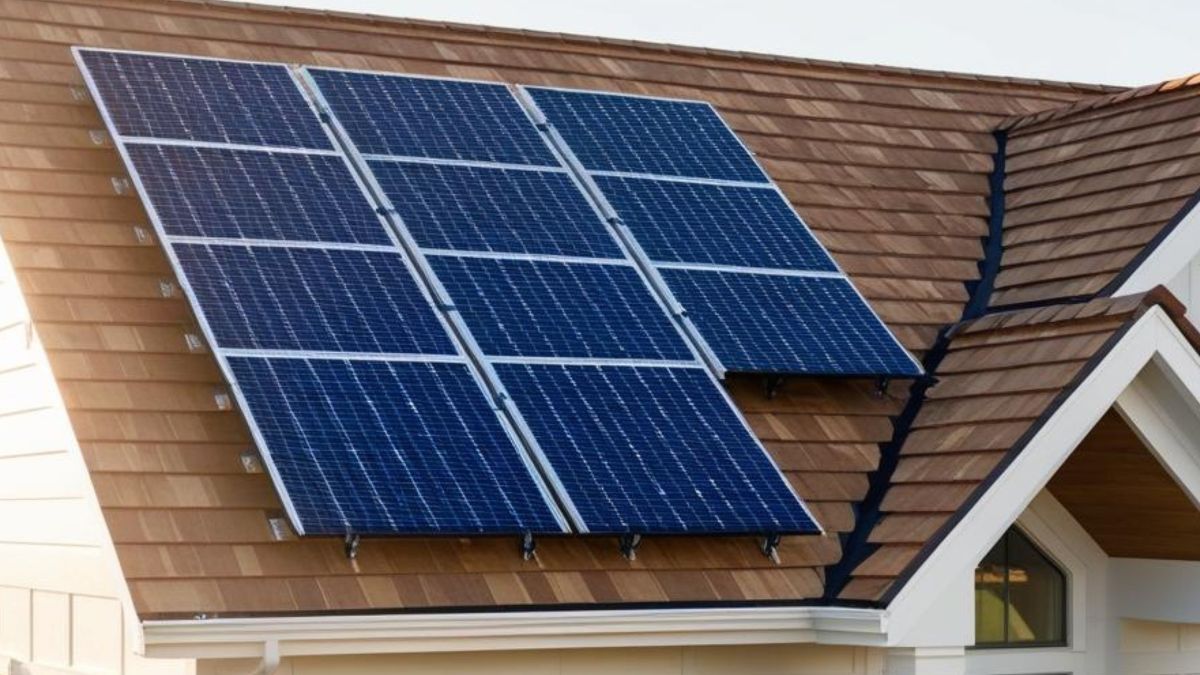




How do you interpret a solar panel datasheet?

Introduction
In this post, Teknikbloggen will explain how to interpret a solar panel datasheet. It contains many figures and abbreviations, which can be a lot to get to grips with, both for those buying a solar installation and for people in the industry. Teknikbloggen will therefore make a valiant attempt to clarify the terminology!
Before we begin, here is a short list of abbreviations. Feel free to refer back to it as you read this post. We will also use LONGi’s 450 Wp panel as an example, with the following electrical data.
| Model Number | LR4-72HPH-450M | |
|---|---|---|
| Testing Condition | STC | NOCT |
| Maximum Power (Pmax/W) | 450 | 333.4 |
| Open Circuit Voltage (Voc/V) | 49.3 | 46.0 |
| Short Circuit Current (Isc/A) | 11.60 | 9.35 |
| Voltage at Maximum Power (Vmp/V) | 41.5 | 38.3 |
| Current at Maximum Power (Imp/A) | 10.85 | 8.70 |
| Module Efficiency (%) | 20.7 | |
List of abbreviations
STC – Standard Test Conditions. “Laboratory-like conditions”
NOCT – Nominal Operating Cell Temperature, the nominal operating temperature of the cell and more realistic figures for comparison.
Pmax – maximum power achieved under STC or NOCT
Voc – Open-Circuit Voltage. The highest voltage achieved under STC or NOCT. Measured between the positive and negative terminals.
Isc – Short-Circuit Current. The highest current achieved under STC or NOCT. Measured with a short circuit between the positive and negative terminals.
MPP – Maximum Power Point. An operating point for the panel where the highest power is achieved.
Module efficiency – the proportion of sunlight converted into direct current, expressed as a percentage.
Conditions for sunlight to reach the panel
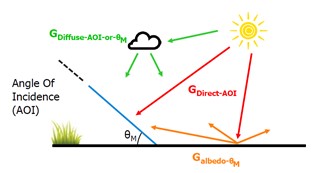
The angle of the sun relative to the Earth is one of the factors that determines how much solar energy a solar panel produces. Depending on where on Earth the solar panel is located, different angles and orientations will be advantageous. In the Northern Hemisphere, panels are positioned facing south (although east and west work too), while in the Southern Hemisphere, panels are positioned facing north.

Solar panels are actually quite a poor name; light panels would have been better. Especially since light is the key ingredient in generating direct current in a solar panel. It is also not only direct sunlight that produces usable solar electricity, but diffuse light reflected by clouds is an important component too. After all, how many cloudy days do we have when conditions are not ideal, yet we still produce solar electricity!
In addition, irradiance via albedo is an important factor to consider. For example, if you live near a lake, reflections from the lake can be reflected towards the panels and contribute positively to production. Albedo is the reflection from the ground itself. Those of you interested in the environment will know that the albedo value changes when the ground changes as ice and snow melt and the ground becomes soil and rock (which absorb much more than snow and ice).
Albedo also becomes more interesting when talking about bifacial panels, i.e. two-sided solar panels. Since these can capture sunlight from both sides, the albedo effect is more pronounced.
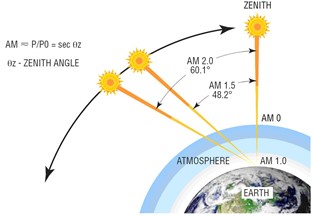
Depending on the angle at which sunlight hits the solar panel, it has passed through different amounts of atmosphere and has therefore been affected by the molecules in the atmosphere, such as oxygen and nitrogen, as well as dirt and pollutants. This determines what light, i.e. which light spectrum, will reach the solar panel. At STC (which will be described in detail below), AM1.5 is used, i.e. 1.5 times the air mass compared with the zenith.
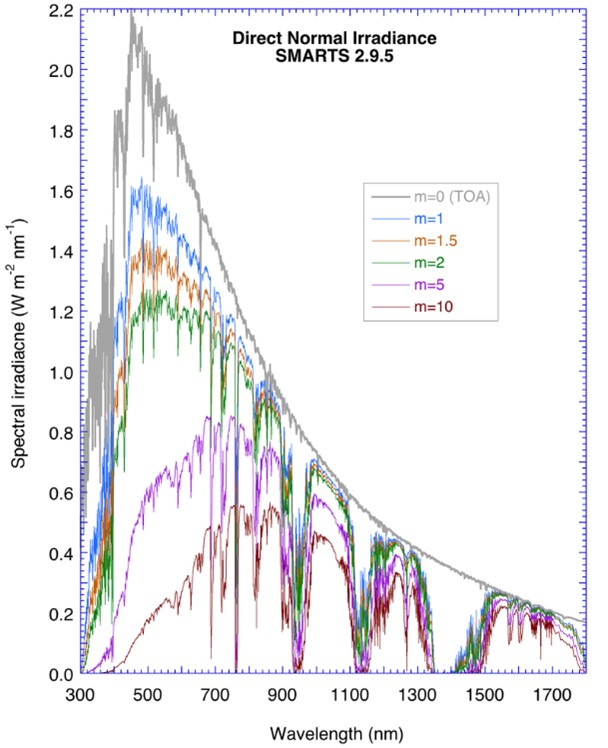
If sunlight had not passed through any atmosphere at all, i.e. AM=0, the grey line in the diagram below would show which wavelengths of light had passed through. The more atmosphere the sun’s rays pass through, the more energy is lost. Different colours (wavelengths) of light also pass through. Different panels are better or worse at absorbing different wavelengths. It is extremely difficult to say which panels are better or worse than others, but if we at Teknikbloggen can get hold of a professor at KTH, we can surely figure it out!
Standard Test Conditions (STC)
Standard Test Conditions, or STC, are a predefined test case that all solar panel manufacturers use to categorise, label and test solar panels. The conditions are defined as follows:
Solar irradiance: 1000W/m2
Cell temperature: 25°C
Light spectrum: equivalent to air mass (air mass) AM 1.5.
It would be almost impossible for both DIY enthusiasts and professionals to compare solar panels if there were no standardised conditions. STC is therefore always used as a reference value when comparing different solar panels. STC is a specific operating condition against which all panels leaving a solar panel factory are tested.
However, all it takes is a change in temperature or light irradiance that is not exactly 1000W/m2 for conditions to no longer meet STC, and this will happen in real life. You could say that a solar panel is a complicated machine with lots of dials and settings, but to compare these “machines”, we set all the dials and controls in the same way.
What sets panels apart are, of course, aspects such as quality and CSR work. Rather than focusing solely on STC values, it is important to remember that different panels will behave differently outside STC’s predefined world. Temperature coefficients, for example, are one such aspect. Different panels lose different amounts of power when it gets hot. These losses can prove costly over the panels’ lifetime.
Realistic enough?
Because STC conditions are relatively specific and do not occur very often in real-world conditions, more realistic values have been developed and are also presented in the panel datasheet. This means that, as a buyer of a solar panel, you know how the panel performs under realistic conditions, and not just in a laboratory.
These more realistic conditions are called NOCT, or Nominal Operating Cell Temperature (nominal cell temperature in operation). The conditions are defined as follows:
- Solar irradiance: 800W/m2
- Ambient temperature: 20°C
- Cell temperature: 45°C (varies for each panel).
- Light spectrum: equivalent to air mass (AM) 1.5.
- Wind speed: 1m/s
This information alone shows that, under more realistic conditions, the panel does not produce power at the STC rating. For example, the power output will fall from 450Wp to 333Wp when comparing the STC and NOCT values. If, as a project designer, you have only taken the STC values into account, for example, you will always buy an oversized and overpriced inverter. This is one of the reasons why solar panel power is typically sized at around 120% of inverter power: there is simply no reason to pay for excess capacity that will only be used for a few hours a year. People often talk about a DC:AC ratio, but to be completely precise, you should probably also specify that this is the DC:AC ratio calculated at STC.
Temperature dependence of the solar panel
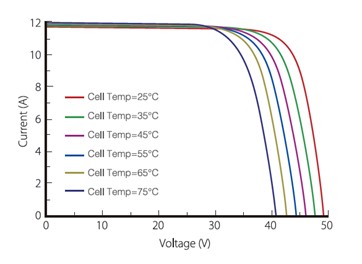
Every solar panel has three temperature coefficients. These indicate the percentage change per degree Celsius in the panel’s current, voltage and power as the temperature changes. Since STC and NOCT are only two snapshots of how a solar panel performs, the temperature coefficients provide a “dynamic picture” of how a solar panel performs at different temperatures.
Let’s take the example below and focus only on the sign (i.e. plus or minus) in front of the coefficient. For Isc, i.e. the current, the relationship is positive. This means that as the temperature rises, the current also increases. This is because resistance decreases and electrons flow more easily through the panel. For Voc, i.e. the voltage, the sign is negative. This means that as the temperature rises, the voltage decreases. In the same way, the voltage in the panel increases as the temperature falls. This means that temperature must be taken into account when designing a solar power system, because the highest voltage in the system is reached on the coldest (and sunny) day of the year. If you have not taken this into account, you could damage your inverter (or optimiser)!
Finally, when we look at the combined result, we see that the power, Pmax, has a negative sign. In other words, the solar panel will produce less power if it gets warmer. This can also be seen from the combined effect of voltage and current (which, when multiplied, gives power: P=IxU): the temperature sensitivity is greater for voltage than for current. In other words, when the temperature changes by one degree, the voltage changes more, so it has the greatest effect.
- Temperature Coefficient of Isc: +0.057%/°C
- Temperature Coefficient of Voc: −0.286%/°C
- Temperature Coefficient of Pmax: −0.370%/°C
If you look at the relationship between current and voltage on a graph for several different cell temperatures, here from 25 to 75 degrees, you can see that the current, I, varies between approximately 11.8 and 12 A at low and high temperatures respectively. The voltage varies from approximately 41 to 49 V, a much greater percentage difference.
The solar panel’s dependence on light
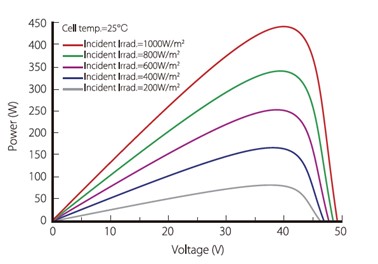
Instead of allowing the temperature to vary, we can hold it at 25 degrees and look at how a solar panel performs at different levels of solar irradiance. Here we have 200–1000 W/m2. In practical terms, this ranges from dawn to a sunny summer’s day.
Unsurprisingly, power output increases with increasing solar irradiance, and a solar panel produces more power in sunny weather than in cloudy weather. An interesting observation in the graph is that, even as solar irradiance rises from dawn to the height of summer, the voltage varies only from around 46 V to 49 V. This means that, for example, if you have solar panels on an east-facing roof and a west-facing roof, the voltage from the panels will be almost the same. This is because voltage is not very sensitive to light. Designers can use this, for example, to connect strings in parallel on roofs facing different directions, provided they have the same voltage—which two strings will have if they contain the same number of panels and are of the same type!
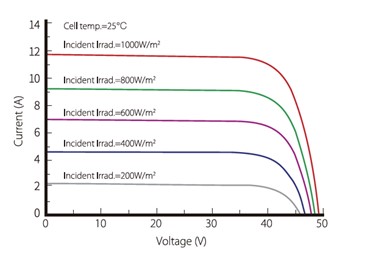
If we instead look at how the current varies when we change the light conditions, we can see that the current would jump if we were to change the light conditions instantaneously. The current varies from about 2 to about 12 A, i.e. a factor of 6!
Another thing we can observe in the graph is that the current remains relatively stable, i.e. horizontal, before dropping sharply after about 40 V. This is very characteristic of diodes in electronics.
FAQ
Can my solar panels produce more than Pmax at STC?
Yes, if the temperature is lower or the solar irradiance is higher. However, it is unusual for it to be both colder and very sunny at the same time. But on a cold spring day with intermittent cloud cover, for example, you can get good output. This lasts until the panels (cells) have warmed up and then lose efficiency.
How much do my solar panels produce on a rainy day?
Since a panel’s output depends on so many parameters (such as current, voltage, temperature, light spectrum, light intensity, wind speed, etc.), it is practically impossible to give a figure. It simply depends on how dark the clouds are and how much light they let through. You could certainly say around 20% of maximum capacity, but the question is more complex than that!
How much power will I get with orientation x and roof angle y?
Power is almost irrelevant. It is like asking, “How far can I drive an electric car with a top speed of 200 km/h?” Instead, asking how much energy I will get from a given roof with specified conditions over the course of a year is a more reasonable question.
Conclusion
To sum up, there are a few key points to take away:
- Understand how solar panel performance depends on temperature
- Know how different levels of solar irradiance affect the solar panel
- Understand the differences between STC and NOCT and how they are used
- Know how to interpret a datasheet from a solar panel manufacturer
Being able to interpret datasheets will put you in a better position to compare different types of solar panels and gain a deeper understanding of the mechanisms behind how a solar panel works, particularly in Nordic conditions
Need help finding the right choice?
We know it’s not always easy to know which product or solution is best for you. Whether you have questions about our range, need guidance or would like help finding a solution that suits your specific needs, we’re here for you. With our knowledge and experience, we’ll help you make the right choice.
Related posts
New rules for functional earthing
Solar energy systems with open architecture – the flexible energy solution of the future