



direct-current grids
Introduction
The time has finally come to cover a topic that is close to the hearts of Senergia’s engineering team, who also write the Technology Blog: direct-current grids. This post will go through why they are beneficial, what to consider, and a few tips and tricks for designing a direct-current grid.
Before we delve too deeply into technical matters, it may be useful to clarify what a direct-current grid is. We are familiar with our usual electricity network, which runs on alternating current, so why should we suddenly switch to direct current?
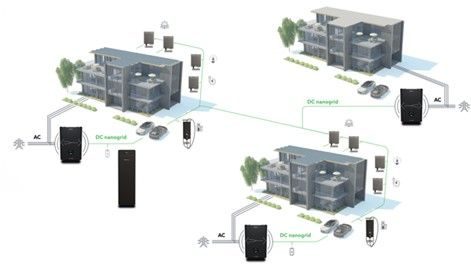
First of all, a direct-current grid is an electricity network in which direct current is sent between different points. As more and more devices, such as computers and mobile phones, run on direct current, and solar power, battery storage and electric cars are becoming increasingly common, it is a natural step to use direct current as much as possible without converting it to alternating current, thereby avoiding conversion losses. Direct current also has the physical property of flowing from high voltage to low voltage, which means that you can control where you want it to flow. In addition, some of the issues surrounding reactive power and the skin effect are eliminated, but we will leave it to our readers to explore these topics for themselves. For example, HERE
Network concession
A concession means permission, or more specifically “authorisation to carry on a particular activity”. When talking about concessions in the context of electricity networks, the issue is who has the right to operate and manage them. This is normally done by electricity network owners such as Vattenfall, Eon, Ellevio and others. They have local monopolies, where there is only one operator with a network concession. There are a number of exceptions to the requirement for a network concession, governed by specific legislation known as IKN, or networks not subject to the concession requirement. These have made it very difficult for property owners to determine whether they are allowed to connect their properties using internal direct-current grids or whether they are breaking the law. Sometimes they have found themselves in a grey area, since certain interpretations are already possible which suggest that direct-current grids between buildings (under certain conditions) are permitted. For example, §22a: An internal network connecting two or more electrical installations for generation, which constitute a functional unit, may be built and used without a network concession. Ordinance (2008:897).
Changes and the future
In the summer of 2019, the Network Concessions Inquiry submitted its report, “Modern permit processes for electricity networks” (SOU 2019:30), to the Government. At EU level, there is also the European Commission’s energy market directive, which states in Article 28 that Member States must adapt their legislation to allow local energy communities (local energy communities).
Given the many different messages, and the fact that clarifications and changes are under way, property owners can prepare for the future today. There are many installations where everything is ready for direct-current grids, but the direct-current switch has not yet been turned on. In other words, everything has been prepared so that they can be ready quickly when the Electricity Act is amended. As a result of the electricity network being under even greater strain, the new rules may contribute to faster decisions and better opportunities to manage demand using direct-current grids, perhaps as soon as 1 January 2021!
Why direct-current grids?
Keeping solar electricity within buildings
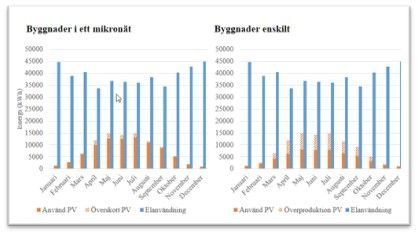
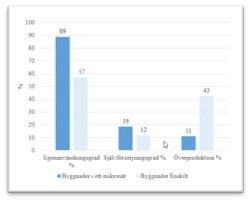
A study by WSP concludes that in buildings connected by direct-current grids, less solar electricity is exported from the direct-current grid, self-consumption increases and surplus production decreases. The main benefit for the property owner is that solar electricity is generated locally and used locally. A larger overall solar installation is shared between more electricity users. This means there is no need to pay a distribution charge or energy tax on electricity transferred, and the external grid is not used or placed under strain. So there are both technical and financial benefits to connecting the buildings!
Shared loads and generation sources
Since all connection points are connected to the direct-current grid, resources on the grid can be shared. These include battery storage, solar panels and electric vehicle chargers.
Shared batteries
Battery storage is an expensive product today. If each property had its own installation, it would need a battery in every building. With a direct-current grid, the battery becomes a shared resource: it can be charged and discharged when demand is needed, and charged using available solar power. This makes the overall installation cheaper, and the property best suited to housing the installation can be chosen, perhaps the one with the most space available.
Shared solar power on the best rooftops
Solar panels can be installed on the best rooftops. For example, in a housing association with three buildings, one of which has a north-facing roof, solar power can still be shared between the properties. In other cases, the direct-current grid makes it possible to build a larger installation on one building because there is demand across the grid (even if there might not be enough demand if the building had its own installation). The direct-current grid therefore makes it possible to maximise solar power generation on the best rooftops, benefiting all the properties on the grid!
Electric vehicle charging
Direct-current charging
By supplying the direct-current grid with electric vehicle chargers that draw power from the direct-current grid and then charge the vehicle directly with direct current, fast and efficient charging can be achieved. There are opportunities to prioritise solar power for vehicles charging on the direct-current grid.
Future possibilities with the Vehicle to Grid (V2G) and Vehicle to Home (V2H) technologies
Alternating-current charging
When many chargers need to be connected, standard alternating-current chargers can also be used to good effect on the direct-current grid. If the chargers are coordinated and controlled using the OCCP protocol and communicate with Ferroamp's APIs, efficient charging can be achieved. This will make it possible to control charging according to the power available at the connection point, which can draw additional power from the direct-current grid's generation sources or batteries. Power from other feeds can also be supplied to the electric vehicle chargers. The advantage of an interconnected system with dynamic control is that no static restrictions create bottlenecks. One example is charging with Ctek E-mobility's Chargestorm Connected charging post.
High peak demand
A typical property's peak demand is limited by the physical service cable installed and sometimes also by the main fuse in the property. When a direct-current grid is available, power can be drawn from all connection points linked to it. This makes it possible, for example, for all the properties to help supply shared electric vehicle charging. The properties will also be able to keep their peak demand down collectively. For example, three properties with 63, 63 and 80 A can very likely reduce their fuses to 63, 63 and 63 A. This leads not only to lower fixed costs, but also to better use of the external alternating-current grid.
Known examples
As mentioned earlier in the post, there are already around 30 direct-current grids in operation (with more on the way). Many of those already built and commissioned are in areas exempt from network concession requirements, or where the network owner has given its approval. Below, we will list two examples, describe how they are designed and explain the benefits they provide to the owner of the direct-current grid.
Uppsala
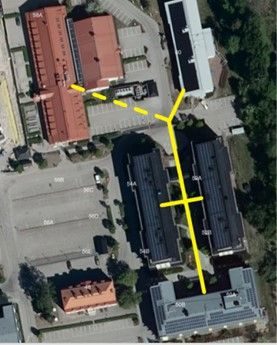
One of the better-known direct-current grids is on Uppsala University's campus, where Vasakronan had three existing solar installations, which it converted to Ferroamp and connected to a direct-current grid. Self-consumption is almost 100%, and no solar power leaves these properties. The direct-current grid has since been extended in the north-east corner with a further 40 kW, on a roof where they would otherwise have installed a maximum of 15 kW. There are plans to extend the direct-current grid to more buildings on campus, which will contribute to more locally generated solar power and better demand management for the already heavily loaded electricity network in Uppsala, one of the most strained in the country!
Östersund
In Östersund, the housing company Östersundshem has built a direct-current grid for a newly built supported housing complex for people aged 65 and over. It consists of three buildings, none of which are at all suitable for solar energy, which have been connected together, and a shared solar PV system has been built on the carports belonging to the properties. Each building has Ferroamp Energy Hubs that act as bridges between direct current and alternating current and connect the buildings to the direct-current grid. The direct-current grid also has a shared battery storage system. Thanks to the direct-current grid, self-consumption is around 80%. This means that the total payback period for the entire project is six to seven years. The project would not have been possible without the approval of the network operator Jämtkraft, since the direct-current grid requires a concession. However, thanks to close cooperation between the parties involved, this is seen as an innovation project that could be carried out ahead of schedule, while awaiting the abolition of the concession requirement for projects of this kind.
Need help finding the right option?
We know it’s not always easy to know which product or solution is best for you. Whether you have questions about our range, need guidance or would like help finding a solution that suits your specific needs, we’re here for you. With our knowledge and experience, we’ll help you make the right choice.
Related posts

Island mode in practice

How do you install an earth electrode and set up off-grid operation – with Richard Nyberg