



Arc-fault detection
Introduction
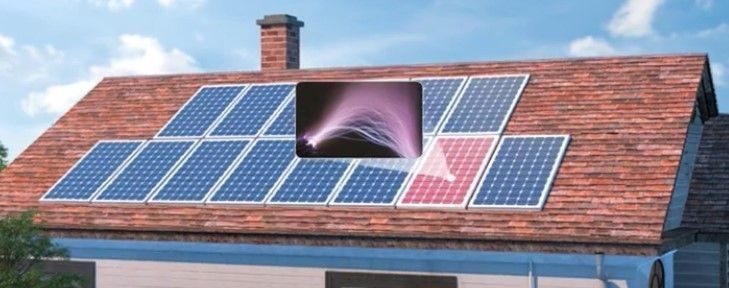
In this article, we will look at a safety feature called arc-fault detection. It is becoming more common on the market, and more people, both clients and installers, have become aware of its functionality. There are increasing demands for greater safety, particularly in terms of fire safety.
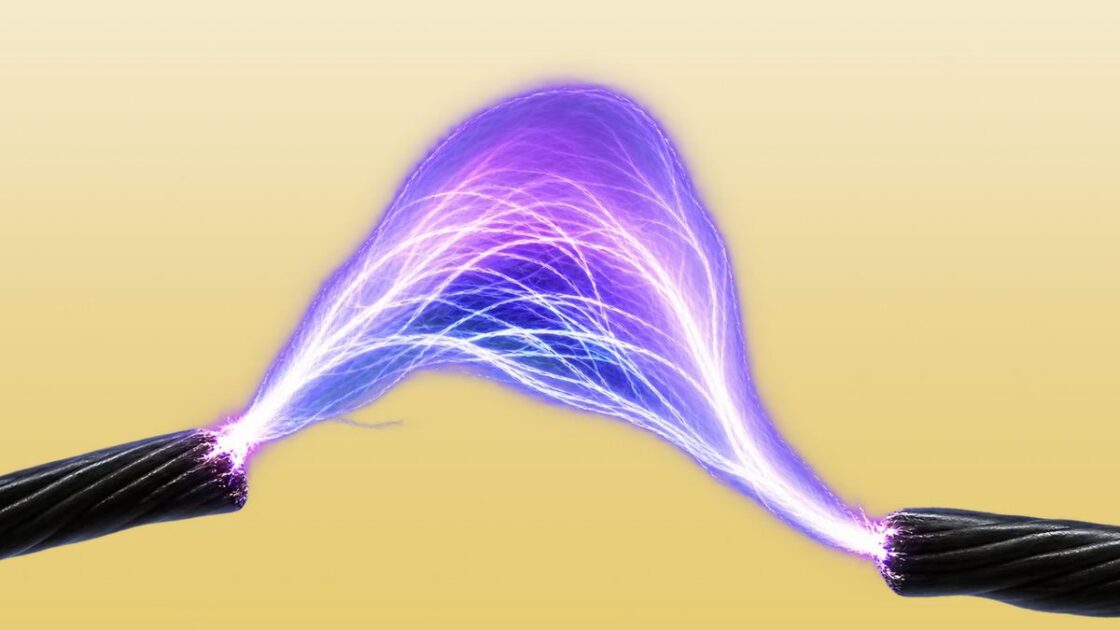
What is arc-fault detection? It is a function used to detect electrical arcs in solar PV installations. What is an electrical arc? It is a “flash” (a flashover or continuous discharge) through the air, where the electrical voltage ionises the air, making it conductive. Arc-fault detection is often referred to in English-language literature as AFC (Arc Fault Current) or AFCI (Arc Fault Circuit Interrupter).
Because solar panels cannot be switched off and always carry a voltage when exposed to sunlight, safety is a key concern both during installation and operation. If an electrical arc occurs, a solar panel will not switch off automatically. This is problematic during installation, as installers must always be vigilant and treat string cables as live. The same applies in the event of a fire, as the fire brigade will always regard the solar PV system as live.
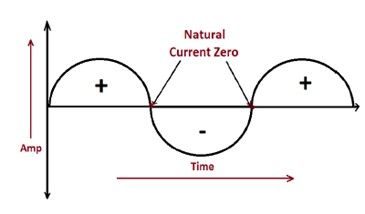
By comparison, AC voltage alternates between positive and negative, usually 50 times per second (50 Hz). Because AC voltage naturally passes through zero, there is a natural extinguishing mechanism: no energy is transferred when the voltage is 0, which naturally extinguishes an electrical arc.
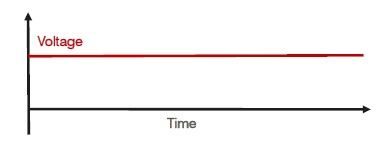
With direct current, the situation is different: the voltage is constant and always above zero, with no natural zero crossings. An electric arc can therefore only be extinguished using an external device.
There are different types of electrical arc that can occur in a solar PV installation. The most common cause of electrical arcs is poor or faulty installation. In fact, many faults occur on the DC side because connectors have been installed incorrectly or incompatible connectors have been used (see Teknikbloggen’s article 1, which covers MC4 connectors).
- Series arc: Caused by faulty MC4 connectors, loose connections or a broken cable. A common cause of fire in solar PV systems.
- Parallel arc: Caused when the insulation on both the positive and negative conductors breaks down. As both conductors are close to each other, the risk is higher. For example, if you were to cut through both the positive and negative cables with a lawnmower.
- Arc to earth: Occurs between the positive and negative conductors and earth. In floating systems (which are not earthed, as in Sweden), two earth faults are required before an arc can occur. If only one earth fault occurs, it can be detected by a residual-current device or an insulation monitor.
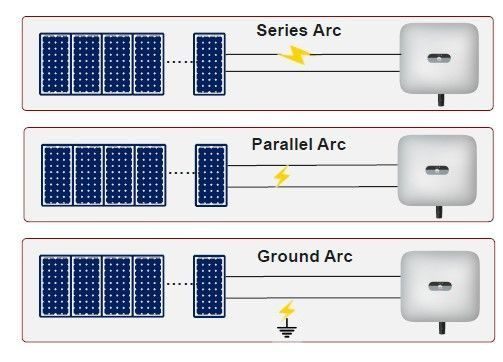
It is also worth emphasising that arc-fault detection is only possible for series arcs. For parallel arcs, the installation and cable routing are vital (as the blog constantly points out, for example in articles 4 & 8). Correct installation is always the top priority, and no technical measures in the world can replace it!
What does AFCI mean for the system owner?
For a system owner, safety and operational reliability are fundamental requirements for their investment in a solar PV system. For installers who work with solar energy every day, it is important to stay up to date with new features and technologies, and how they can be integrated into their offering to the market. Arc-fault detection is one such feature that is not discussed very much in sales meetings, even though it can be the difference between a full-scale fire and a service call.
AFCI step by step. See video from Huawei (LINK)
- The inverter monitors the solar panel strings and reads parameters with very high accuracy.
- In the event of a fault, the arc-fault detection algorithm (AFCI) identifies an electrical arc within a few hundred milliseconds.
- The inverter shuts off the current in the circuit extremely quickly as soon as the electrical arc is identified. This extinguishes the arc before a fire breaks out.
- The inverter sends an alert via an app and shows which part of the solar panel string the fault has been identified in.
- The fault is rectified and the system can quickly be up and running, producing solar electricity again
Arc-fault detection provides peace of mind for the system owner, whether it is an agricultural installation, a housing association, an industrial property or a detached house! The technology is now so effective and mature that more people should be asking for it, and it should be specified as a requirement in tender documents and procurement processes.
The peace of mind that comes with arc-fault detection is about more than simply sleeping better at night. In the event of a fault, for example, Huawei's new inverter series can pinpoint where the electrical arc occurred and immediately send an alert to the system owner and installer.
Which inverters/manufacturers have AFCI?
| Cell type | Advantages | Disadvantages | Examples of electric car manufacturers |
|---|---|---|---|
| Pouch |
|
|
|
| Cylindrical |
|
|
|
| Prismatic |
|
|
|
How does it work?
For all you “tech geeks” who follow the blog, here’s an extra section for you, where the Technology Blog explains (in fairly simplified terms) how arc-fault detection works in practice
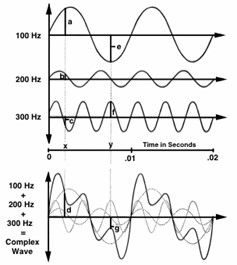
Fourier analysis
Fourier analysis is a mathematical theory of how functions can be represented or approximated as sums or integrals. What Fourier analysis gives us as a tool is the ability to start with a complex signal (for example, the DC voltage in a solar PV system) and then separate it into its constituent parts, where we can see several signals superimposed. These signals overlap, and the whole thing can look very complex. But with Fourier analysis, the signal can be separated into its constituent parts (“sub-signals”).
Let’s use a juice example. If we analyse a glass of tropical juice, we can see that the juice is red-orange in colour, but not much more. But if we use Fourier analysis, we can see that it consists of orange, strawberries and kiwi. We get a connection between the “whole” and the “constituent parts”.
The key to Fourier analysis is that we make use of the fact that we can find out the frequencies of the sub-signals. These frequencies are highly characteristic when an arc occurs. Other frequencies are then sent through the cable that are not there otherwise, and these can be interpreted using a certain amount of signal processing.
Artificial Intelligence (AI)
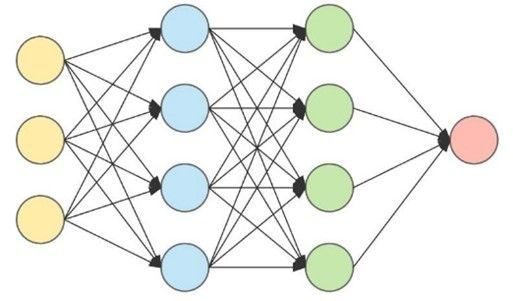
Within artificial intelligence, there is a field called machine learning. It is a method that enables computers/programmes to learn from examples. It is a method that also improves with experience (more data). In practice, it involves giving your AI large numbers of different examples of a problem. For example, to classify whether an image shows a dog or a cat, you give the algorithm lots of examples of cats and dogs and let it classify the images. The AI then learns what distinguishes a dog from a cat, from outlines and colour combinations to other significant differences.
The algorithm is trained to classify; in the case of arc-fault detection, for example, the options are: arc or no arc, based on data from Fourier analysis. The more data available, and the more opportunities the AI is given to update itself, the better it continually becomes. The AI learns patterns and combinations and learns to draw conclusions from its data. Millions of combinations of patterns are tested alongside the many different examples, enabling the algorithm to draw general conclusions, even for data it has never seen before!
With the help of techniques such as neural networks and deep learning, very good results have been achieved. The algorithm operates in the background of the inverter, and arc-fault detection is performed continuously and locally in the inverter in a few hundred milliseconds (much faster than the current standard). This means that arcs are identified quickly and accurately, without giving warnings either too often or too rarely. AFCI is a technology that brings cutting-edge technology from the IT sector into the world of renewable energy!
Conclusions
Arc-fault detection is a valuable feature that doesn’t cost the earth. More people should take an interest in the enhanced safety that arc-fault detection provides, and after reading this blog article, end customers, installers and clients should all give the functionality greater consideration!
Need help finding the right solution?
We know it is not always easy to decide which product or solution is best suited to your needs. Whether you have questions about our range, need guidance or would like help finding a solution that suits your particular needs, we are here for you. With our knowledge and experience, we will help you make the right choice.
Related articles

Island mode in practice

How do you install an earth electrode and set up off-grid operation – with Richard Nyberg