



The aggregator and the frequency-services market

Introduction
Batteries and battery management are a hot topic. Much of it is new to many people, and batteries involve parts of the energy market that have previously been unexplored by both solar panel installers and private individuals. The aggregator, which plays a new role in the energy landscape, enables new revenue streams for energy storage system asset owners.
Aggregator
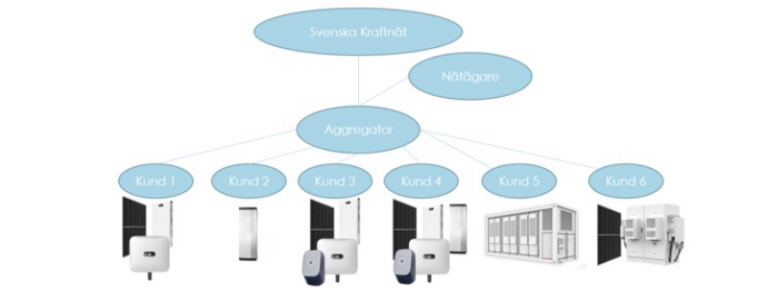
An aggregator is an energy-market player that combines multiple resources into larger units, which can then offer services for sale on the electricity market. These resources may be able to increase or decrease their power demand, or may take the form of energy storage systems. An aggregator could be seen as a joint “manager” of resources, helping their owners maximise the return on their investments. An aggregator is often a software-only company, using algorithms and software to analyse and forecast, and automatically submit bids on the electricity market. This involves large amounts of data and highly sophisticated data solutions to perform the task.
In Sweden, several aggregators offer somewhat different business models, remuneration levels and compatibility with various energy storage systems. This is a fast-moving market that is continually changing. It is important to stay up to date on what is compatible with what.

Flexibility markets
The electricity system must always be balanced. At every moment, as much electricity must be produced as is consumed. The balance can be maintained by controlling both production and consumption. The Swedish transmission system operator is responsible for balancing the electricity grid and, in turn, purchases the ability to control power demand on the electricity market. Previously, only larger electricity consumers could participate in trading in the frequency-services market (for example, hydropower plants). Smaller resources were previously excluded, but when a market participant combines several resources, a virtual power plant made up of aggregated flexible resources is created, allowing them to participate. These may include batteries, electric vehicle chargers or solar panels that can be used in these flexibility markets. With the help of these services and market participants (known as aggregators), both homeowners and housing associations that own a flexible resource can earn revenue from these markets.
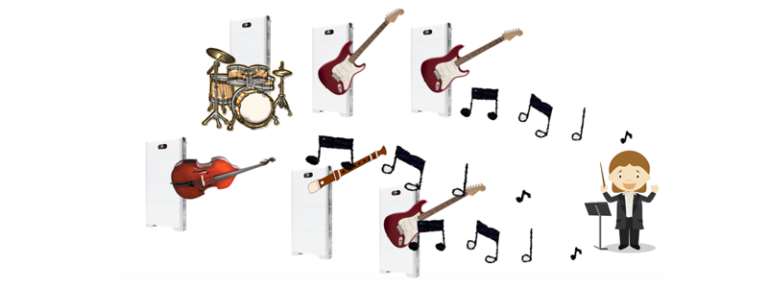
The aggregator’s role can best be described as that of a conductor in the electricity system. To achieve the combined capacities of many small installations, charging and discharging must be synchronised with very little delay. The challenge for the aggregator is that all the aggregated resources must respond within a few seconds. This places demands on both hardware and software.
Frequency markets
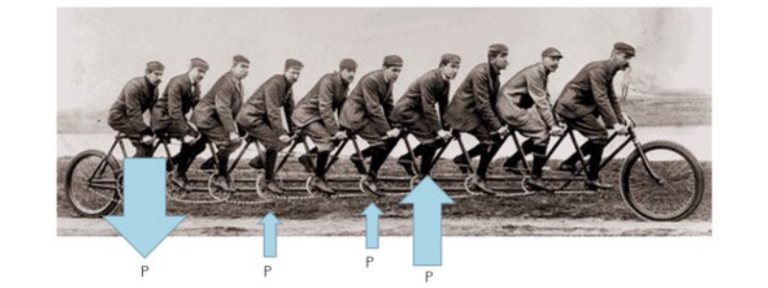
The frequency in the electricity grid must always be 50Hz. At the slightest imbalance, the system is heading towards collapse, and it must always remain between 49.9-50.1Hz. You could think of the electricity system as a long tandem bicycle. This bicycle must maintain a speed of 50km/h whether going downhill or uphill. In addition, one of the gentlemen on the bicycle might pedal less (in our analogy, a way of saying that a power plant is running at half capacity). Let us illustrate this by imagining that the gentleman sitting at the back (you cannot see him if he is getting a free ride) suddenly pedals less vigorously (reduces his power generation). The speed drops for everyone on the bicycle (just as the frequency does in the electricity system). This is compensated for by the other three gentlemen pedalling harder to restore the speed to 50km/h, i.e. increasing their power generation. In the new equilibrium, the speed is once again 50km/h.
The frequency in Sweden, Norway, Finland and eastern Denmark is part of the same so-called synchronous grid. This means that generators connected directly to the electricity grid rotate in synchrony at the same frequency. The frequency is therefore shared across the system. In other words, wherever you measure the frequency, it is the same throughout the synchronous grid.
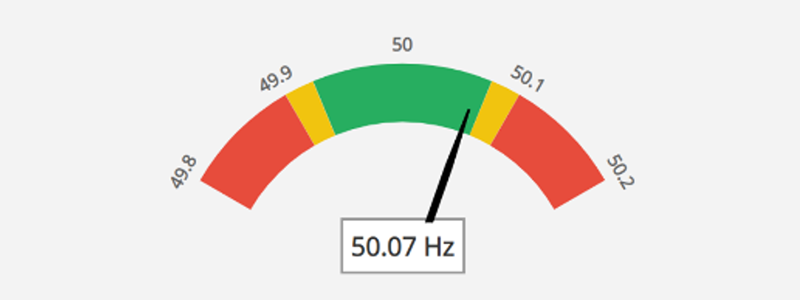
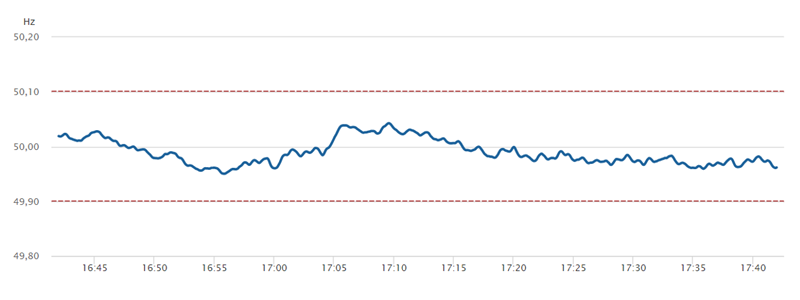
As both production and consumption vary over time, the frequency also varies. This can be seen in Figure 7, where the frequency can be both above and below 50 Hz. A surplus or deficit in either production or consumption can cause the imbalance.
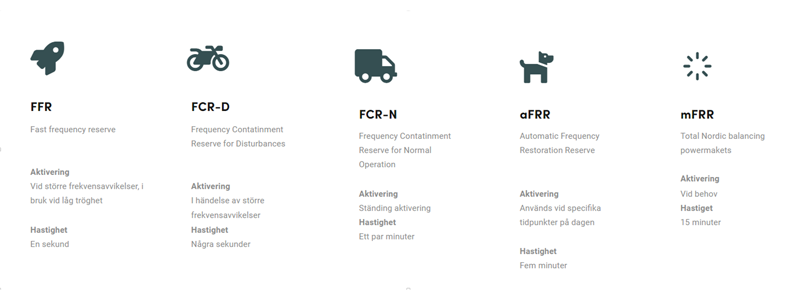
There are different markets used by the system operator, the Swedish transmission system operator, depending on the scale and speed required. This means that, for example, in the event of a sudden shutdown of a nuclear power plant, the fastest resources must be activated within seconds (FFR), whereas if a larger frequency deviation occurs, the resource can be activated within a few seconds (FCR-D).
Capacity markets (local flexibility)
Unlike frequency challenges that affect the entire electricity system, there are also local problems. These often occur in major cities or metropolitan regions where the electricity grid is heavily loaded and new connections, for example for new industry or housing, are not permitted due to a lack of capacity. Quite simply, there is not enough power available locally, resulting in bottlenecks.
The electricity system is designed for a maximum capacity, and the more loads (and generating facilities) there are, the closer the system gets to the grid’s actual limit. From a socio-economic perspective, it is very costly to size the electricity grid to cope with peak levels that occur only for short periods. It is considerably cheaper to make use of existing infrastructure than to upgrade capacity. Consider the example of the Covid-19 pandemic, when Swedish healthcare was under severe strain because many people fell ill at the same time. If everyone had fallen ill at once, hospitals would have needed enormously greater capacity to treat everyone simultaneously. But by keeping their distance and sanitising their hands, people did not all fall ill at the same time. It would have been a disaster, and also very expensive, to build and size the healthcare system to cope with such a peak.
Just as in the electricity-grid sector, it is much better to spread electricity use across all hours of the day. Making use of existing electricity infrastructure provides the most socio-economically efficient solution
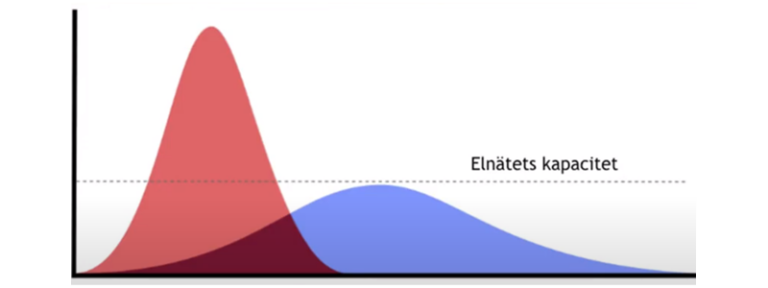
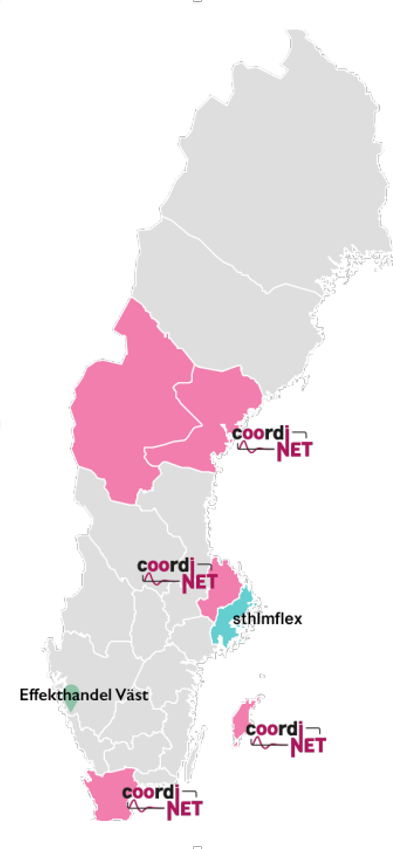
To free up capacity in the electricity grid, several local auctions have been launched, such as Stockholm Flex. This is a capacity market where local grid operators can buy capacity from producers or consumers that can use electricity flexibly. For example, by reducing its power demand, a factory can receive compensation, while the grid operator avoids reinforcing the part of the grid that is overloaded for only a few hours each year. In this case, this allows the factory to be paid for not consuming electricity, while the grid operator avoids paying for a grid upgrade. A win-win for both parties.
Need help finding the right solution?
We know it isn’t always easy to work out which product or solution is best for you. Whether you have questions about our range, need guidance or would like help finding a solution that suits your specific needs, we’re here for you. With our knowledge and experience, we’ll help you make the right choice.
Related posts
Solar energy systems with open architecture – the flexible energy solution of the future
The grid challenge – How the solar energy systems of the future can contribute to a stronger electricity grid