


OpenADR 3.0 – network operators’ communications interface for prosumers
Introduction
Sweden’s electricity grids face a dual challenge: rapidly growing demand for power and an increasing share of distributed, variable generation. At the same time, the role of the prosumer is growing—customers who both consume and generate electricity, often with solar panels, batteries and electric vehicle charging. For this to work without halting new grid connections or overinvesting in the grid, network operators and flexible customer installations need a common “language”.
This is where OpenADR 3.0 comes in—a modern, open communications protocol for demand flexibility and the control of distributed resources. In practice, it is the communications interface between network operators and flexibility providers, on the one hand, and you as a prosumer, on the other. OpenADR 3.0 is described as an “emerging standard poised to redefine grid-to-customer communication” by replacing earlier, more complex solutions and enabling efficient, cost-effective control of load and generation.[1]
In this post, we’ll look at what OpenADR 3.0 is, the scenarios in which it can be used—from conditional electricity contracts to solar panels, batteries, electric vehicle charging and V2G—and how open digital standards can accelerate electrification.
What can OpenADR be used for?
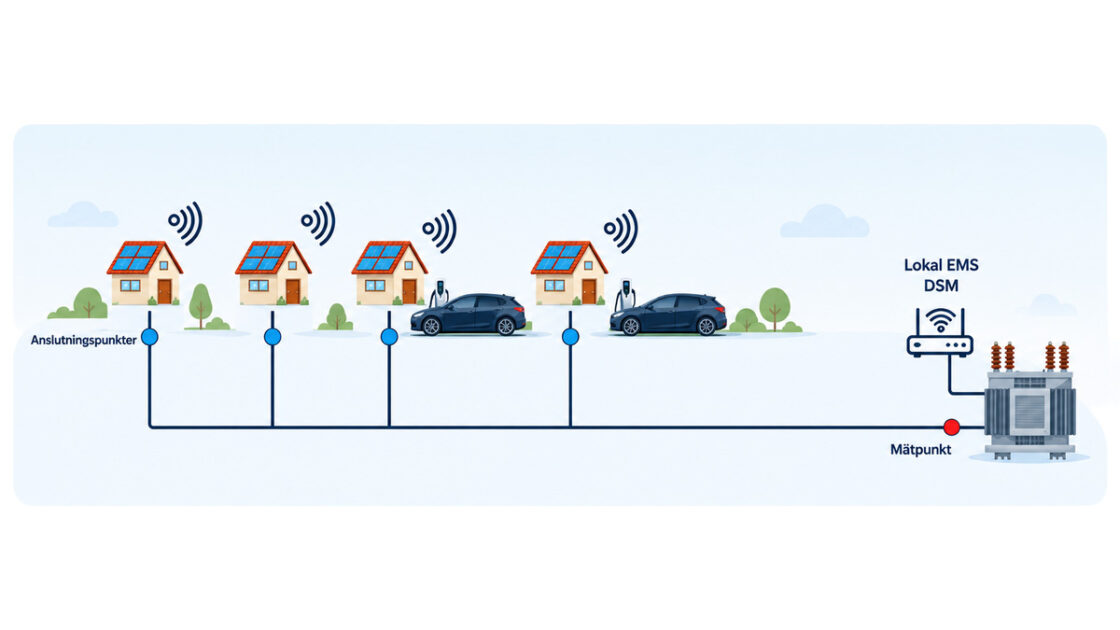
OpenADR 3.0 is used for demand flexibility, control and optimisation of both consumption and generation – from conditional electricity contracts to fleet charging of electric vehicles.[3]
Some key applications:
- Power management of larger facilities where the electricity grid is under strain
- Control of electric vehicle charging (and discharging)
- Optimisation of battery storage and solar installations
- Price-based flexibility, where resources are managed in response to dynamic real-time prices[4]
From a consumer perspective, OpenADR is primarily noticed indirectly – you don’t see the protocol, but you notice:
- that your grid connection has been made possible despite local grid constraints,
- that your charging/battery operation is sometimes managed automatically,
- that you get lower costs or compensation when you contribute flexibility.
Below, we go through some specific scenarios.
Conditional electricity agreements
Conditional grid connections are used to bring forward connections in areas with capacity shortages. Energiföretagen Sverige describes how conditional connections can enable earlier grid connections in areas where the electricity grid has limited capacity.[5]
For these conditional agreements to work, reliable, standardised communication is required between the electricity network operator and the customer. Energiföretagen has therefore developed a voluntary industry recommendation to use OpenADR as a communications protocol between the electricity network operator and the customer.[5]
- Practical example for a prosumer:
- You operate a large charging facility or an industrial site in an area with grid capacity shortages.
- The network operator offers a conditional connection, allowing you to connect sooner in return for the possibility of limiting your maximum power demand during certain critical hours.
- Using OpenADR, the network operator automatically sends capacity or power-limitation signals to your energy management system.
- Your system reduces electrical loads—for example, by reducing the charging speed at some charging points or pausing less critical consumers.
As an end user, you may experience this as some chargers occasionally “running a little slower” during peak hours, or as receiving advance information about time windows with limited capacity. In return, you get an earlier connection, often designed cost-effectively.
Solar PV system
For solar PV systems, OpenADR can play several roles:
Curtailment during grid constraints
When solar generation is high and there are local bottlenecks, the network operator can use OpenADR to send a signal to temporarily limit export power. Your energy management system translates the signal into a command to the inverter (via, for example, Modbus or a manufacturer-specific API).
You notice the effect because you may not always be able to export at full power to the grid, but you can compensate by increasing self-consumption or charging a battery.
Price-based generation optimisation
In future, more dynamic pricing scenarios—where OpenADR 3.0 can handle price-based flexibility[4]—your system could, for example:
- control when the battery is charged (during cheap hours with surplus generation),
- or when you would rather sell electricity than use it yourself.
Although many inverters can already communicate with various cloud APIs today, OpenADR is what connects the network operator’s needs and price and capacity signals with your local control, instead of each electricity network company integrating directly with every manufacturer.
Battery
Batteries are ideal resources for demand flexibility: they can both absorb and deliver power at short notice.
With OpenADR 3.0, an aggregator or network operator can:
- Send events announcing upcoming flexibility windows (e.g. between 17:00 and 19:00).
- Specify the desired power profile (charge, remain idle, or deliver power).
- Combine this with dynamic price or capacity levels.
From the end customer's perspective, you might notice:
- the battery sometimes charging more at night than you are “used to” seeing,
- it discharging earlier in the evening to reduce your grid consumption during expensive hours,
- while still maintaining certain comfort or reserve levels (e.g. never below 20% SoC).
Codibly describes how OpenADR 3.0 is a key component of the flexible grids of the future, where standardised communication simplifies the control of DERs and batteries at scale.[1,2]
Electric vehicle charging
Electric vehicle charging is one of the clearest and easiest-to-understand use cases for OpenADR 3.0.
With OpenADR 3.0, charging operators can schedule charging for times when electricity is cheap or when there is plenty of wind or solar power in the system.[3]
A practical scenario for a private customer or housing association:
- You connect your charging points to a service that supports OpenADR 3.0.
- The network operator or aggregator sends signals (via VTN → VEN) indicating when it is advantageous to charge – based on grid load and prices.
- Charging is optimised automatically:
- Higher power output at night, when prices are low and the grid is less heavily loaded.
- Lower power output (or a pause) during critical afternoon hours.
For the driver, it means that the car is “always fully charged when you need to leave”, while charging takes place in a way that both reduces your electricity costs and eases the load on the grid. In a larger depot with vehicle fleets, this can be crucial to avoiding costly upgrades, and OpenADR 3.0 makes it easier to turn EV fleets into reliable flexibility resources for the electricity grid.[3]
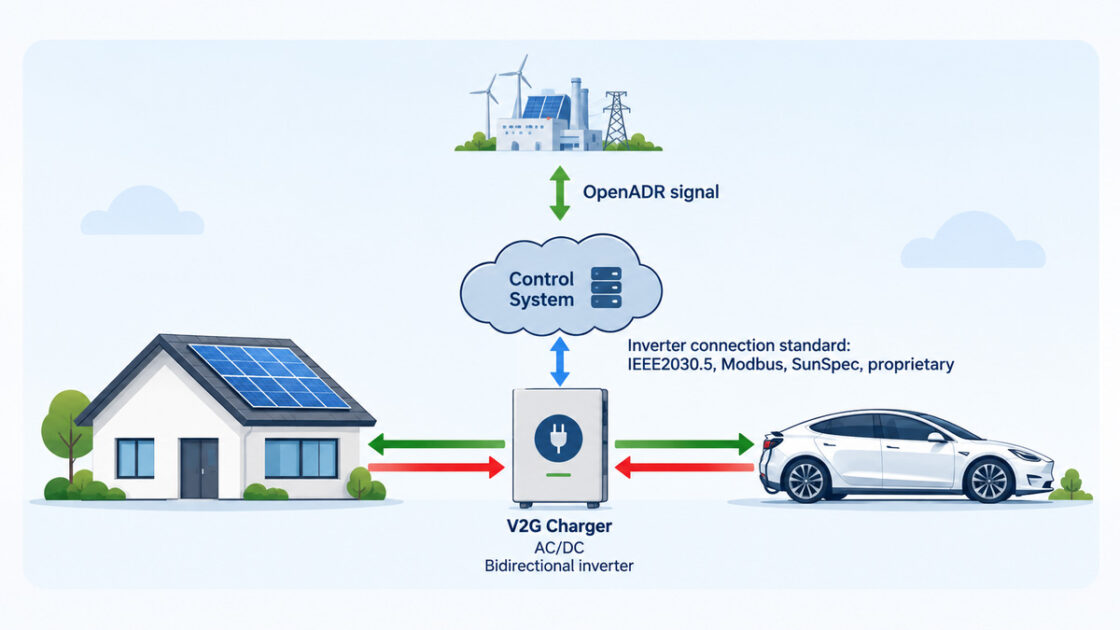
Vehicle-to-Grid (bidirectional electric vehicle charging)
Vehicle-to-Grid (V2G) means that electric vehicles do not just charge from the grid, but can also feed electricity back when needed. The OpenADR initiative emphasises that V2G is often misunderstood – the focus is often on the electrical connection, whereas the real purpose is how vehicles can function as distributed resources in a flexible electricity grid.[6]
OpenADR, in combination with DER control, addresses this by:
- Viewing V2G cars as a subset of Distributed Energy Resources (DER).
- Using the same standardised signals and programme logic to control batteries, electrical load and V2G vehicles.[6]
For an end user with a V2G charger, this could, for example, mean:
- The car is charged to a certain level cheaply overnight.
- For a couple of hours in the morning, when the grid is heavily loaded locally, a small amount is fed back to the grid in return for compensation.
- The system ensures that you still have sufficient range for your planned journeys.
OpenADR then gives network operators and aggregators a consistent way to activate V2G resources alongside other DER, without needing bespoke solutions for each car make or charger brand.
How can digitalisation accelerate electrification?
Electrification requires more than just cables and transformers – it requires software, open standards and collaboration.
OpenADR 3.0 is an example of how open protocols can:
- Reduce the cost of new flexibility and control services
- Enable more players to build compatible systems
- Facilitate international harmonisation – OpenADR 3.0 is positioned as a global standard for flexibility communications.[4,7]
Within LF Energy – the Linux Foundation’s initiative for open source in the energy sector – there are projects such as OpenLEADR, which provides open implementations of OpenADR (including in Rust for OpenADR 3.0).[8] This enables network operators, suppliers and systems integrators to build robust, secure solutions without starting from scratch every time.
The Energistrategipodden podcast has highlighted this ecosystem around LF Energy and open source. An episode about LF Energy Summit 2025 emphasises how open source and collaboration are becoming crucial as capacity shortages and rising demand put pressure on Europe’s electricity grids, and how LF Energy brings together network operators, suppliers and authorities to develop shared software.[9]
At the same time, there is a clear lack of open standards at other levels of the chain – not least when it comes to inverters. Although most products today support communication via APIs or Modbus (RTU/TCP), the following issues remain:
- Implementations vary greatly between manufacturers.
- There is no widely accepted, open standard profile for, for example, power limitation, ancillary services and status reporting that everyone follows.
The result is costly, bespoke integrations – which hold back both flexibility services and innovation.
Here, the combination of open standards such as OpenADR and open source projects within LF Energy can act as an accelerator:
- OpenADR 3.0 defines how network operators/aggregators express their needs (price, capacity, flexibility programmes).
- Open, shared libraries (such as OpenLEADR) simplify implementation on the VTN/VEN side.[8]
- The next step is shared, open profiles for hardware (inverters, chargers, batteries) – which could standardise the “translation” of OpenADR signals into actual control commands.
Digitalisation accelerates electrification when:
- Network operators can offer conditional contracts and new tariff models without every customer integration becoming unique. OpenADR 3.0 and industry recommendations, such as the one from Energiföretagen Sverige, are important steps in that direction.[5]
- Prosumers have clear incentives and low barriers to participating in flexibility – through smart chargers, EMS and battery systems that “just work”.
- The open source ecosystem (LF Energy, OpenLEADR, etc.) reduces lock-in, increases transparency and enables smaller players to contribute and innovate.[8,9]
Summary and conclusion
OpenADR 3.0 is on its way to becoming the network operator’s standardised language for communicating with prosumers, charging operators, aggregators and other flexibility stakeholders. It replaces older, more complex technology with modern, web-based APIs and clear data models, reducing complexity and improving interoperability across the energy system.[1,2]
For you as a prosumer, this does not mean that you have to learn a new protocol — rather, it means that:
- Conditional grid agreements can give you a faster grid connection in areas with capacity shortages.[5]
- Your solar installation, battery and electric vehicle charging can be managed more intelligently, in coordination with the needs of the electricity grid and electricity prices.
- V2G and other advanced DER applications can be integrated into a shared flexibility framework instead of existing in isolated pilots.[6]
When this is combined with open protocols and open-source software, such as the projects run by LF Energy, the conditions are in place to accelerate electrification without losing control of complexity.[8,9]
For the industry — utilities, installers, system integrators and technology providers — the message is clear: start planning for and implementing OpenADR 3.0 and other open standards now. Prosumers would be wise to seek out systems and providers that support open protocols. This is how we can work together to build a more flexible, robust and cost-effective electricity system.
References
1. Codibly. OpenADR 3.0: Unlocking the Next Generation of Energy Flexibility. Codibly. Cited 2026-01-05. https://codibly.com/blog/articles/openadr-3-0-unlocking-the-next-generation-of-energy-flexibility
2. Codibly. Convention over specification - a deep dive into OpenADR 3.0. Codibly. Cited 2026-01-05. https://codibly.com/blog/articles/open-adr-3-0-features
3. Codibly. Top 5 use cases of OpenADR 3.0 in the renewable energy industry. Codibly. Cited 2026-01-05. https://codibly.com/blog/articles/5-use-cases-openadr-3-0
4. PV Magazine USA. OpenADR 3.0 standard can maximize demand flexibility to help integrate renewables. 2025. Cited 2026-01-05. https://pv-magazine-usa.com/2025/01/10/openadr-3-0-standard-can-maximize-demand-flexibility-to-help-integrate-renewables/
5. Energiforetagen Sverige. New industry recommendation: OpenADR proposed for conditional grid agreements. 2023. Cited 2026-01-05. https://www.energiforetagen.se/medlemsportalen/medlemsnyheter/2023/oktober/ny-branschrekommendation-openadr-foreslas-for-villkorade-natavtal/
6. OpenADR Alliance. OpenADR, V2G and DER. Cited 2026-01-05. https://www.openadr.org/openadr-v2g-and-der
7. openLEADR - LF Energy. OpenLEADR - Open Automated Demand Response. LF Energy. Cited 2026-01-05. https://lfenergy.org/projects/openleadr/
8. OpenADR Alliance. OpenADR 3.0 Introduction and Certification Program. Cited 2026-01-05. https://www.openadr.org/openadr-3-0
9. Sigholm. Energy Strategy Podcast - LF Energy and open source in the energy sector. Sigholm. Cited 2026-01-05. https://www.sigholm.se/energistrategipodden?page=1&search_query=lf+energy
Need help finding the right option?
We know it is not always easy to know which product or solution is best. Whether you have questions about our range, need guidance or want help finding a solution that suits your specific needs, we are here for you. With our knowledge and experience, we will help you make the right choice.
Related posts
Smart meter, a smart electricity meter
surge protection device (SPD)