




How to upgrade your solar PV system to Solar Electricity 2.0

I already have another inverter; can I switch to Ferroamp?
Perhaps, after a year or so, you’re wondering whether your solar PV installation turned out exactly as you had planned? Or whether it lacks some of the features you’d like from a solar PV system? Perhaps you’d like to expand it with battery storage, make better use of your main fuse when charging your electric vehicle, or take advantage of Ferroamp’s phase-balancing technology. Whatever the reason, there are plenty of opportunities to upgrade an existing system.
What are the reasons to upgrade?
Upgrade with Ferroamp and a Battery
If your existing solar PV system cannot be upgraded with a battery, Ferroamp is the solution for you. Ferroamp has 3 different compatible batteries, with different sizes and chemistries. Private individuals can apply for a battery grant of 60% or a maximum of SEK 50,000 for a battery and inverter package. In addition to the battery, the grant also covers smart energy hubs. In other words, purchasing an Energy Hub 14kW/20A with a Nilar 5.76kWh battery is covered by the current grant.

Maximum electric vehicle charging
Today’s electric cars and plug-in hybrids mostly use single-phase charging when you charge them.
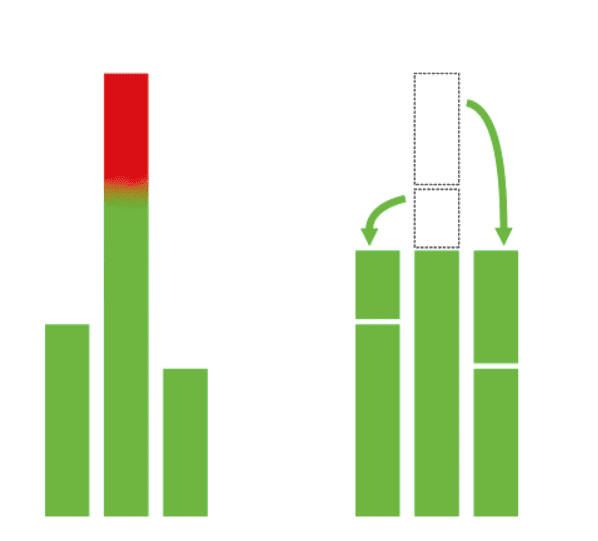
With a Ferroamp Energy Hub, for example, you can make full use of a 36 A single-phase load with only a 16 A main fuse.
This enables faster and more efficient electric vehicle charging
Reduce the main fuse rating
With Ferroamp’s world-unique phase balancing, you can reduce the rating of the main fuse in your property and save hundreds of kronor a year in fixed charges

Keep or replace?
The options are to replace the existing inverter (if it is a string inverter, e.g. Fronius or SMA) or to add a parallel inverter if you have an optimiser-based system (SolarEdge).
If you want to supplement your solar PV system with a Ferroamp system, there are good opportunities to upgrade your system!
Existing string inverter
Option 1. Parallel Ferroamp system
If you leave your existing inverter in place, you will still see your solar electricity production in the app provided by that manufacturer. The Ferroamp inverter will operate in parallel with the existing system, and Ferroamp’s current transformers will measure electricity imported from and exported to the grid. If you have a battery, this type of system will have slightly higher losses because the solar electricity (which is direct current) must be converted to alternating current by the existing string inverter and then converted back to direct current before entering the battery connected to the EnergyHub.
When you then use the stored energy, the direct current in the battery is converted back to alternating current and fed into the property’s electrical system. That makes three conversions in total, with losses of approximately 3% due to conversion.
Option 2. Replace the existing inverter
To find out whether Ferroamp can replace the existing inverter (with minimal work), you must first check the strings. Their voltage must not exceed 720 Vmpp. This must be checked against the datasheets for the existing panels. You will need to replace each string with a Ferroamp solar string optimiser.
This type of system will have lower overall losses because the solar electricity can be fed directly into a battery without being converted to alternating current. The system can also be expanded if more solar panels are to be added in the future!
Example: A house has 34 solar panels, with 20 connected in series on a south-facing roof (string 1) and 14 in series on an east-facing roof (string 2). The inverter is a Fronius Symo 8.2-3-M. The panels are Trina Solar 300 Wp, with a Vmpp of 32.6 V.
Solution: String 1 has a voltage of 20 × 32.6 = 652 V. That is less than 720 V, so the voltage is OK.
String 2 has a voltage of 14 × 32.6 = 456.4 V. That is also less than 720 V, so the voltage is OK.
Strings 1 and 2 are replaced by two SSOs (solar string optimisers), and the existing inverter is sold on Blocket.
Existing optimiser-based system (SolarEdge)
If there is an optimiser beneath each panel, it will not be possible to connect a string of panels to a Ferroamp system. This is because SolarEdge optimisers are only compatible with SolarEdge inverters.
Option 1. Parallel Ferroamp system
The easiest way to add battery storage to a SolarEdge system, if you are not switching to a SolarEdge-compatible inverter called StorEdge*, is to add a Ferroamp system. As described above, the Ferroamp and SolarEdge inverters will then operate in parallel in the property’s electrical system, just as a washing machine and dishwasher can both be connected to the same electricity network in a property.
Option 2. Replace the existing inverter
If you are determined not to have a complete Ferroamp system and already have a SolarEdge system, all the optimisers must be removed from the roof. It may also be necessary to reconfigure the strings on the roof to suit Ferroamp’s solar string optimisers. This solution is both labour-intensive and demanding!
Need help finding the right option?
We know it isn’t always easy to know which product or solution is best for you. Whether you have questions about our range, need guidance or would like help finding a solution that suits your specific needs, we’re here for you. With our knowledge and experience, we’ll help you make the right choice.
Related posts

Island mode in practice

How does an EMS system work?