

How much can you earn from a battery with grid flexibility services, and what will it be like in the future?

Introduction
When the electricity price is low, the profitability of the solar PV system decreases. This is despite the fact that private individuals receive 60 öre per kilowatt-hour sold back to the electricity grid. You do not have to pay energy tax, VAT or transmission charges on the electricity you use yourself, so it is worth considerably more than having to sell a kWh. The major trend in the solar industry is to combine investment in a solar PV system with energy storage. This means you can receive the higher grant amount (50%) for labour and materials related to installing the battery. These include the battery itself, a smart meter, a hybrid inverter and the electrical connection of these components. You can receive a grant of up to SEK 50,000 per person each year. The government replenishes the funds annually, and you can also take advantage of this to add larger energy storage in the future!
As a homeowner, you are faced with a great many choices and several different installers, each with different offers, payment terms and experience. To help guide you through the solar jungle, this blog post will explain how to calculate a typical investment for a detached house, with and without energy storage. This will illustrate how the investment works both with and without a battery.
The future of the frequency-regulation market?
Forecasting the frequency-regulation market and revenues is very difficult, as the frequency services FCR-D and FFR are based on Svenska Kraftnät procuring capacity that is ready to be called upon if the frequency deviates by more than 0.1 Hz. The fluctuations being compensated for are extremely rapid, and these markets do not have the same conditions as the rest of the electricity market. There are very few alternatives that can respond quickly enough to support the frequency. These markets are dominated by energy storage.
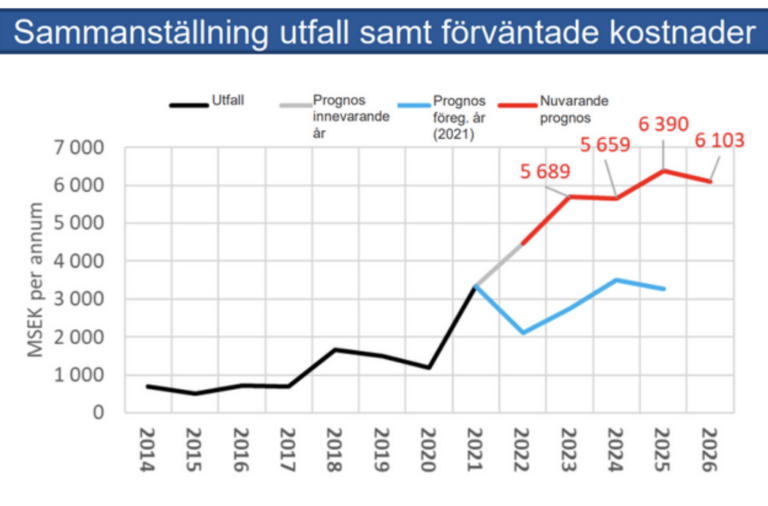
In 2021, Svenska kraftnät forecast how much it expected to spend on frequency-support services. It thought spending would peak around 2022 and that the rate of investment would then decrease. In other words, there would be less money to share among battery owners.
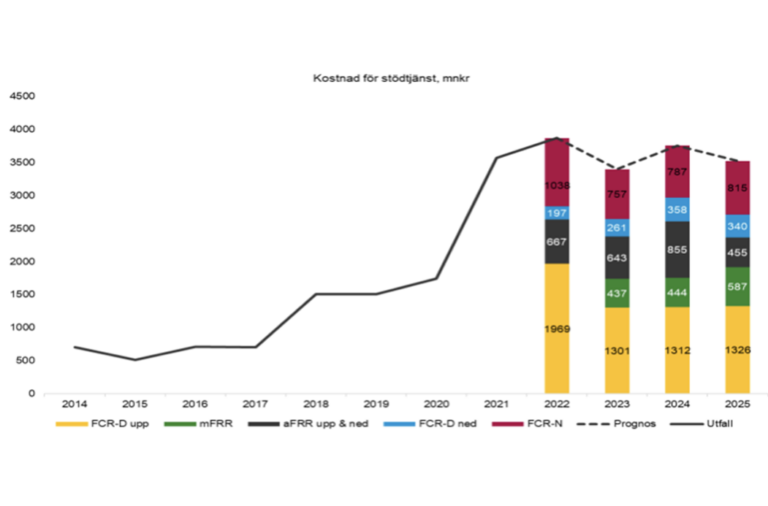
During 2022, the forecast was updated and indicates a sharp increase, with the peak expected to occur around 2025 instead. What you need to factor into the equation as the owner of an energy storage system is that many large energy storage systems are waiting to be connected to the electricity grid. These will have a cannibalising effect on payment levels because the more batteries there are, the more that will be sharing the payments from Svenska kraftnät.
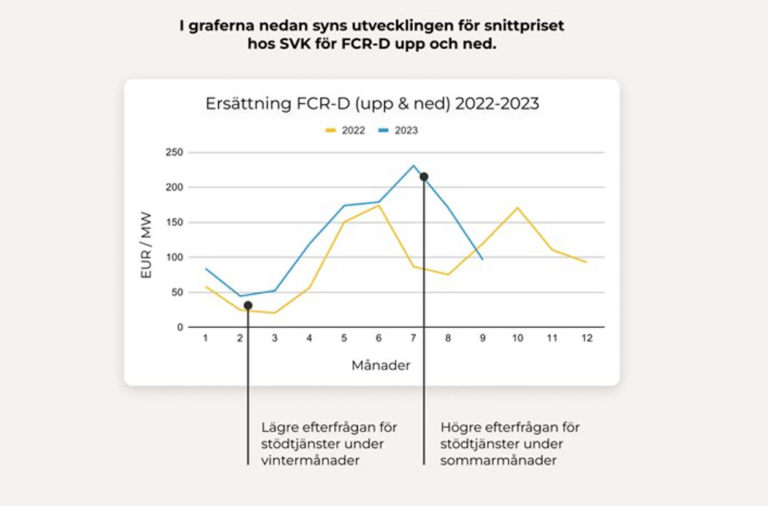
Several factors affect the compensation rates for ancillary services, and these also vary over time. For example, pricing is affected by electricity prices on the retail market, the availability of water in reservoirs, and the amount of renewable electricity generation in the power system. Prices for ancillary services also vary depending on the season. In Sweden, hydropower has historically helped provide FCR-D. Hydropower’s ability to provide ancillary services is not straightforward and depends on several factors, such as turbine type, water flows and the season—for example, ice formation in winter and spring floods in early summer. This means that fewer systems can provide ancillary services during these periods, driving up costs. Batteries are not sensitive to seasonal variations and can provide ancillary services quickly and easily. This is a major advantage, as they are based on power electronics and have no moving parts.
SAJ – A worked example
In this example, the technology blog requested prices from the installer Solnord to make the prices as relevant as possible. The prices are based on a single-storey house with concrete roof tiles and 26 Longi 430Wp panels. The prices shown are after the green technology tax deduction, and the inverter is an SAJ H2 hybrid inverter. Note that the investment is deliberately limited here, as a household with two people can claim a maximum of SEK 100,000 in green tax deductions.
| Solar PV system without battery | Solar PV system with battery | |
|---|---|---|
| Solar panels | 26 × Longi 430 HIMO 6 | 26 × Longi 430 HIMO 6 |
| Installed capacity (kWp) | 11.18 | 11.18 |
| Inverter | SAJ H2 10kW (Hybrid) | SAJ H2 10kW (Hybrid) |
| Battery | - | SAJ B2 10kWh / 6kW |
| Solar installation without battery | Solar installation with battery | |
|---|---|---|
| Price before green tax deduction (incl. VAT) | 160 911 kr | 263 513 kr |
| of which green tax deduction (2 people) | 31 217 kr | 100 000 kr |
| Price after green tax deduction (incl. VAT) | 129 694 kr | 163 513 kr |
| Solar panel installation without a battery | Solar panel installation with a battery | |
|---|---|---|
| Net present value | 103 702 kr | 165 674 kr |
| Internal rate of return | 8% | 12% |
| Cumulative cash flow | 172 676 kr | 245 358 kr |
| Payback period | 11 years | 8 years |
| Solar electricity income | |
|---|---|
| Share of electricity used on site | 35% |
| Price of purchased electricity (including VAT and tax) | 1,40 kr |
| Price of electricity sold (spot price) | 0,50 kr |
| Grid benefit | 0,05 kr |
| Number of years with tax reduction | 15 years |
| Tax reduction | 0,60 kr |
| Total price of electricity sold | 1,15 kr |
| Battery | |
|---|---|
| Power | 6 kW |
| Energy | 10 kWh |
| Frequency services revenue in year 1 | 4 320 kr |
| Number of years of frequency services | 6 years |
| Annual reduction in frequency revenue | 20% |
| Battery lifespan | 12 years |
| Annual battery revenue (after year 6) | 2500 kr |
The conclusions to be drawn are that, although the investment cost is higher for an energy storage system, the installation pays for itself faster thanks to the substantial revenues that will be available on the frequency-regulation market over the coming years. In addition, an energy storage system provides better diversification through multiple revenue streams. For example, you are less sensitive to a fall in electricity prices (and earn less from selling solar electricity). At the same time, your energy storage system gives you flexibility and allows you to take advantage of the high payments on the frequency-regulation market.
The future of the frequency-regulation markets
It is always difficult to predict the future, especially in an industry like the energy sector, where things move very quickly. This applies both to energy storage, where large numbers of small batteries owned by homeowners are being connected to frequency-support services, and to several enormous energy storage facilities that are due to be commissioned in the near future. As more variable electricity generation, such as solar and wind power, comes online, the need to keep the frequency stable increases. At the same time, Sweden’s energy consumption is growing through several major industrial investments, including Northvolt, H2 Green Steel and Hybrit, to name a few.
The advantage of an energy storage system is that it is easy to adjust what you want to do with the battery and how you want to optimise its use. This is done entirely through software. Having a digital service that constantly maximises the benefit and value of the battery is therefore very important.
It is reasonable to assume that the extraordinary prices we have seen on the frequency-support markets in recent years will fall over the next three to five years. That does not mean the market will disappear, but compensation will be significantly lower than it is today. This means that, in a few years’ time, the focus will need to shift towards other sources of income from the energy storage system. What is interesting is that homeowners have received a 50% grant for their battery, been able to benefit from the high levels of compensation on the frequency-regulation market, and will then have another 8–10 years with an energy storage system that has already paid for itself.
For example, all electricity supply contracts will be subject to power tariffs by 2027 at the latest, making peak shaving a potential source of income. As more variable electricity generation is installed, spot prices will vary more, creating opportunities for spot price arbitrage. We do not know exactly how people will use their energy storage systems in the future, but we do know that it is very easy to change their control and optimisation to meet tomorrow’s needs!
Need help finding the right option?
We know it isn’t always easy to know which product or solution is best suited to you. Whether you have questions about our range, need guidance or would like help finding a solution that meets your specific needs, we’re here for you. With our knowledge and experience, we’ll help you make the right choice.
Related posts
How much may the electricity network cost, and what may network owners earn?
What will happen to the price of solar panels and batteries in autumn 2026?
This is how a fire safety engineering design is carried out