



Flash data
The age of flash data is over
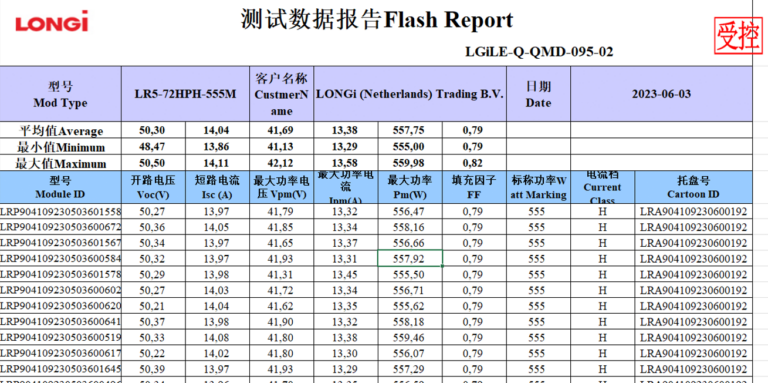
When someone (for example, a wholesaler) imports solar panels, the buyer always receives a flash test report. This contains the solar panel’s serial number and pallet number. The flash test report is provided to identify the solar panel’s origin, batch, production line, factory, etc., so that any deviations in power output can be traced.
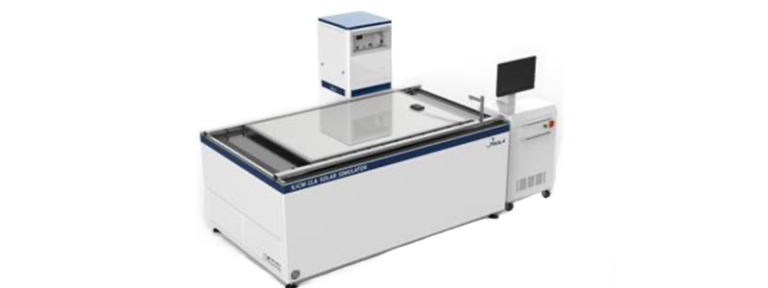
A flash test involves illuminating the solar panel at 1000W/m2, with the cell temperature at 25°C and a light spectrum corresponding to AM=1.5. These test variables are also known as STC parameters (more about the solar panel’s characteristics and datasheet can be found in post 19 on the technology blog). The solar panel is placed face down beneath powerful xenon lamps, which illuminate it intensely. At the same time, important parameters such as voltage, current & power output are measured. These are measured as open-circuit voltage, Voc; voltage at the maximum power point, Vmpp; current at the maximum power point, Impp; and short-circuit current, Isc.
The test parameters verify that the solar panel meets the requirements set for it. The panels you buy today are always so-called positive power tolerance panels. This means that, as a buyer of solar panels, you are guaranteed at least the power output stated on the datasheet and paid for, but you may get more. The tolerance can be specified, for example, as 0 to +5 W or 0 to +1%. If you look at the attached flash test report from LONGi Solar below, the panels in the container (approx. 700–900 solar panels) have a power output of at least 555.00 Wp and at most 559.98 Wp.
Historically, flash test reports were important to solar panel buyers, partly because the price per watt was considerably higher than it is today. At the same time, because production lines and manufacturing methods were less standardised, and factory processes less automated, the quality of solar panels produced 10–15 years ago was not as consistently uniform as it is today. Variation could be plus or minus 10%. If you bought a 200 W solar panel, it could be anywhere between 180 W and 220 W. That was a risk buyers did not want to take, and with the help of the factory's flash test data, they could pay for the exact performance they received. It also gave buyers the assurance that they could carry out spot checks against the factory's data to verify that the performance in the flash test matched the performance in reality. It was therefore important to know that the exact solar panel you had bought had precisely the right specifications, since manufacturing was not consistent enough.
Flash tests, however, are a thing of the past. The solar panels produced today are of very high quality, thanks both to a high degree of automation and to factory robots carrying out the work consistently and with great precision. There are now fewer differences between the top-tier manufacturers, and even though the technologies (e.g. TOPCon, back contact, etc.) differ, production methods are extremely standardised. Despite this, there are cases where flash test reports are required when purchasing a solar installation. This even applies to small residential installations.
At Senergia, we do not consider this necessary, as it does not provide any specific customer value or benefit.
Therefore, from 19 January 2024, Senergia will stop scanning solar panels when they are dispatched (for customer orders).
This means that Senergia will continue to offer the flash test data, but customers will need to contact Senergia with a completed Excel file so that we can provide them with the data. By not scanning every customer's orders, we can save costs that you, as a customer, will benefit from.
Today, you can scan the barcodes of the serial numbers yourself using a number of free apps for both iPhone and Android. Senergia always stores the flash test data digitally, as usual, and as an installer you are very welcome to send us the serial numbers for your order, and Senergia will retrieve the flash test data for your specific panels.
What does this mean for you as an installer?
- If you want to retrieve the flash test data, scan the panels’ barcodes yourself before installation.
- Send Senergia an Excel file containing the serial numbers and your order number (SO number).
- Senergia charges SEK 500 per order to provide the flash test data.
What does this mean for you as the end customer?
- If you require flash test data, specify before the project starts that a flash test report is required.
- If you purchase a full container (or more) with delivery directly from the port, flash test data is always provided.
Our advice to you as someone specifying requirements or working as a consultant in the industry is to think again. Flash test reports were relevant historically, but today they add no value at all for most projects. Where required, manufacturers and distributors can still provide flash test data. However, for the general public and even for larger commercial projects, this is something that should be stopped altogether.
Need help finding the right one?
We know it’s not always easy to know which product or solution is best for you. Whether you have questions about our range, need guidance or would like help finding a solution that suits your particular needs, we’re here for you. With our knowledge and experience, we’ll help you make the right choice.
Related posts
How much may the electricity network cost, and what may network owners earn?
What will happen to the price of solar panels and batteries in autumn 2026?