



Battery School 2 | The battery systems of the future – efficient, safe and scalable
Introduction
Battery storage has become a central part of modern solar installations and is now one of the most dynamic areas of technology in renewable energy. For installers, this means not only new business opportunities, but also the need to keep up to date with the latest technology and best practices. Understanding different system configurations and types of battery storage systems is essential for sizing, installing and optimising solutions that meet customers’ needs – both today and in the future. In this blog post, we take a closer look at the most common battery types, how to calculate capacity, the difference between low-voltage and high-voltage batteries, and how series and parallel connections affect system performance and flexibility. The aim is to inspire you as an installer to take the next step and deliver even smarter, more sustainable energy solutions.
How do you calculate the capacity of a battery module? Ah, V and number of cells
Understanding how to calculate the capacity of a battery module is essential for sizing the right system. Capacity is usually stated in amp-hours (Ah) and voltage in volts (V). To calculate the total energy (Wh), multiply the capacity by the voltage:
E = V x Ah x N
Where E is the energy (Wh), V is the voltage in volts, Ah is the battery capacity (amp-hours) and N is the number of battery cells connected in series.
Using a calculation example with e.g. Qapasity Arctic series, which is 53Ah and has 32 cells, we get:
E= 3.2V x 53Ah x 32 = 5427.2Wh or 5.4kWh.
Low-Voltage vs High-Voltage Batteries
Low-Voltage Batteries
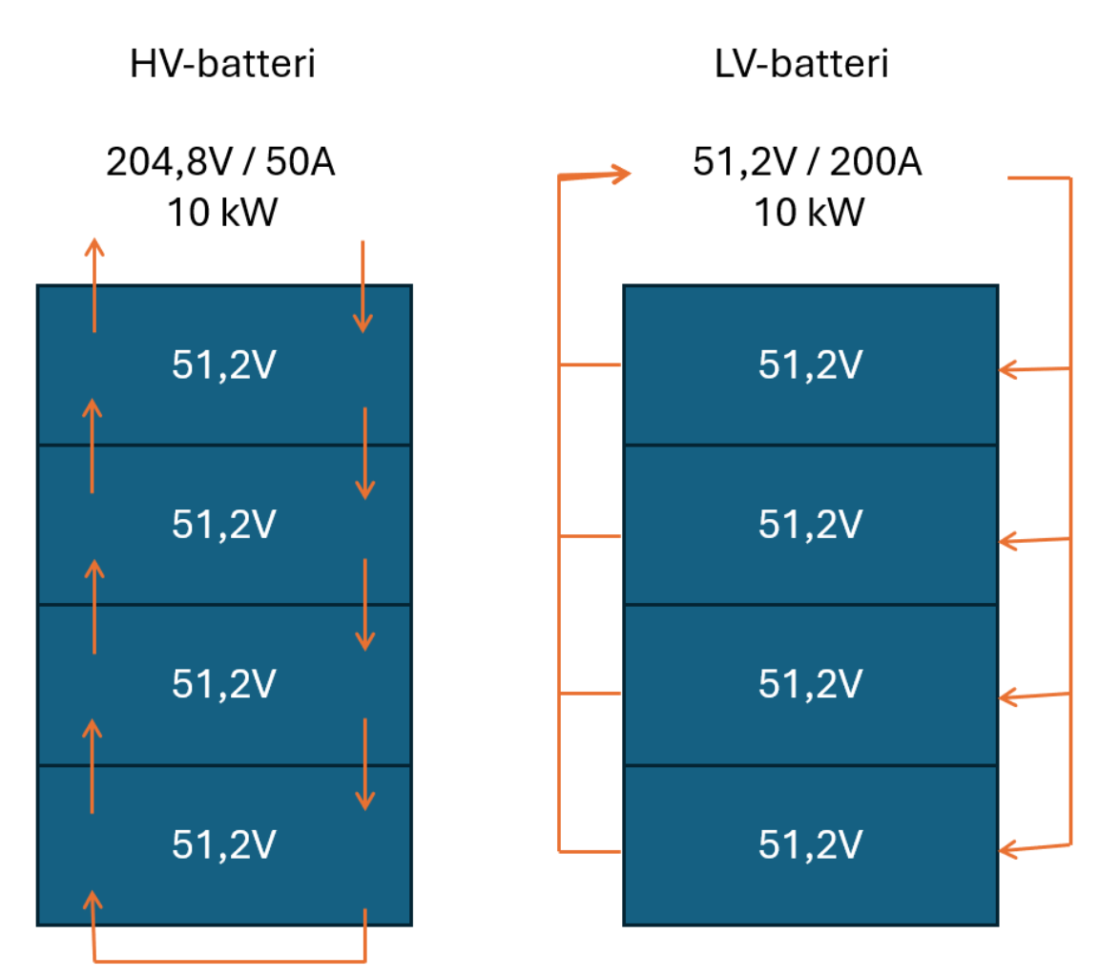
Overseas, especially in Africa, Eastern Europe and large parts of Asia, low-voltage batteries are very popular. These are typically 12, 24 or 48 V and have long been standard in smaller systems, thanks to their simplicity, robustness and low cost. They are often easier to install, require less advanced electronics and are well suited to smaller households, holiday homes and off-grid solutions. Low-voltage batteries are also more forgiving when it comes to installation and maintenance, making them a popular choice for many installers. One limitation of low-voltage batteries is that they cannot be scaled up to particularly large systems, because the current becomes very high when the voltage is low. If we take a battery consisting of four battery modules, each delivering 50 A, the total current is 200 A. Such a battery still delivers ‘only’ 10 kWh. A battery like this requires substantial cables because the current is very high. This means that cable losses are high and the cables are expensive.
High-Voltage Batteries
High-voltage batteries, often 200–800 V, have become increasingly common in larger systems and commercial applications. Their advantages include higher efficiency, lower cable costs and the ability to deliver more power at the same current. Higher voltage means less current is required for the same power, reducing losses and allowing thinner cables. However, high-voltage batteries require a more advanced BMS (Battery Management System) and higher safety standards, placing greater demands on both the installer and the user. For larger installations, where power requirements are high and distances are long, high-voltage batteries are often the most cost-effective and future-proof choice.
If we take a look at how Qapasity MAX is configured, we can see that this battery module consists of 16 102 Ah prismatic cells connected in series (16S1P). These are all connected in series, and the module voltage reaches 16 × 3.2 V = 51.2 V.
Series- vs parallel-connected batteries
How you connect the batteries – in series or in parallel – has a major impact on the system’s characteristics and performance. Below are examples of two battery systems (both based on 50Ah cells), one with the battery modules connected in series and the other in parallel. Exactly the same amount of chemically stored energy, but two completely different ways of building the system configuration.
Series connection:
When batteries are connected in series, the voltage is added together, while the capacity (Ah) remains the same. Example: Two 48 V batteries connected in series provide 96 V. This reduces the current for the same power, reducing losses and allowing thinner cables. Series connection is particularly beneficial in high-voltage applications, where higher voltage improves efficiency and makes integration with certain inverters easier.
Parallel connection:
When batteries are connected in parallel, the capacity (Ah) is added together, while the voltage remains the same. Example: Two 48 V, 100 Ah batteries connected in parallel provide 48 V, 200 Ah. This gives longer operating time and greater energy storage, but requires the batteries to be well matched to avoid imbalances and reduced service life. Parallel connection is often used when you want to increase storage capacity without changing the system voltage.
Choosing the right connection depends on the application, the desired voltage and capacity requirements, as well as the inverters and charging systems being used. In practice, series and parallel connections are often combined to create systems with both the right voltage and sufficient capacity.
DC/DC-optimised battery systems
On the Swedish market, series-connected HV (high-voltage) batteries are much more common than LV batteries. In this section, we will look at combining the two technologies: parallel-connected LV batteries, with the voltage of each battery module stepped up to high voltage (around 400 V).
An exciting development in battery storage is DC/DC-optimised battery systems, where each battery module has its own DC/DC converter. Its purpose is to take the voltage and current from the battery and convert them to a higher voltage. This means that significantly smaller cable cross-sections can be used thanks to the higher voltage.
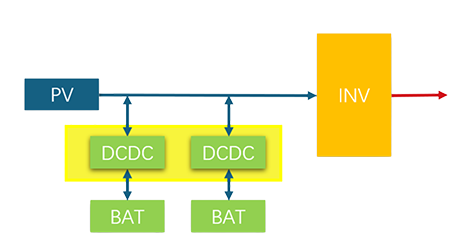
This enables individual control and optimisation of each module, providing greater flexibility and better performance when expanding the system or if one module performs less well than the others. The advantages of DC-DC optimisers are as follows:
- The option to expand the system with new battery modules
- If one battery module stops working, the rest of the system continues to work
- Battery modules can be switched off individually, and the system can be switched off at the positive and negative terminals of each battery module.
Looking at a high-voltage DC/DC-optimised battery system, it uses exactly the same type of battery cells as a system in which the cells are connected in series. Controlling the current and voltage in each battery module gives you greater control over the system.
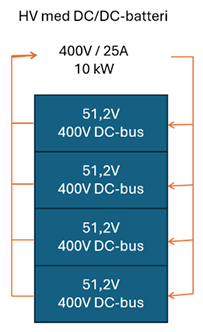
With DC/DC optimisation, the system can continuously balance and optimise the energy flow between modules, reducing the risk of bottlenecks and extending the overall service life. Such systems can often combine different battery types and ages in the same installation, simplifying both servicing and expansion. For installers, this means easier troubleshooting, greater scope for customisation and a future-proof solution that can grow with the customer’s needs. There are several manufacturers using this system configuration, and some of the best-known on the Swedish market are:
- Huawei (S0 & S1)
- SAJ
- Sunwoda
- Sigenergy
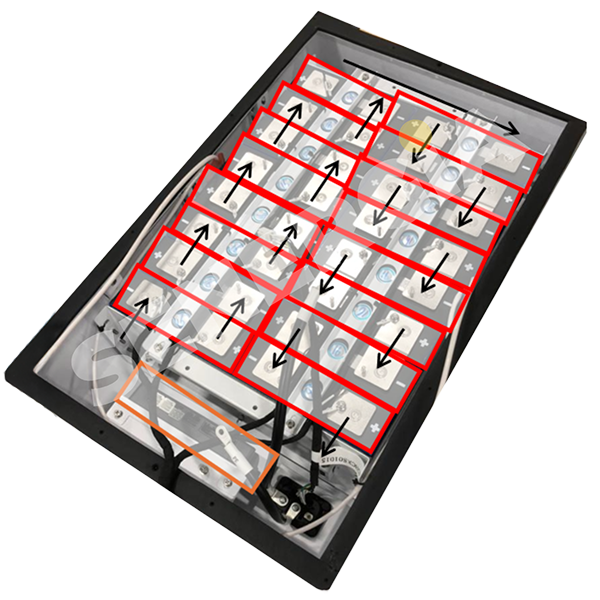
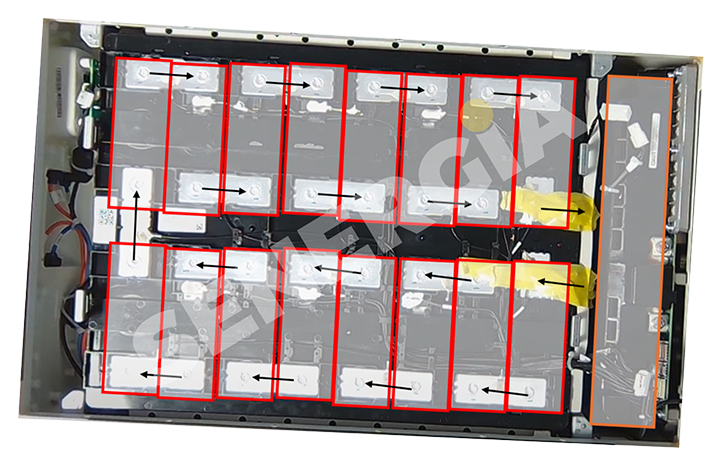
If we take a look at Huawei’s E0 battery module, we can see that it consists of 16 battery cells connected in series, each rated at 100 Ah (16S1P). These are connected to the orange unit, which is both a slave BMS and a DC-DC optimiser that converts the battery cells’ voltage from 51.2 V to around 400 V, as required by the inverter.
Expansion of existing systems
One of the major advantages of modern battery systems is the possibility of modular expansion. When the customer wants to increase their storage capacity, new modules can easily be added—provided the system is sized correctly from the outset and the BMS and inverter support expansion. When batteries are connected in parallel, it is important that the new batteries are of a similar type and age to avoid imbalances, but with DC/DC-optimised systems this is less critical. Expansion can also involve replacing older modules with newer, more efficient versions, giving the system a longer lifespan and better performance over time. For the installer, this means repeat business opportunities and more satisfied customers, as systems can be adapted and expanded in line with changing needs and circumstances.
Expanding parallel-connected systems (DC/DC-optimised)
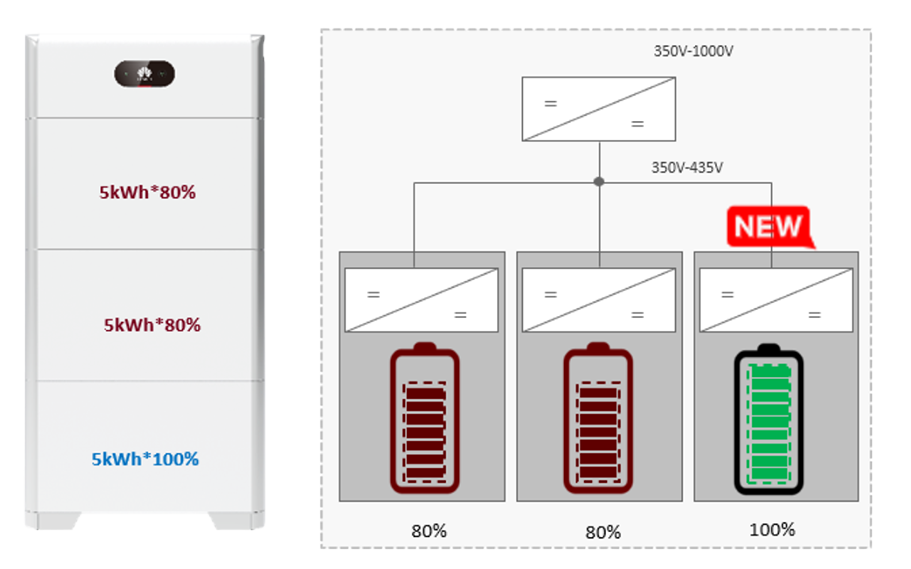
If you want to expand a battery stack with one or more new battery modules, it is very simple. You need to check that the stack does not become too large (or too tall). For example, Huawei S0 allows a maximum of 15kWh (three battery modules) and Huawei S1 allows a maximum of 21kWh (also three battery modules). There is no problem mixing batteries with different SoC and SoH.
Expanding series-connected systems
When expanding a system with series-connected battery modules (without DC/DC optimisers), there are a few things to consider, and these vary depending on the manufacturer. So make sure you read the manual carefully before expanding the system. Generally speaking, there are no problems with expanding the system by adding more battery modules to the same stack or by installing new parallel stacks alongside an existing stack.
Adding more battery modules (to the same stack)
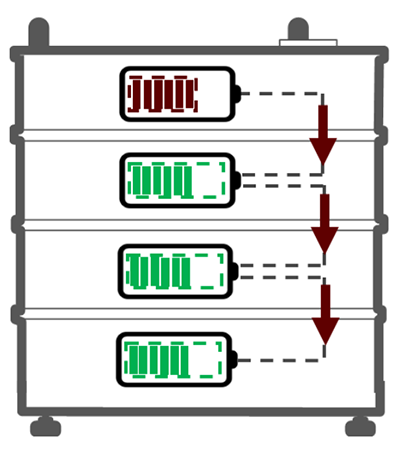
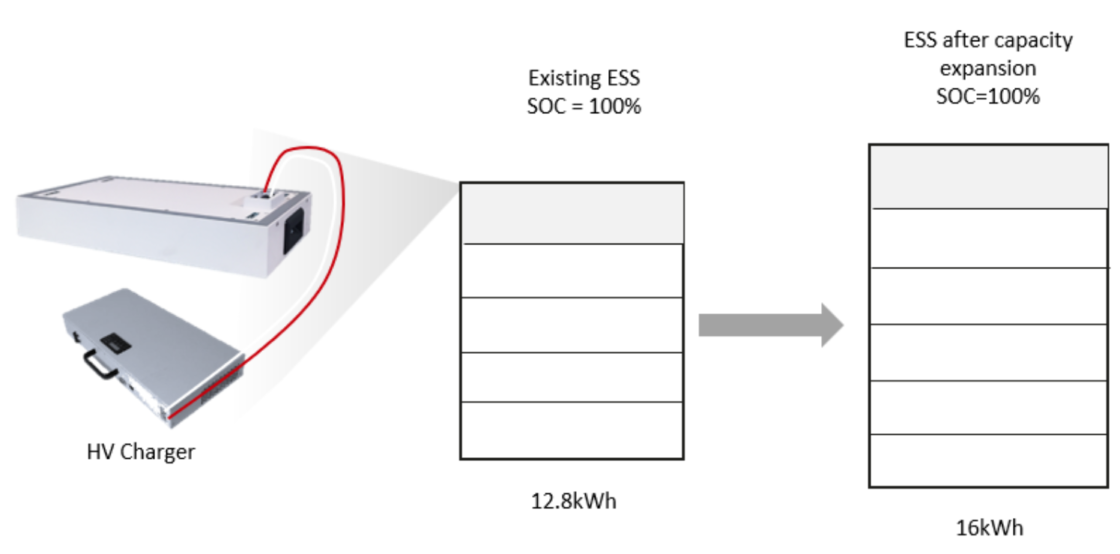
If a stack (battery tower) is expanded within 3 years, there are generally no issues, as the ageing of the existing battery modules (SOH) will not have been significantly affected. It is important to check how the batteries should be connected and what SOC they should have when they are connected. The manufacturer provides instructions for this. It is important to ensure that:
- All battery modules have the same capacity in amp-hours (Ah)
- The battery modules are of the same type and are approved by the manufacturer for connection in series with the existing modules.
- The connection sequence is followed. That is, the SOC of both the existing modules and the new modules must meet the manufacturer's specifications.
To expand the system, ensure that all battery modules reach 100% SoC and that the new battery module is also installed at 100% SoC
Expansion with additional battery modules (in the same stack)
Expanding with additional battery stacks in parallel
As with the reasoning above for adding more batteries, you can also add entire battery towers. There are a few additional aspects to consider here, just as in the example above. However, the most important thing with battery stacks connected in parallel is that the new battery tower must be of the same type. That is, it must have the same number of cells in the module and the same amp-hour rating (Ah).
If the system is too old (SOH too low)
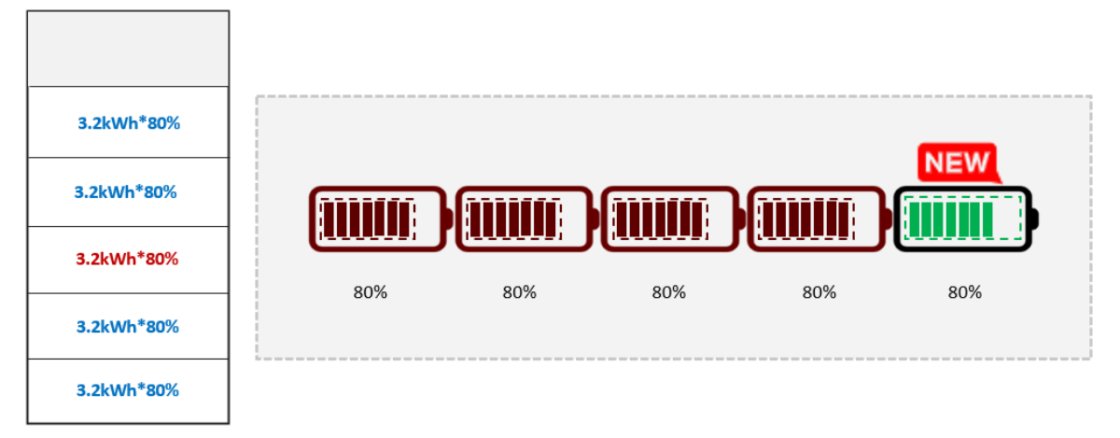
If the system is too old, the worst battery cell or cells will limit the newly installed battery module. This does not necessarily have to be a major problem, but after a certain time you reach a point where you should not scale up the system, but replace it. Where this limit lies varies.
Summary and conclusion
Choosing the right system configuration and type of battery storage system is essential for a successful, future-proof solar installation. By understanding the differences between low-voltage and high-voltage batteries, and how series and parallel connections affect the system’s characteristics, you as an installer can create solutions that are both efficient and flexible. DC/DC-optimised systems and the option for easy expansion open up new possibilities for future energy storage. As an installer, it’s important to keep exploring, learning and daring to try new technologies – that’s how we can build tomorrow’s smart, sustainable energy systems together. Seize the opportunity to stay ahead of the curve and inspire both colleagues and customers with your knowledge and commitment!
Need help finding the right option?
We know it isn’t always easy to know which product or solution is best for you. Whether you have questions about our range, need guidance or would like help finding a solution that suits your needs, we’re here for you. We’ll help you make the right choice with our knowledge and experience.
Related posts
Battery School 1 | Understanding the difference between different battery cells
Battery School 2 | The battery systems of the future – efficient, safe and scalable