



Battery School 1 | Understanding the difference between different battery cells
Introduction
The solar industry is undergoing rapid development, with energy storage becoming increasingly important for maximising the benefits of installed solar power systems. For installers, this brings new opportunities and technical challenges. In this blog post, we’ll look at how lithium-ion batteries (focusing on LFP cells) are manufactured, the different cell types, their advantages and disadvantages, and how they are used in both electric vehicles and stationary energy storage systems. We’ll finish with an overview of Senergia’s battery range and the cell technology used in each product.
How is a lithium-ion battery (LFP cell) made?
Lithium iron phosphate (LFP) is one of the most popular chemistries for lithium-ion batteries, particularly for stationary energy storage systems, thanks to its safety and long service life. An LFP cell is manufactured in several stages:
- Raw materials: The main chemical materials are lithium carbonate, iron phosphate, graphite (for the anode), copper and aluminium foil, and electrolyte (often a lithium salt solution in an organic solvent).
- Electrode production: The cathode material (LFP) and anode material (graphite) are mixed with binders and solvents, applied to foil and dried.
- Cell assembly: The electrodes are stacked or wound together with a separator, and the cell is filled with electrolyte.
- Sealing: The cell is sealed (in pouch, cylindrical or prismatic form) and undergoes what is known as the “formation” process, in which it is charged and discharged in a controlled manner to activate the chemistry.
- Quality control: Finally, the cells are tested and sorted before being built into battery modules and systems.
Overview of different battery cells
Battery cells are available in different formats, such as prismatic, cylindrical and pouch cells, because different applications and products have varying requirements in areas such as space, form factor, performance and manufacturing process. By offering several formats, battery manufacturers and product developers can optimise battery characteristics according to what matters most for their particular application. The aim is to create flexibility in design and function, so that batteries can be integrated in the best possible way into everything from small electronic devices to large stationary energy storage systems and vehicles. Different formats therefore enable better adaptation to technical, economic and practical needs across various industries.
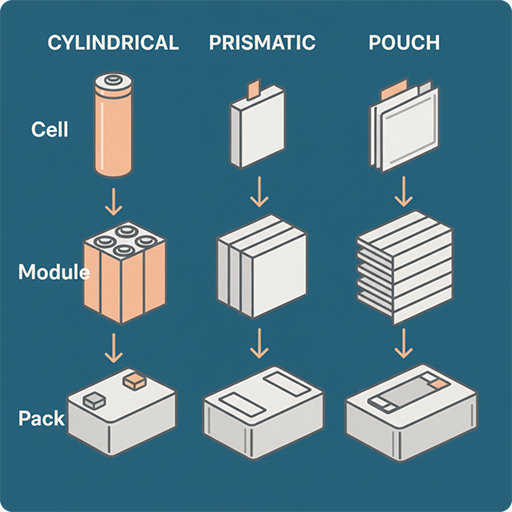
Below, the three different cell types are listed, along with their various advantages and disadvantages based on their physical design and format.
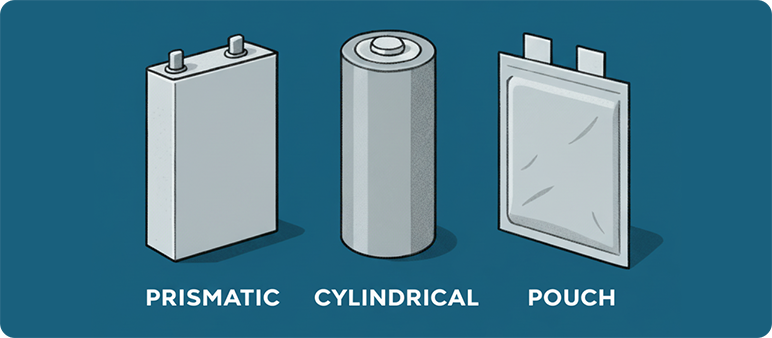
Different battery cell formats—cylindrical, prismatic and pouch cells—play a crucial role in how battery packs are designed and perform in the automotive industry. Cylindrical cells, which have long been the standard in the electric vehicle segment, are robust and easy to manufacture, enabling a high degree of automation. They are often packed closely together in modules, providing good mechanical stability but potentially posing challenges for heat dissipation, especially in larger packs where the cells are close together. Prismatic cells, with their rectangular format, can be packed more efficiently and make better use of the space in the vehicle. They often have built-in cooling channels or cooling plates, which improve their thermal properties and make it easier to manage both heat and cold. Pouch cells are flexible in shape and can be adapted to fill irregular spaces in the vehicle’s chassis. They are lightweight and have high energy density, but are more susceptible to swelling and therefore require careful mechanical framing and cooling. The choice of cell type therefore affects not only energy density and cost, but also how effectively heat can be dissipated and how the battery performs at different temperatures—a critical factor for both safety and service life in electric vehicles.
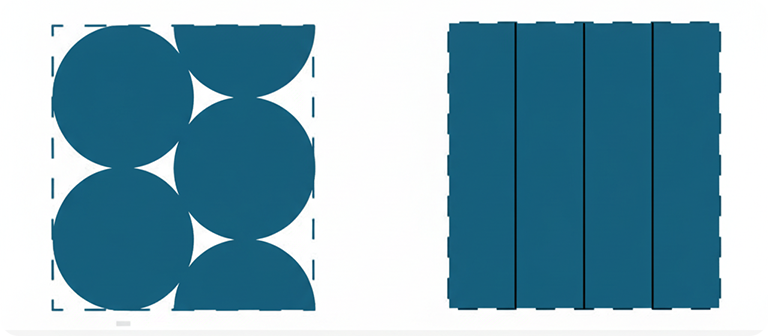
A battery is assembled by first joining several individual cells together to form a module. The cells may be cylindrical, prismatic or pouch cells, and are connected both electrically and mechanically within the module. Several modules are then assembled into a battery pack, the finished unit used in applications such as electric vehicles or energy storage systems. In addition to cells and modules, a battery pack also includes components such as a monitoring system (BMS), a cooling system and protective enclosures. These components ensure that the battery operates safely and efficiently. Assembly takes place in stages: cells → modules → battery pack, with each level contributing to the battery’s overall capacity and safety.
Pouch cells
Pouch cells have a flexible, flat casing made of aluminium-plastic film. They are lightweight and can be customised in size, making them popular in applications where space is limited, such as electric cars and some stationary systems. Pouch cells generally allow more cells to fit into each module, increasing the voltage. In stationary systems, pouch cells are installed in “compartments”, which keeps them mechanically stable.
Cylindrical cells
Cylindrical cells are the most traditional lithium-ion cells, often in the 18650 or 21700 format. They are robust, easy to manufacture in large volumes and offer good mechanical stability. They are often used in electric cars and battery packs where cooling and modular design are important.
Prismatic cells
A prismatic battery cell is a type of lithium-ion cell in which the electrochemical materials are enclosed in a rigid, rectangular metal casing. Inside the cell, the anode, cathode and separator are arranged in thin layers that are rolled or stacked on top of one another to maximise the surface area and, in turn, the energy density. When the battery is charged and discharged, lithium ions move between the anode and cathode through the electrolyte, generating an electric current. Prismatic cells are popular because their shape makes them easy to stack and pack tightly into modules and battery packs, saving space and providing a stable structure. They are often equipped with safety valves and protection against overheating. Prismatic cells are commonly used in electric vehicles and stationary energy storage systems thanks to their high energy density and flexible design.
Advantages and disadvantages of different cell types, with examples from the automotive industry
The automotive industry and transport sector are major drivers of the battery market as a whole, and most of the world’s batteries are manufactured for the transport sector. The electrification of transport is driving forward several different technologies and technological developments. For example, many car manufacturers have invested in different types of cells, each with its own advantages and disadvantages.
| Cell type | Advantages | Disadvantages | Examples of electric car manufacturers |
|---|---|---|---|
| Pouch cell |
|
|
|
| Cylindrical |
|
|
|
| Prismatic |
|
|
|
Tesla has used both cylindrical (18650, 21700) and prismatic cells in its models. Model S and X have traditionally used cylindrical cells, but the newer Model 3 and Y also use prismatic cells in some versions, particularly those with LFP chemistry.
Porsche Taycan, Audi E-Tron, Volvo XC40 and the new Porsche Cayenne use pouch cells, which enable high performance and low weight, but require careful battery management and cooling.
Overview of stationary batteries
Stationary energy storage systems require batteries with a long service life, high safety and stable performance. LFP cells are therefore dominant in this segment. Below is a table of some of the most common batteries sold by Senergia, as well as a selection of other batteries on the Swedish market. The list includes the cell type they use:
| Product name | Cell type | Battery chemistry | Capacity (kWh) | Ah | Cell configuration | Cell manufacturer |
|---|---|---|---|---|---|---|
| qapasity Arctic Series | Pouch cell | LFP (semi-solid state) | 5,42 | 53Ah | 32S1P | Qingtao |
| qapasity Max | Prismatic | LFP | 5,22 | 102Ah | 16S1P | RJE |
| Dyness Tower | Pouch cell | LFP | 3,55 | 37Ah | 30S1P | COSMX |
| Dyness Tower PRO | Pouch cell | LFP | 3,68 | 40Ah | 30S1P | COSMX |
| Dyness Stack100 | Prismatic | LFP | 5,12 | 100 | 16S1P | BYD |
| Dyness Stack100 PRO | Prismatic | LFP | 5,12 | 100 | 16S1P | BYD |
| SAJ HS3 (BU3-5.0-TV2-Pro) | Prismatic | LFP | 5,32 | 52 | 32S1P | EVE |
| Huawei Luna S0 | Prismatic | LFP | 5,12 | 100 | 16S1P | CATL/BYD |
| Huawei Luna S1 | Prismatic | LFP | 7,17 | 280 | 8S1P | EVE |
Advantages and disadvantages of different cell types in stationary applications
As the table above shows, both prismatic and pouch cells are used in stationary applications in the Nordic solar energy market. As mentioned earlier, prismatic cells have a cost advantage because they contain more ampere-hours per cell and are therefore physically larger. One way to think about it is to compare larger battery cells to 1.5-litre bottles of soft drink and smaller pouch cells to 0.5-litre bottles. In other words, even if the total amount of soft drink is the same in both boxes, different numbers of bottles are needed to fill them.
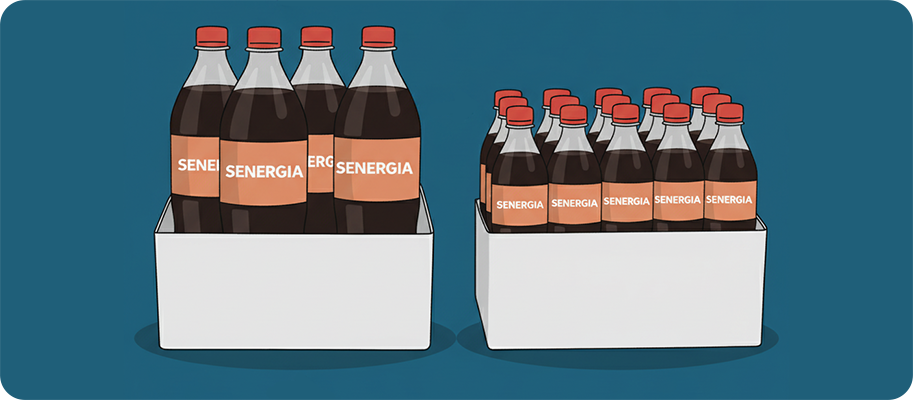
This means that since each battery cell in LFP batteries has a nominal voltage of 3.2 V, the voltage will vary depending on how many cells (Coca-Cola bottles) are included. Take the Qapasity Arctic Series, which contains 32 pouch cells (53 Ah), giving a voltage of 3.2 x 32 = 102.4 V per battery module. Qapasity MAX contains 16 cells (102 Ah), giving a voltage of 16 x 3.2 = 51.2 V per battery module. This then has consequences for the inverter, which requires a certain start-up voltage at the battery input. For example, a Solis S6 10 kW requires 120 V. This means that at least 2 modules from the Qapasity Arctic Series (10.84 kWh) are required, while at least 3 modules are needed when using Qapasity MAX (15.66 kWh). The minimum size of the systems therefore depends on the voltage. The voltage, in turn, depends on how many battery cells are installed in the battery module.
There is no direct disadvantage to using one cell technology or the other. For example, pouch cells have no built-in mechanical or structural strength, as they are designed like a bag. When pouch cells are used, they are structurally enclosed in the battery module so that the cells stay in place and do not move around. Because of their different physical properties, pouch cells and prismatic cells are welded together in different ways, and prismatic cells have built-in pressure-relief valves in case overpressure occurs within a cell.
To summarise pouch vs prismatic cells:
- There is no obvious technical winner between pouch and prismatic cells. Both have clear advantages and disadvantages.
- Different manufacturers focus on different form factors depending on the application. For example, smaller systems use pouch cells, while larger systems use prismatic cells.
- Prismatic cells are somewhat cheaper per kWh because less non-cell material is required. For example, Qapasity Arctic has 31 connections between the cells, while Qapasity MAX and Dyness Stack100 have 15 connections. In addition, less material is needed per Wh of cell capacity when the cells are made larger. This is why there is a clear trend towards using large (prismatic) battery cells in larger energy storage systems.
- Stationary energy storage in homes and domestic applications is significantly less demanding than use in the transport sector (where temperature extremes, higher power levels, vibration, moisture and dirt are all factors).
Summary and conclusion
As a solar installer, it is important to understand the differences between various battery cells and how these affect installation, operation and service life. LFP cells offer a high level of safety and a long service life, and are available in several different cell formats – each with its own advantages and disadvantages. By choosing the right battery solution for the right application, you can maximise value for your customers and contribute to a more sustainable energy future.
Need help finding the right option?
We know it isn’t always easy to decide which product or solution is best for you. Whether you have questions about our range, need guidance or would like help finding a solution that suits your specific needs, we’re here for you. We’ll use our knowledge and experience to help you make the right choice.
Related posts
How much may the electricity network cost, and what may network owners earn?
What will happen to the price of solar panels and batteries in autumn 2026?