

Year in Review – The Solar PV Year 2024
Introduction
During the 2022 energy crisis, when the whole of Europe was plagued by high energy prices, there was also a severe shortage of many components in the solar PV industry. Inverters and batteries were worth their weight in gold. During this latter period, and in the aftermath of COVID-19, there were shortages of both hardware and installation capacity. The pent-up demand led many companies to increase their workforce in 2023 and work very hard to reduce their very long queues of private individuals waiting to have their systems installed. In 2022 and 2023, there was a low-interest-rate environment, with favourable conditions for borrowing capital cheaply (the repo rate was even negative). This, combined with high wholesale electricity spot prices, made an already booming solar energy industry even busier.
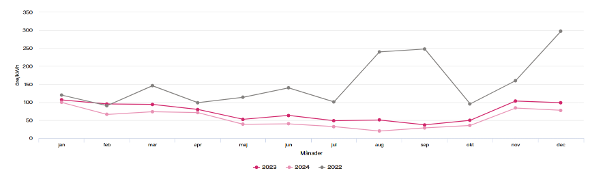
During the record-breaking year of 2023, 106,000 solar PV systems were installed (source: Svensk Solenergi), many of which had been contracted in 2022 and were then installed in 2023. By mid-2023, electricity prices had returned to low and stable levels, while inflation had prompted the Riksbank to start raising interest rates sharply. This, combined with the Swedish Tax Agency’s decision on 4 January 2024 that energy storage systems would not be eligible for the 50% green technology tax credit if they were used for grid-balancing services, caused the rate of installations and willingness to invest to plummet. This decision was overturned six months later, but the damage to the industry had already been done.
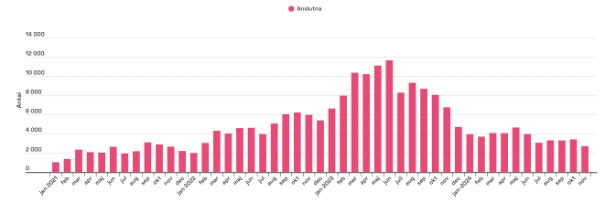
As mentioned, 106,000 solar PV systems were installed in 2023. In 2024, the market more than halved. Although the official statistics for 2024 are not yet complete, a simple interpolation suggests that the number of installations will end up at just under 44,000 systems. That is a decrease of 58%(!!).
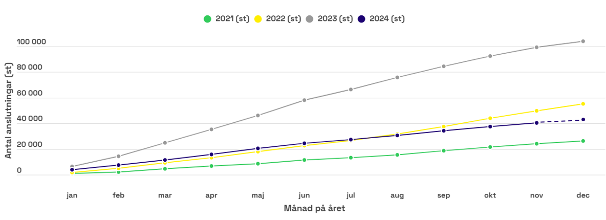
If we disregard the exceptionally record-breaking year of 2023, the figures for 2024 are not all that far from those for 2022. This is probably a market size that can be expected for the foreseeable future. If economic growth picks up again, energy use will increase, leading to higher electricity prices. This will have a positive impact on the development of the solar energy market.
Reasons behind the shrinking market in 2024:
- Lower electricity prices (wholesale spot prices)
- Higher interest rates
- The Swedish Tax Agency's troubles with the green technology tax credit for batteries
- Reduced payments for grid-balancing services (FCR-D)
5 important trends for 2025
A lot of new things will happen in 2025, both in terms of technology and hardware, as well as market conditions, taxes and subsidies. The following section lists some of the most important events and trends that will affect the solar market in 2025:
The cost of tied-up capital remains high
Senergia’s customers, the installers, are affected both by fluctuating global market prices for installation materials (e.g. solar panels) and by the fact that many installers have tied up a lot of capital in their own stock. These are costs they are currently paying dearly to get rid of. Variations in the rate of installations in the market have made it difficult for many installers to adapt their staffing and supply chain to the new reality. Senergia has seen many installers revise their strategies, enabling them to focus on what matters to them: their customers.
The 60-öre tax credit is expected to disappear
In 2025, there are many indications that the so-called 60-öre tax credit will disappear. This means that private solar PV system owners will no longer receive a tax rebate on electricity sold (of 60 öre per kWh). This is a sign of the market’s maturity and means that solar power is more self-sufficient, while exported electricity from a system is now less attractive. This will mean that more systems install batteries, systems are sized for self-consumption, and it becomes more worthwhile for system owners to consume their own solar power rather than export it for low compensation.
Green technology tax credit falls from 20% to 15%
The Government has proposed reducing the green technology tax credit for a solar PV system from 20% to 15%. However, many industry analysts (including me) believe this will have only a marginal impact on the market. Naturally, if you want to maximise the tax credit, you should invest before the middle of 2025. It is important to point out that there are no indications that the 50% green technology tax credit for batteries will be affected, only the part relating to the solar PV system.
Prices of solar panels, batteries and inverters continue to fall
As the entire European solar energy market is sluggish, demand has fallen. However, production of components and hardware has not declined at the same rate, particularly in China. This has led to record-low prices during 2024, and prices have continued to fall in 2025. The Chinese Government, together with product manufacturers, has tried to curb the price collapse to reduce losses, but so far it has not slowed it down.
The share of newly grid-connected solar PV systems with batteries is approaching 100%
As mentioned earlier in point 1, the solar PV systems of the future will be closely linked to energy storage. This is because exporting electricity will not be as profitable as using it yourself (as you avoid electricity transmission charges, VAT and tax), and property owners can also use the battery to smooth out their electricity costs. In other words, charge when the electricity price is low and discharge when it is high. We can already see at Senergia that almost all solar PV systems sold in the Swedish market today come with a battery.
Grid-balancing services aren’t everything
In 2024, installed battery capacity reached approximately 1,000 MW (1 GW). The rapid roll-out has reduced the profitability of Svenska kraftnät’s so-called grid-balancing services, especially FCR-D, as more batteries are sharing the available revenue. Battery owners are now looking towards new services, such as FCR-N, and can also use energy storage locally within their properties while participating in grid-balancing service markets (for example, EMS control from Enequi). This increases the remuneration and benefits of energy storage. New markets and revenue opportunities, such as local flexibility, also mean that batteries are not only used in the best way from a system perspective; they increase the profitability of solar investments and reduce the need to upgrade and reinforce the electricity grid. This could potentially save between SEK 400 and 600 billion!
The cheapest option isn’t the best choice
The sharp slowdown in 2024 has led to a number of bankruptcies as a result of the changing market. The industry has had to adapt its cost base to lower turnover and less demand for installations. Choosing an installer is more important now than ever before. With installers’ finances under strain and several manufacturers also fighting for survival, private individuals choosing an installer have a heavy responsibility.
Some tips:
- Choose your installer carefully
- Make sure payments correspond to work completed
- Ask for references and do your research on the installer
- Check the installer’s financial situation
- Find out who owns the installer and who is behind the company.
- Check whether the company carries out the installation itself or uses a subcontractor
- Choose members of Svensk Solenergi
- Choose a company with certified solar panel installers
- Have the system inspected before making the final payment
The Future of Solar Energy
Interest rates are changing
Interest rates have continued to fall, leaving Swedes with more money in their pockets. Rates are stabilising at around 3%, and the cost of capital is falling. This will enable more homeowners, businesses and housing co-operatives to invest in a solar PV system with energy storage.
Electrification continues
Although the pace of electrification slowed in 2024, the trend is clear. Electrification is taking place across many areas of society, from major structural changes such as fossil-free steel, fossil-free cement and electrofuels, and the electrification of the transport sector, to electrification in the everyday lives of ordinary Swedes—for example, getting an electric car or installing a solar PV system.
The green wave continues, but not as strongly
In 2024, the UK closed its last coal-fired power station. It has been an astonishing journey, made possible by a rapid and substantial expansion of renewable energy in the form of solar and wind, combined with energy storage. According to the International Energy Agency (IEA), renewables are set to generate more electricity than coal in 2025 (they came close in 2024). In Sweden, the Tidö parties have mostly focused on talking about nuclear power and have blocked many of the wind power projects that were proposed. You can read Tomas Kåberger’s post on the subject here: LINK.
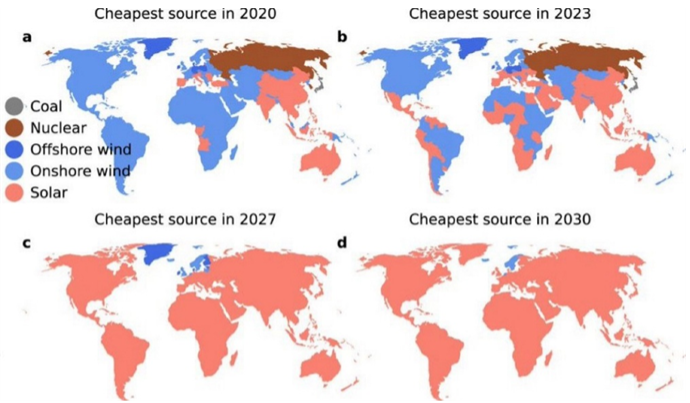
Globally, falling costs and technological maturity mean solar energy will be the world’s cheapest energy source in just a few years. And as the maps show, this applies everywhere except Norway and Sweden, where the sun is giving way to wind power.
New EU requirements
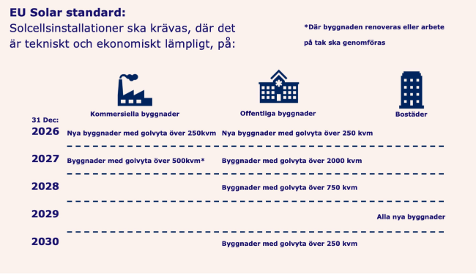
On 24 April 2024, a revised version of the Energy Performance of Buildings Directive (EPBD) came into force. This EU legislation requires solar panels on both new and existing buildings. All new buildings must be “solar-ready”, meaning they must be designed so that solar energy can be installed easily. Sweden must develop a national building renovation plan to integrate solar energy into its building stock. Solar panel requirements will be introduced gradually from 2026, with different timelines for different types of building. Member States must establish national criteria for these requirements, taking technical and economic feasibility into account. To facilitate the transition, Member States must provide support and measures, including financial and technical resources. Exactly how these will be implemented in Sweden has not yet been fully determined, but these regulations will have a positive impact on the industry.
Continued technological development
Solar panels: On the solar panel side, technology and efficiency have gradually improved. Today, the most efficient panels in Senergia’s webshop are just over 23% efficient. An absolutely remarkable figure when you look back 4–5 years! In addition, solar panel manufacturers are introducing new, innovative technologies, such as built-in shading management in the panel cells. Aiko has implemented this since 2024 (LINK), and Longi has launched its HPBC 2.0 technology with similar functionality (LINK).
Batteries
Battery technology continues to improve, while the price per kWh (and kW) continues to fall. Among other things, in 2025 we can expect a new liquid-cooled 100 kW/215 kWh commercial battery from Huawei, and Dyness will release its outdoor and 1C model, Dyness Tower Pro. We’ll also have to wait and see whether any further announcements are made at the major trade fairs in Europe and China.
Closing remarks
After a turbulent 2024, we look ahead to 2025. A year for the industry to lick its wounds after the collapse that took place in 2024. In 2025, further maturation will help solar energy stand even more firmly on its own feet. With less external and government support, solar energy will compete in the electricity market like everyone else (note that there is no support for housing associations, commercial systems or solar parks).
Batteries will continue to be installed on a large scale, from the smallest systems in homes to large battery parks of tens of megawatts (some perhaps even reaching a hundred or several hundred MW). Batteries are now so cheap, and with the support available to homeowners, it is now a dereliction of duty not to buy a battery for your solar PV system. With smarter algorithms, AI and intelligence, batteries can now operate autonomously and make the most profitable decisions.
At Senergia, we look forward to 2025, when we will continue supporting installers across the Nordic countries with our expertise, service and products. We look forward to a host of new products and services that we will deliver. This includes everything from the ongoing development of our own design tool, Senergia Planner, to new features in our e-commerce platform. Everything is aimed at making it as efficient and convenient as possible to be a customer. We will continue to challenge the industry and be a breath of fresh air through our clear specialisation as a distributor of solar energy, energy storage, smart control and EV charging.
Tim Ljunggren
Tim Ljunggren is one of the founders of Senergia. He is a qualified Master of Science in Electrical Power Engineering from KTH and holds a bachelor's degree in economics from SU. Tim is a frequent industry speaker and trainer and has written two handbooks. From 2022 to 2024, he served on Svensk Solenergi's Technical Committee, and in 2024 he was elected to the board of the industry association Svensk Solenergi.
Need help finding the right solution?
We know it isn't always easy to know which product or solution is best. Whether you have questions about our range, need guidance or want help finding a solution that suits your specific needs, we're here for you. With our knowledge and experience, we'll help you make the right choice.
Related posts
Senergia gains a long-term, financially strong principal owner.

Senergia’s incoming CEO Tim Ljunggren – This is where the energy industry of the future is being shaped