

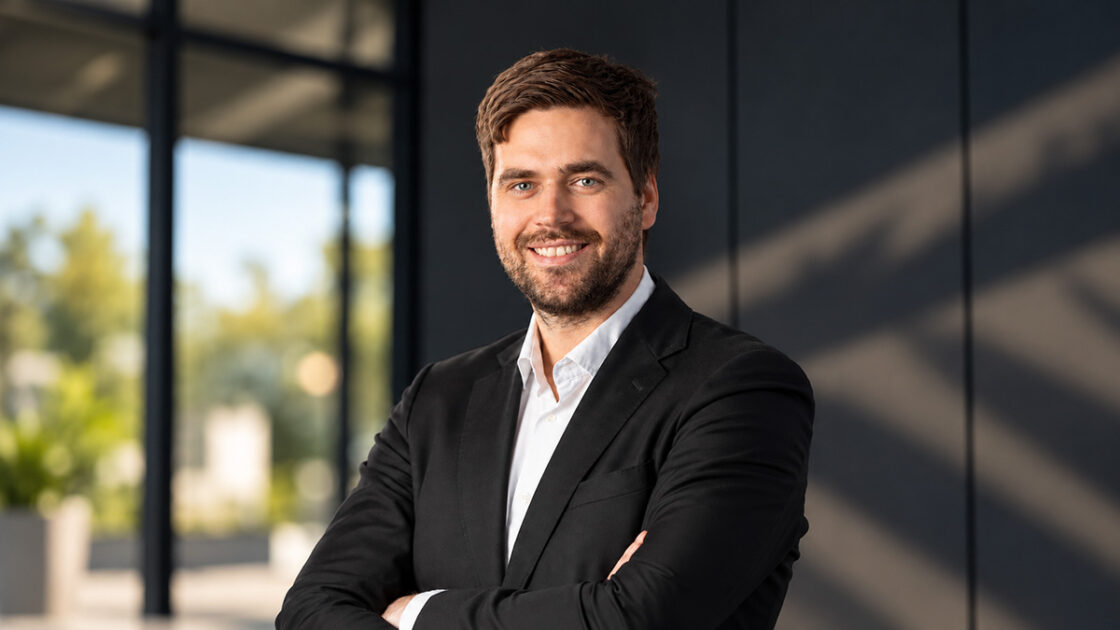
Senergia’s incoming CEO Tim Ljunggren – This is where the energy industry of the future is being shaped
Introduction
When my two co-founders, Jonas and Thomas, said that Senergia would become Sweden’s leading wholesaler and turn over 500 million kronor in three years, I thought: “These guys are completely out of touch with reality – yes, they’re completely crazy.” In hindsight, it took us 3.5 years to reach half a billion. The industry grew as if there were no tomorrow, doubling every year for several years in a row. Growth was enormous – too enormous.
The solar energy boom was fuelled by an energy crisis in Europe triggered by Russia’s war in Ukraine, extremely low interest rates and cheap capital, high electricity prices, and political deafness which, in the midst of all this, resulted in support for individuals installing solar panels being increased from 15% to 20%. The combination of geopolitics, cheap financing and generous subsidies created a perfect – and dangerously seductive – tailwind for our industry.
The industry’s challenges
Profitability
The industry’s major structural problem is profitability. In 2026, several major players – including El av Sol, Solifokus and the giant Sesol – have gone bankrupt. This is no coincidence, but a symptom of a business climate in which price pressure, mispriced risks and overly optimistic growth plans have taken precedence over sound financial logic.
When margins are squeezed over a long period, resilience is eroded. When the economy slows, interest rates rise and volumes fall, there is no financial buffer left. That is where we are now.
2.2 Bad debts
Bad debts are closely linked to profitability. When installers and contractors push their prices down to levels where any deviation in a project wipes out the entire profit, liquidity becomes fragile. A couple of delayed payments from end customers, the odd failed project or a major general slowdown – and suddenly cash flow no longer holds together.
In such a situation, problems spread quickly through the value chain. Suppliers and wholesalers have to bear the credit risk, banks’ risk appetite declines and the industry is squeezed indirectly through worse terms and tighter credit lines. When profitability is lacking, a vicious circle of rising bad debts is created, which in turn makes it even harder for serious players to grow sustainably.
The aftermath of growth
The extreme growth of recent years attracted a host of new, sometimes untested, players into the solar industry. Far from all of them were unscrupulous – but far too many lacked the experience required to handle the complexity of selling, designing and running profitable solar energy projects.
The challenges have been – and remain – significant. How should a system be sold? What can you actually promise the end customer? What does a realistic profitability calculation look like, given today’s prices, taxes and levels of support? Even today, in 2026, we see calculations that are completely detached from reality. Revenue from ancillary services is guaranteed, and payback periods are promised to be as short as just a few years, when a more realistic payback period for a solar installation with an accompanying battery is closer to eight years at today’s price levels.
The more people feel they have been deceived by promises of deals that are too good to be true, the harder it becomes for the industry to restore its reputation. Every dissatisfied customer is not just a lost sale – it chips away at the legitimacy of solar energy as a whole. It is dismaying that the industry, despite its size and level of maturity, has still not fully grown up.
Quality, service and support
Quality must be rewarded. If the lowest price is consistently the only thing that matters, the right solutions will not be installed, and the right expertise will not remain in the industry. Solar energy is not a standard product on a shelf – it consists of complex systems that are meant to work for decades.
End customers need support and help over time, but installers often do not factor this into their prices because they are fighting for their short-term survival. The result is that quick sales are prioritised over long-term customer relationships. In the long run, this undermines trust in suppliers, installers and the technology itself.
We need a shift in mindset in which quality, after-sales service and long-term performance become just as central as the installation itself.
3. The solar energy market in transition
3.1 A slowing market — but with a battery renaissance
As regulations tighten, we are seeing a clear slowdown in the market. Several leading players now report that sales are dominated by batteries, while demand for solar-only installations is significantly weaker. A recent quarterly report describes how the period was strongly characterised by battery sales, resulting in squeezed margins [4]. This reflects the situation across the entire installation sector: batteries are now the lifeline.
| Year | Charging point | Battery | Solar panels |
|---|---|---|---|
| 2022 | 95 000 | 14 000 | 59 000 |
| 2023 | 81 000 | 43 000 | 122 000 |
| 2024 | 77 000 | 55 000 | 48 000 |
| 2025 | 81 000 | 78 000 | 25 000 |
But even though the battery business is growing, that does not mean total volumes are increasing at the same rate as before. An analysis of the Swedish Tax Agency’s statistics shows that the number of approved tax deductions for green technology has fallen dramatically. In Q1 2026, the number of green technology deductions stands at around 2,000, compared with approximately 6,000 in the same quarter of 2025 – a decline of around 70% [4].
| Year | Charging point (Q1) | Battery (Q1) | Solar panels (Q1) |
|---|---|---|---|
| Q1 2024 | 15 000 | 11 000 | 10 000 |
| Q1 2025 | 16 000 | 14 000 | 5 000 |
| Q1 2026 | 14 000 | 18 000 | 2 000 |
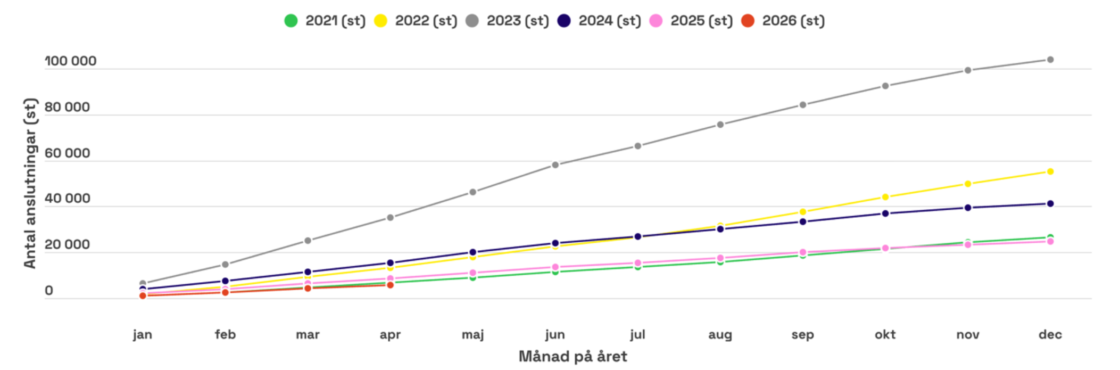
Svensk Solenergi’s ongoing statistics also show a clear slowdown in new solar installations from 2024 onwards, following the record year of 2023 [5]. A compilation by Grow Sverige, based on data from Svensk Solenergi and the Swedish Energy Agency, shows that Sweden connected approximately 21,500 solar energy installations in 2025, and that the total number of grid-connected solar installations stood at approximately 314,000 at the turn of the year [5,6].
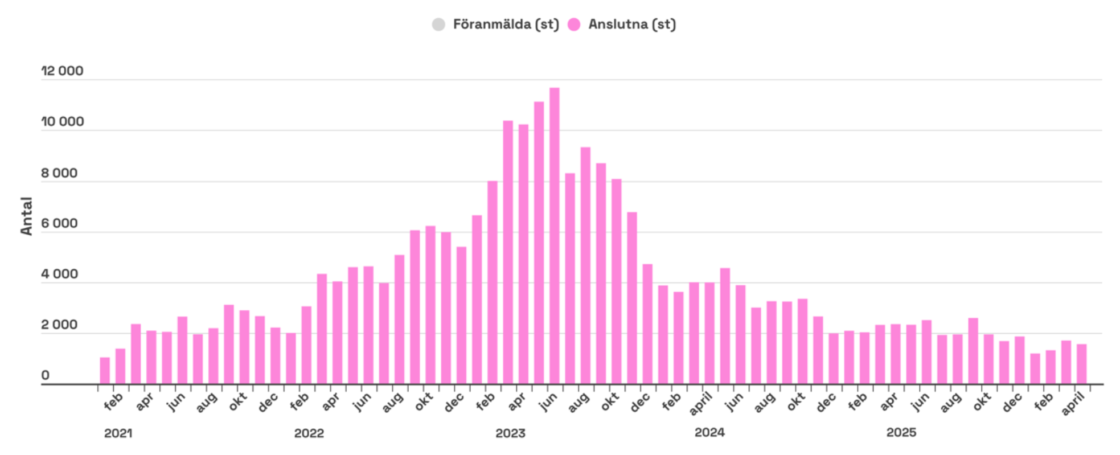
Looking at 2026, the curve is still rising, albeit at a significantly slower pace. At the start of the year, the number of newly connected systems is only a few thousand, which represents a weaker start than the same period in 2025 [5,6]. The market has not collapsed – but it has slowed down considerably.
Today, business in the residential segment is in practice entirely dependent on selling batteries to existing solar installations. Roughly speaking, Sweden has just over 300,000 solar installations [6,7]. If around half of these already have a battery, that means approximately 150,000 installations still lack energy storage.
At the same time, every battery installation completed at an existing site means one fewer customer to sell future system solutions to. The strategy of relying on retrofit batteries therefore works as a short-term lifeline — but also poses a potential systemic risk for the entire industry. Once the backlog of existing solar customers has been worked through, we will have no volume coming in unless we are also selling new solar installations with batteries from the outset.
Senergia’s role has changed — but we’re still who we’ve always been
When we founded Senergia, we decided — very much influenced by my time as a student teacher — that education would be at the heart of what we offered. We took on assignments from vocational colleges, ran installer training courses and delivered training together with a large number of suppliers. Consultants, electricians, installers and students — from customers to competitors — have all, in one way or another, attended or taken part in Senergia’s training courses.
I’ll never forget an occasion at Elmia Solar when a fellow wholesaler was asked whether wholesalers really should be involved in training. He said no. What he didn’t know was that, a few years earlier, I had trained two of his colleagues on a three-day system design course.
Today, the need for traditional training is considerably smaller — at least according to many installers. They rarely prioritise deepening their knowledge, and much of the focus is on simpler battery installations. At the same time, Senergia has built a fully digitised knowledge bank and a digital range of courses on Sana’s AI platform. Everything is ready to train your next colleague, when the industry once again recognises the value of expertise as a competitive advantage.
We have changed the format of our training, but not our conviction: a mature industry requires a high level of expertise throughout the entire value chain.
Solar energy has become a system
Solar energy today is no longer just solar panels on a roof. Solar installations are now sold together with a battery, EV charging and smart control via energy management systems (EMS). The installations are complex – in terms of structural integrity, waterproofing and electrical engineering.
On top of this, another increasingly important dimension comes into play: control and optimisation. The systems require configuration and fine-tuning so that the end customer’s various components work as a well-orchestrated unit. The electric car needs to be charged, as does the stationary battery; users participate in ancillary services markets and local flexibility schemes, and optimise loads to increase their own consumption – for example, a heat pump, ventilation, a hot tub or other power-hungry loads.
This makes very different demands from yesterday’s relatively simple on-off solutions. To deliver genuine customer value, installers and suppliers need expertise in hardware, software and understanding energy systems.
The wholesaler’s role is changing
The wholesaler’s role has also changed fundamentally. Material availability is better than ever today, and installers can increasingly buy exactly the products they want and need. This calls for fast stock handling, precise logistics flows and high delivery accuracy. Solar panels are large, heavy and fragile – a logistical challenge that Senergia and its partners have refined over almost a decade.
Today, the wholesaler effectively also acts as a bank for the installer. We enable low capital tied up in stock, reduced inventory and price risks for the installer, and a smoother day-to-day working life. An increasing proportion of orders are placed via EDI, API or other IT integrations. Speed and digitalisation are driving development forward. We are building more functionality into Senergia Planner and digitising the ordering process for installers.
At the same time, demands for risk control, credit assessments and financial discipline are increasing. Being a wholesaler in the solar energy industry in 2026 means operating at the intersection of technology, logistics, finance and digitalisation.
What Senergia has been focusing on recently
As the industry shrank by around 60% between 2024 and 2025, and by a further approximately 40% between 2025 and 2026, we have been forced to rationalise our operations in depth. We have made extensive cost savings, particularly in staffing – from 83 colleagues down to today’s 25. These have been tough but necessary decisions to ensure Senergia remains robust even in a much smaller market.
At the same time, we have optimised our warehouse space and today base our business on a highly flexible warehouse that can be scaled up quickly and enables customised, flexible logistics solutions. Solar energy requires the right product in the right place at the right time – and this is a core competency we have chosen to strengthen, not scale back.
We have also accelerated our digitalisation journey and implemented AI solutions as an integrated part of our employees’ day-to-day work. This ranges from an AI bot that takes notes at both internal and external meetings, to bespoke integrations with customers for efficient order flows, to automation and scripting in our business system. The aim is the same throughout: greater speed, less manual work and increased efficiency.
Senergia’s strategic focus is also on diversification. We see how, as a knowledge leader, we are constantly copied in our business methods, supplier choices and strategies. In one sense, this is flattering – but it also makes the need for a clear niche and specialism of our own even more important.
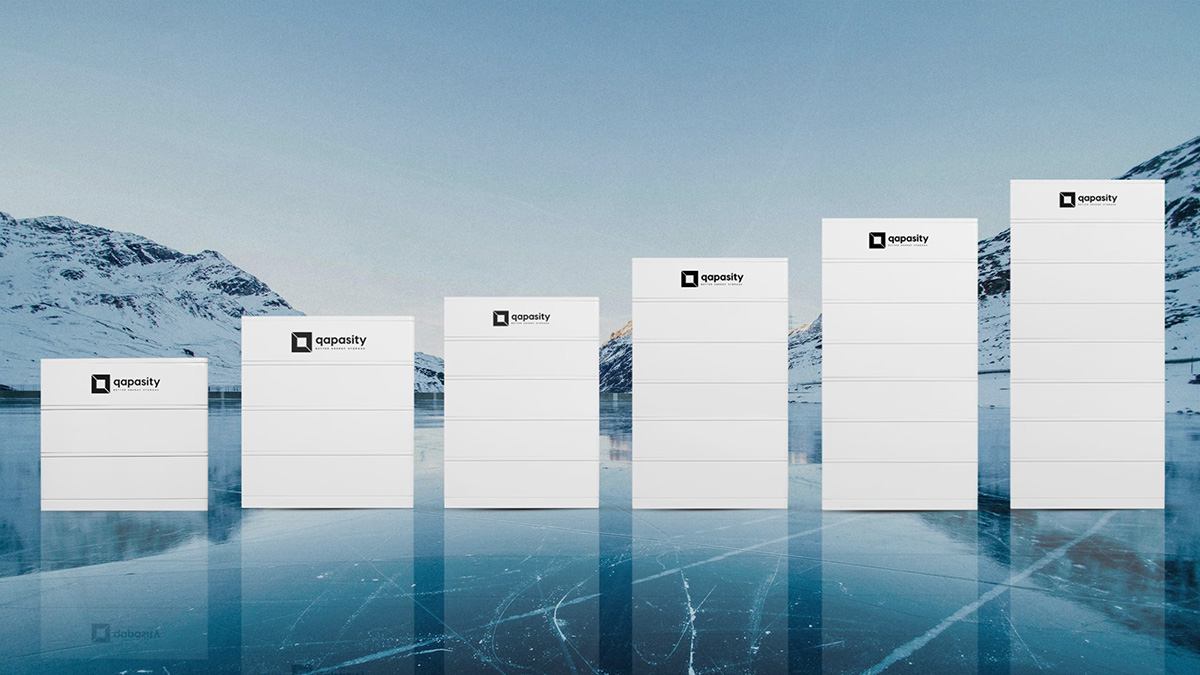
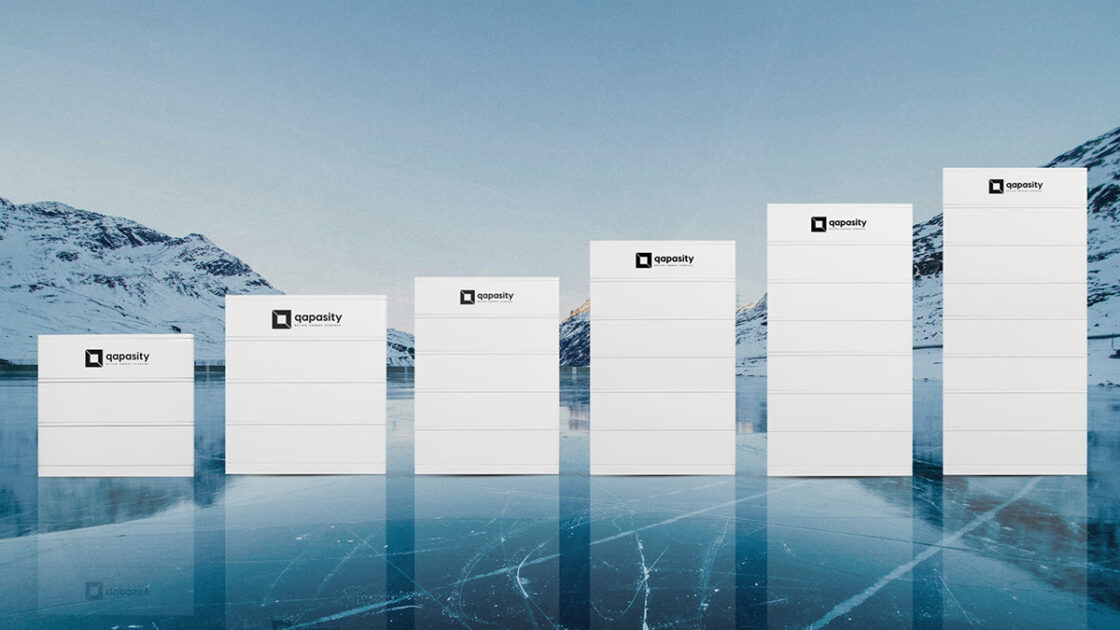
One example is our own Qapasity brand, with hundreds of semi-solid-state technology batteries installed to date. They combine the market’s highest level of safety with outstanding performance in cold climates. In addition, Qapasity can be installed in larger systems than several competitors, in line with the new BBR regulations.
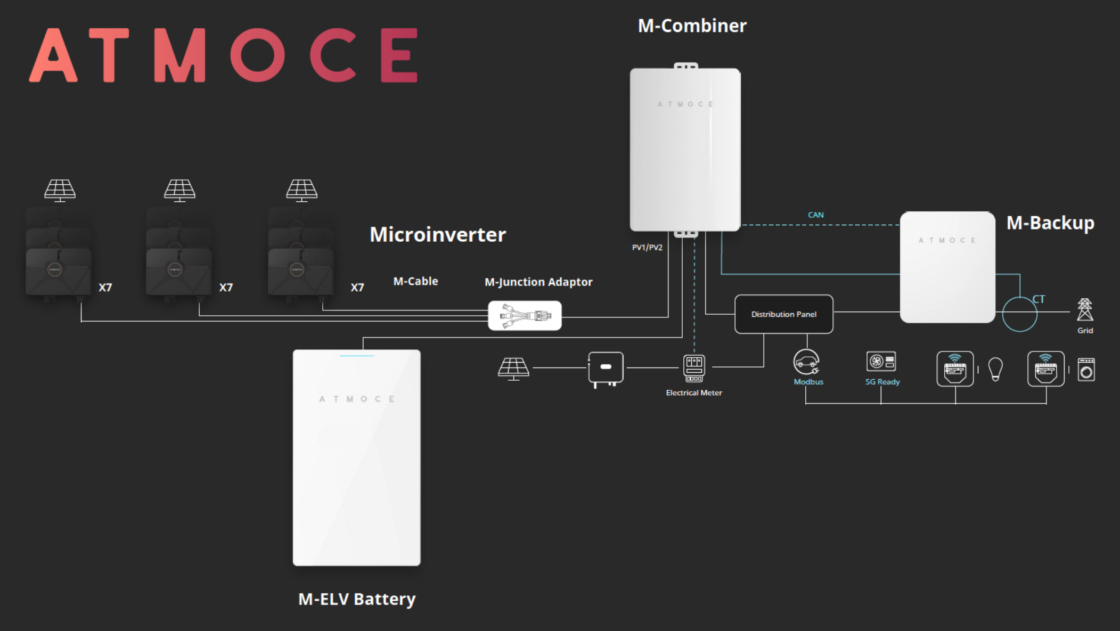
Another example is our strengthened collaboration with Atmoce, where Senergia has worked exclusively to establish its microinverters and world-leading low-voltage batteries in the Nordic market. It is a partnership built on a clear model: if one party succeeds, so does the other. These kinds of long-term, mutually beneficial relationships are at the heart of how we want to build Senergia’s future.
What needs to happen next in the industry?
Clear policies
This is an election year. Energy policy is high on the agenda, but the debate is almost entirely about nuclear power – or subsidies for it. It is much less clear where solar energy actually fits into policymakers’ plans.
The potential for solar energy in Sweden is significant. Assessments indicate that solar energy could realistically account for at least 10% of Sweden’s electricity consumption by 2035 and around 15% by 2045, given the right conditions [5–7]. At the same time, the industry’s fortunes currently depend on the green tax deduction, particularly for batteries.
My personal preference would be to adjust the deduction rates for both batteries and solar installations to 30%. If designed appropriately, this level could both reduce incentives for fraud and simplify administration for the Swedish Tax Agency, while creating more predictable rules for industry players.
The industry must find the keys to profitability
Without profitability, many end customers will have no one to turn to for support, warranty issues or complaints. The long-term credibility of solar energy rests on customers feeling confident throughout the system’s entire lifespan – not just at the time of installation.
Profitability will also become an increasingly clear requirement from banks, funds and credit institutions when it comes to credit lines for suppliers and access to capital. Private equity firms, venture capital funds and other investors will gradually shift their focus from pure revenue growth to sustainable profitability.
For the industry to continue attracting capital – and therefore to be able to grow – it must get its finances in order. This means sound pricing, professional project management, realistic estimates and a willingness to say no to deals that are not viable.
What does the incoming CEO believe about the future?
Despite all the challenges, my conviction remains unshaken: solar energy has a bright future. Solar energy is already the world’s fastest-growing energy source, and batteries are being installed at a rapid pace alongside it [1–3]. Both solar panels and energy storage have fallen dramatically in cost over the past decade [1–3].
What began as an environmental and climate-driven issue has increasingly become a matter of security policy, energy sovereignty and breaking free from dependence on fossil fuels. The arguments have shifted—but the conclusion is the same: we need more clean, domestic energy.
The macro factors all point in the same direction. Sweden will need more electricity for the electrification of the transport sector, the transformation of industry (for example, fossil-free steel and cement), the production of electrofuels for industry, aviation and heavy transport, and the very rapid expansion of data centres.
Today, Sweden exports around 40 TWh of electricity annually. Within just a few years, we could well be back to being a net importer unless the expansion of new electricity generation accelerates.
Although the political debate is currently dominated by nuclear power, we must face the realities. Large parts of Sweden’s existing reactors—six in operation with a capacity of around 6 GW—will need to be phased out or undergo extensive lifetime extensions over the coming decades. The proposed new SMR reactors that are often discussed currently represent only around 2.4 GW of planned capacity [2]. The gap between them cannot be filled by nuclear power alone.
This is where solar energy, together with wind power, energy storage and flexibility solutions, plays a crucial role. We need an electricity system that is robust, diversified and scalable. Solar energy can be built quickly, close to centres of demand and on a large scale—from villa rooftops to large ground-mounted installations.
As incoming CEO of Senergia, I believe in an industry that, despite the setbacks, will emerge stronger and more professional. We will see fewer players, but more competent ones. Fewer castles in the air, but more sustainable business models. Fewer unrealistic promises, but more satisfied customers.
Senergia will continue to be a partner driving that development—through training, digitalisation, financial discipline and an uncompromising focus on quality. The sun does not stop shining because the economy slows. Our task is to ensure that the energy reaching our roofs and façades is harnessed in a way that is profitable, secure and sustainable—for everyone involved
References
[1] International Energy Agency. World Energy Outlook 2025. Paris: IEA; 2025. [2] International Energy Agency. Electricity Market Report 2025. Paris: IEA; 2025. [3] BloombergNEF. New Energy Outlook 2025. London: BloombergNEF; 2025. [4] Ferroamp. Interim Report Q1 2026. Stockholm: Ferroamp AB; 2026. [5] Svensk Solenergi. Statistics on solar panel installations in Sweden 2023–2026. Stockholm: Svensk Solenergi; 2026. [6] Energimyndigheten. Statistics on grid-connected solar panel installations 2020–2026. Eskilstuna: Energimyndigheten; 2026. [7] Grow Sverige. Solar energy in Sweden – current situation and developments 2025–2026. Stockholm: Grow Sverige; 2026.Need help finding the right option?
We know it isn't always easy to know which product or solution is best for you. Whether you have questions about our range, need guidance or would like help finding a solution that suits your specific needs, we're here for you. With our knowledge and experience, we can help you make the right choice.
Related posts
Senergia gains a long-term, financially strong principal owner.
Senergia becomes ATMOCE’s exclusive distributor in Sweden