



Solar Market 2025 Year in Review and 2026 Trends Outlook
Introduction
The 2025 solar year has come to an end, and in this review we summarise the year. It was not the recovery many had hoped for after the turbulent period of extremely high electricity prices, pandemic effects and soaring material costs. Instead, the market continued to decline, with the slowdown reaching -40% in the number of connected systems compared with the previous year. But from my solar perspective, 2025 was still an important year – a year in which the industry continued to mature, business models became established, and batteries took over as the most important product for our customers.
The solar industry is still suffering from a “hangover” following the record years up to 2023 (and part of 2024). During that time, the industry doubled in size every year, and the influx of both customers and new installers in the Swedish solar energy market seemed limitless. Payback calculations based on making money, selling kWh and profiting from the ancillary services market generated forecasts that were not just too good to be true. They are now taking their toll on the industry, damaging perceptions of the industry as a whole.
Political debate continues to focus on different forms of power generation (or almost exclusively on one: nuclear power). Politicians have completely lost momentum on the green transition, while the global energy transition continues. 2025 will be another record year, but Sweden is falling behind.
At the same time, more support schemes for solar energy are being phased out. From 1 January 2026, the so-called 60-öre subsidy will be abolished, meaning that people will no longer be overpaid for selling and exporting electricity to the grid. Solar energy will instead be treated more like other forms of power generation in the market. This makes batteries and self-consumption even more profitable and a clearer part of how to achieve the best possible system economics.
The solar energy industry never ceases to surprise. It is constantly changing, and the English expression “The Solar Coaster” is a fantastic description of an industry that is constantly shifting, evolving and springing surprises. 2025 was no exception!
2025 in review
Looking back at 2025, we see that the number of solar PV installations in Sweden continued to increase, but with a clear change in character. The rate of growth slowed compared with the most intense years, but installed capacity continued to grow and solar PV cemented its role as an established part of Sweden’s energy mix. Solar power now totals around 5 GW and accounts for around 3% of our energy mix.
The segments moved in different directions. The residential market was more cautious than during the record years, under pressure from low GDP growth, high unemployment and low electricity prices. At the same time, interest grew in adding batteries and smart controls to existing solar PV installations – the retrofit market became an increasingly important driver for the industry.
On the commercial side, clear changes were apparent, with new solar PV installations slowing despite record-low prices for solar panels and batteries. In the run-up to 2026, China, which accounts for around 95% of global production, will reduce its export rebate, driving prices up. The government has begun manipulating prices in the solar PV market, in a similar way to OPEC, so as not to put further pressure on Chinese producers, who are selling below production cost.
Looking at the number of solar PV installations year by year, we can clearly see the enormous boom in the solar PV market and the growth in 2022 and 2023, followed by the ‘backlash’ that hit the industry in 2024 and continued in 2025. Preliminary market figures for 2025 show that around 25,000 solar PV installations have been connected to the Swedish electricity system.
| Year | Number of installations | Change (number) | Change (%) |
|---|---|---|---|
| 2021 | 26 539 | – | – |
| 2022 | 55 329 | 28 790 | 108% |
| 2023 | 103 939 | 48 610 | 88% |
| 2024 | 41 395 | −62 544 | −60% |
| 2025e | 25 000 | −16 395 | −40% |
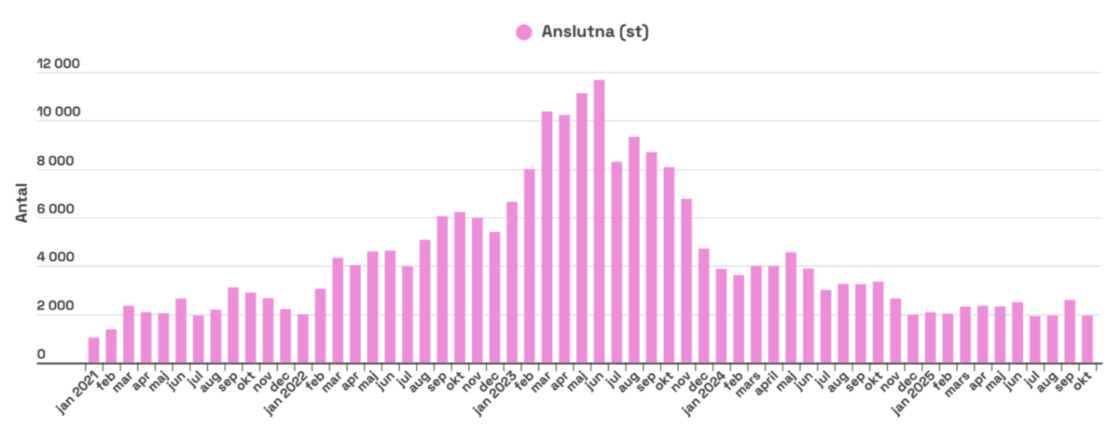
Looking at connected solar installations over time, we can see that the installation rate has more or less remained constant over the past 12–14 months. This is at a level of 2,000 connections per month, giving an annual volume of around the figure mentioned in the table above, approximately 25,000.
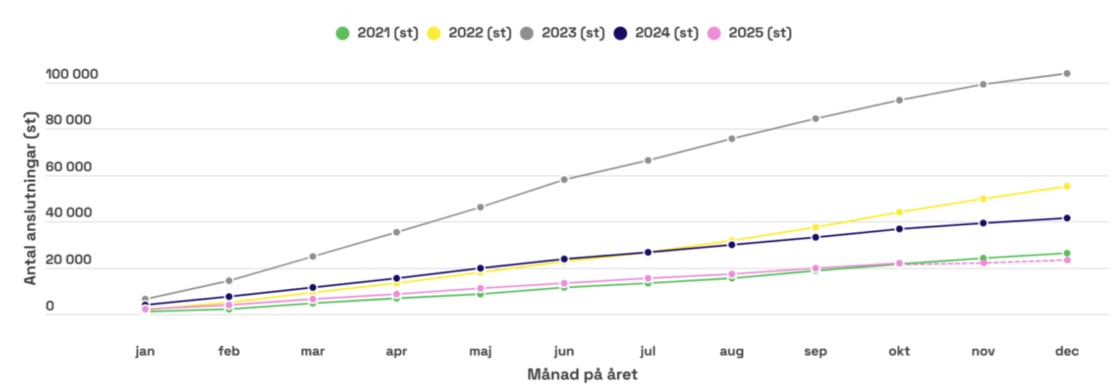
Looking at the data on the number of connections and comparing different years, we can see that 2025 is marginally worse than 2021, while the record year of 2023 naturally stands out.
At the same time, it is impossible to ignore the fact that conditions in the industry were difficult for many players in 2025. Affärsvärlden describes how a clear wave of bankruptcies has swept through the solar segment as demand has returned to normal and margins have come under pressure, with more and more companies unable to cope with the combination of lower volumes, higher interest rates and tougher competition [5]. Several reviews of solar companies that went bankrupt in 2025 make it clear that the industry is undergoing not only a technological transition, but also a structural shake-out in which weak business models are being eliminated.
| Year | Number of installations | Change (number) | Change (%) |
|---|---|---|---|
| 2021 | 26 539 | – | – |
| 2022 | 55 329 | 28 790 | 108% |
| 2023 | 103 939 | 48 610 | 88% |
| 2024 | 41 395 | −62 544 | −60% |
| 2025e | 25 000 | −16 395 | −40% |
For customers, this means a greater need to choose stable, long-term suppliers—and for those of us in the industry, a reminder that sustainability is also about economics and business discipline, not just kilowatt-hours and amperes.
Key milestones & events in 2025
Several things stood out during the year:
The aftermarket came to the fore.
A large part of the business shifted from new installations to upgrades. Batteries, new inverters and connected EMS systems were installed in existing solar PV systems. For installers, this meant new revenue streams, closer customer relationships and greater technical complexity. Adding battery installations to their existing customer base became the industry's most important source of revenue in 2025.
Customers became more knowledgeable.
Where conversations had previously often revolved around “How quickly will I make my money back?”, customers in 2025 asked about load curves, power charges, future electricity grid regulations, VPP revenues and cyber security. This placed high demands on those of us in the industry – anyone unable to explain the whole picture risks being left out of the business. Being an installer is now a much more complex business, as you are more likely to become the customer's smart home consultant than a solar panel installer.
Technology took a step forward.
New generations of batteries, inverters and EMS made it easier to control energy flows, optimise for both price and climate benefits, and prepare systems for aggregation in virtual power plants. Cloud-based platforms, more open APIs and better data made it possible to build solutions that would have required bespoke systems just a few years ago.
Battery prices continued to fall.
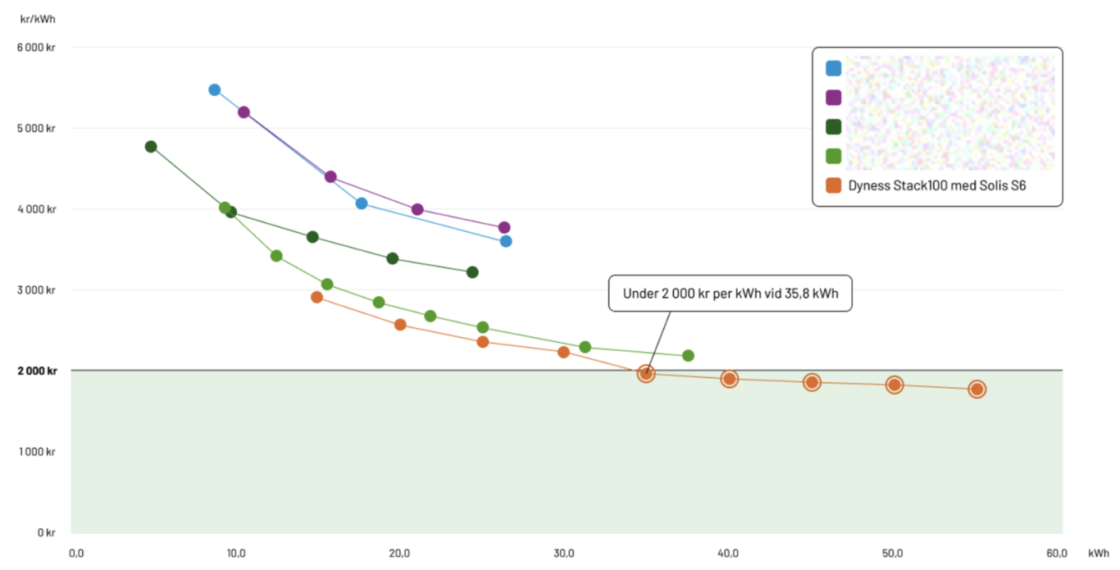
When Senergia's customer benchmarked the battery market, we were able to conclude that, through our suppliers Solis and Dyness, we offer the most cost-effective system on the market. Combined with a strong launch of external EMS systems such as Enequi and Tibber, our packages became very attractive to installers and end customers. What we are seeing now is that battery prices have fallen below the magic threshold of SEK 2,000/kWh, with the price also including a new inverter and installation (including VAT). The graph shows two important trends:
- The cheapest battery systems have now become so affordable that, in absolute terms, a 15 kWh battery costs approximately SEK 45,000.
- The largest systems are growing thanks to a lower cost per kWh. This means systems are increasing in size, and the average battery today is between 20 and 30 kWh and will grow in the future
Weather vane for 2026 – tailwinds and headwinds
As we look ahead to 2026, it is clear that the industry is caught between powerful tailwinds and significant headwinds.
On the plus side, the green tax deduction is staying in place, at 50% for batteries and 15% for solar panels in 2026. This provides predictability, which customers value highly, and means that the financial case for batteries is often far more attractive than it was just a few years ago. Together with a strong retrofit market, this means that many homeowners and property owners who already have solar panels now see an opportunity to take the next step and add energy storage and more advanced control systems. Homeowners should give serious thought to whether they believe the subsidy will last forever or be phased out (yes, this subsidy is on its last legs, and personally I expect the support level to be 30% in 2027, or for battery support to be phased out entirely).
Another clear strength is the high level of technical expertise in Sweden’s solar and battery industry. Installers, wholesalers and system suppliers are moving rapidly up the learning curve – from “putting up panels” to designing complete energy systems. This is particularly evident in the growing interest in EMS (Energy Management Systems) and VPP (Virtual Power Plants), where many players are now beginning to understand the business models behind flexibility, ancillary services and aggregation.
What works against VPPs and ancillary services is that grid operators lack models for integrating batteries into their grids, as they penalise batteries with demand tariffs when they seek to participate in ancillary services markets and support the Nordic electricity system. This kind of “giving with one hand and taking with the other” is something that the many solar and battery owners will not accept, and it is suboptimal from the perspectives of society and grid utilisation.
At the same time, the headwinds are real. Low GDP growth, a slow pace of new construction and high unemployment directly affect willingness to invest, on both the consumer and business sides. Low energy prices dampen the sense of urgency – electricity bills are no longer as frightening as they were during the crisis years – and the high savings rate means that many households choose to “sit tight” rather than make major investments.
On top of this come the substantially increased charges from El-Kretsen on batteries, which take effect from 1 January 2026. These will worsen the financial case for energy storage unless hardware prices continue to fall at the same rate. The charges hit larger systems and commercial installations particularly hard, where battery volumes are significant, and risk holding back expansion plans and delaying investments [4].
Add to this the fact that important EU regulations such as EPBD are not expected to have their full effect until around 2027. This means that some of the powerful long-term drivers – requirements for energy efficiency, renewable energy in buildings and improved property ratings – are still a few years away. 2026 therefore risks becoming yet another “in-between year”, in which those willing to think long term establish a position while more short-term players choose to wait.
To me, the conclusion is clear: compared with the price-driven market of recent years, 2026 will be more about strategy than panic. Those who can combine technical expertise, financial understanding and good advice will be in a strong position – despite the macroeconomic headwinds.
Trends for 2026
Open architecture becomes the standard, not the exception
One of the biggest trends heading into 2026 is the move towards open systems connecting inverters, batteries and EMS. Instead of locked, proprietary ecosystems, we are now seeing inverters and batteries designed to communicate with each other via open interfaces and standardised protocols.
In an article on Senergia’s technology blog, I described how solar energy systems with open architecture give installers much greater freedom to combine inverters, batteries and control systems to create the solution that best meets the customer’s needs [1]. This development is accelerating in 2026. Installers want to be able to choose the right battery for the right application – backup, peak shaving, ancillary services, V2X, etc. – without being locked into an ecosystem where every component has to come from the same manufacturer.
For the end user, this means better future-proofing. An open system can be expanded, upgraded and integrated with new services, rather than having to be replaced in its entirety when needs change. Above all, it means a system that does not lock in the customer.
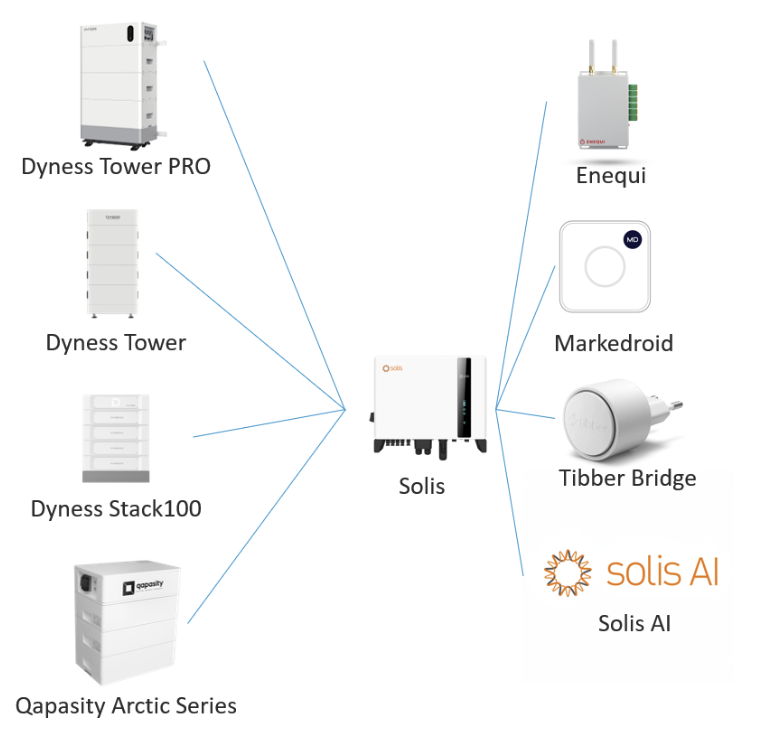
A concrete example of the power of open architecture is how Tibber Bridge has quickly become an extremely popular solution for making batteries smart. By connecting EV charging, battery management and heating control with ancillary services such as Grid Rewards, households can make full use of their flexibility while also getting paid to help the system. In practice, this means that the same open interface that gives installers freedom also allows end customers to combine comfort, lower costs and new revenue streams in a single ecosystem.
Profitability and quality as a matter of survival
2026 will also be the year when the industry is forced to take a step back and seriously reconsider its approach to profitability and quality. The growth-at-any-cost mindset of recent years is no longer defensible. There will be a cost—in the form of companies disappearing, consolidation and a painful culling of players unable to deliver sustainable profitability. At the same time, this is absolutely essential if the solar and battery industry is to be healthy in the long term. Entrepreneurship, business operations and commercial acumen must become more long-term, more professional and more firmly rooted in sound margins, robust delivery commitments and high quality at every stage.
EMS and VPP move to the cloud
The next clear trend is that EMS and VPP solutions are increasingly moving to the cloud. Local controls will remain—not least to ensure safe operation if the connection is lost—but intelligence, analysis and optimisation are increasingly taking place on cloud-based platforms.
This opens the door to a whole new generation of energy services: dynamic optimisation based on hourly electricity prices and power demand, aggregated ancillary services, smart EV charging and coordination between multiple properties or installations [2]. For installers, this means closer collaboration with software providers and energy service companies; for customers, it means that “solar panels with a battery” become a connected energy service rather than a standalone product.
Batteries reach the dream threshold of under SEK 2,000/kWh
Battery prices continue to fall, and in 2026 we will see market-leading solutions genuinely dip below the psychologically important threshold of SEK 2,000/kWh at system level. In an earlier comparison, I showed how Senergia’s batteries had already stood out as among the cheapest in their class, and that trend continues downwards as volumes increase and manufacturing supply chains become more efficient [3].
Getting below SEK 2,000/kWh does more than just improve the figures—it shifts batteries from “nice to have” to a necessity, and today batteries are installed in 99% of all residential systems. With the 50% tax deduction for batteries added to falling prices, it becomes difficult to argue against at least preparing for energy storage in every new installation.
The batteries of the future are knocking at the door
While today’s lithium iron phosphate (LFP) batteries dominate the market, next-generation technologies are beginning to make an entrance. Semi-solid-state solutions, such as those from qapasity, are a clear example of how the technology is advancing.
Semi-solid-state technology has several advantages:
- Greater safety, as the semi-solid electrolyte reduces the risk of leakage and thermal runaway compared with conventional liquid electrolytes.
- Better temperature performance, with cells able to operate more reliably across a wider temperature range—particularly relevant in the Nordic climate, with its considerable temperature variations.
- Potentially higher energy density, which could eventually provide more stored energy per installed square metre or per kilogram—important both for cramped plant rooms in buildings and for mobile applications.
2026 is unlikely to be the year semi-solid-state technology takes over the market, but it will be the year the technology moves from “talk of the future” to becoming firmly established in both small and large systems.
V2X starts to become a reality
Another clearly emerging trend is V2X—the ability to use an electric car as an active part of the energy system. So far, much of the discussion has focused on its potential, but 2026 could be the year V2X moves from PowerPoint to practice.
Ferroamp’s V2X-ready chargers began to be delivered to the market on a small scale in 2025, providing the first concrete experience of how vehicles can be integrated into a building’s energy system and, in time, into VPP solutions. The combination of solar panels, batteries, EMS and V2X creates a whole new kind of flexibility in which the car is not just a load, but also a resource.
As both hardware and regulations gradually mature, property owners, businesses and individuals will have the opportunity to use their electric cars for peak shaving, backup power and ancillary services. 2026 could therefore very well be the year V2X stops being a concept of the future and instead becomes a concrete part of the energy strategy for the most forward-looking players
2025 for Senergia
When a large part of the market disappeared in 2024, Senergia changed its strategy, both in terms of products and internally. At the beginning of 2025, Senergia launched inverters from the world’s third-largest inverter manufacturer, Solis, and batteries from Dyness. This was a deliberate strategy to move towards an open architecture for batteries and EMS, and to build a flexible ecosystem for us, our customers and our end customers. We integrated Dyness batteries with Ferroamp and drove down system costs through economies of scale. In the spring, SAJ launched its new All-in-one HS3, and success soon followed. After the summer, we launched qapasity with semi-solid-state batteries, creating new offerings for our customers that give them a competitive advantage.
We consolidated our solar panel range. When 2026 begins, you’ll be able to count all of Senergia’s different solar panels in stock on one hand. This is a deliberate strategy to make things simpler for you as a customer and to maintain stable stock levels for our bestsellers.
Internally, Senergia strengthened its position, with more people in customer-facing roles, more field sales representatives and an increased presence with our customers. We strongly believe in being physically present and visiting our customers in person for a cup of coffee. This not only builds relationships but also gives us the opportunity to demonstrate both technology and expertise.
Senergia’s second area of focus during the year was our technical support, which continues to maintain a very high standard. Today, you can both chat with and call the support team, and we act as first-line support for our customers when they need help or assistance with their business. We see many others scaling this back, leaving installers stranded.
During the year, Senergia launched an enhanced version of its digital design tool, Senergia Planner. Installers can now do all their calculations in one place and order complete systems without missing a single screw, with all documentation included. Digitalisation is something we will continue to develop. We have more exciting news on the way!
We also changed warehouse premises during the year. The move took place during some very busy weeks for the sales team, but was completed without any impact on our customers. We remain in Jönköping and now have an even better-equipped warehouse, with more new opportunities for our logistics services for you as a customer.
Senergia strengthened its position during 2025, both as a source of knowledge in the industry and as a service organisation. Today, half of Senergia’s employees work in customer-facing roles in sales, technical support, e-commerce and supply chain. We continue to believe in meeting customers in person and in staying close to installers in the market.
Concluding remarks
2026 looks set to be the year when the systems perspective truly takes hold. Solar panels are no longer the star of the show on their own – they now share the limelight with batteries, EMS, VPP and V2X.
Macroeconomic headwinds, low electricity prices and tardy EU regulations mean that the market will not take off by itself. But it is precisely in situations like this that the long-term winners emerge. Customers who dare to invest strategically, and players who take on the role of knowledge carriers and system partners, are laying the foundations for the next major wave of expansion.
Personally, my feeling after the 2025 solar year is a mixture of humility and optimism. The industry is more complex than ever, but also more exciting. We no longer just provide renewable energy – we are building flexibility, resilience and intelligence into the energy system.
And when we look back in a few years, I believe we will see 2025–2026 as the period when solar panels went from product to platform. A platform for energy services, new business models and an electricity system that can actually handle both electrification and climate targets. That is the journey I want to help drive forward.
About the author:
Tim Ljunggren is one of the founders of Senergia. He is a qualified Master of Science in Engineering in electrical power engineering from KTH and holds a bachelor's degree in economics from SU. Tim is a frequent speaker and trainer in the industry and has written two handbooks. During 2022–2024, he served on Svensk Solenergi's Technical Committee and was elected to the board of the industry association Svensk Solenergi in 2024.
References
[1] Ljunggren T. Solar energy systems with open architecture – the flexible energy solution of the future. Senergia Technical Blog. Read more here [2] Ljunggren T. Comparison of EMS – control for the energy systems of the future. Senergia Technical Blog. Read more here [3] Ljunggren T. Senergia’s batteries named the cheapest. LinkedIn. Read more here [4] Senergia. El-Kretsen introduces new charges for batteries. Read more here [5] Sandström J. Dark clouds for solar panels – wave of bankruptcies gathering pace. Affärsvärlden. Read more hereNeed help finding the right option?
We know it isn’t always easy to know which product or solution is the best fit. Whether you have questions about our range, need guidance or would like help finding a solution that suits your specific needs, we’re here for you. With our knowledge and experience, we’ll help you make the right choice.
Related posts
Senergia gains a long-term, financially strong principal owner.

Senergia’s incoming CEO Tim Ljunggren – This is where the energy industry of the future is being shaped