

Politics and Policy
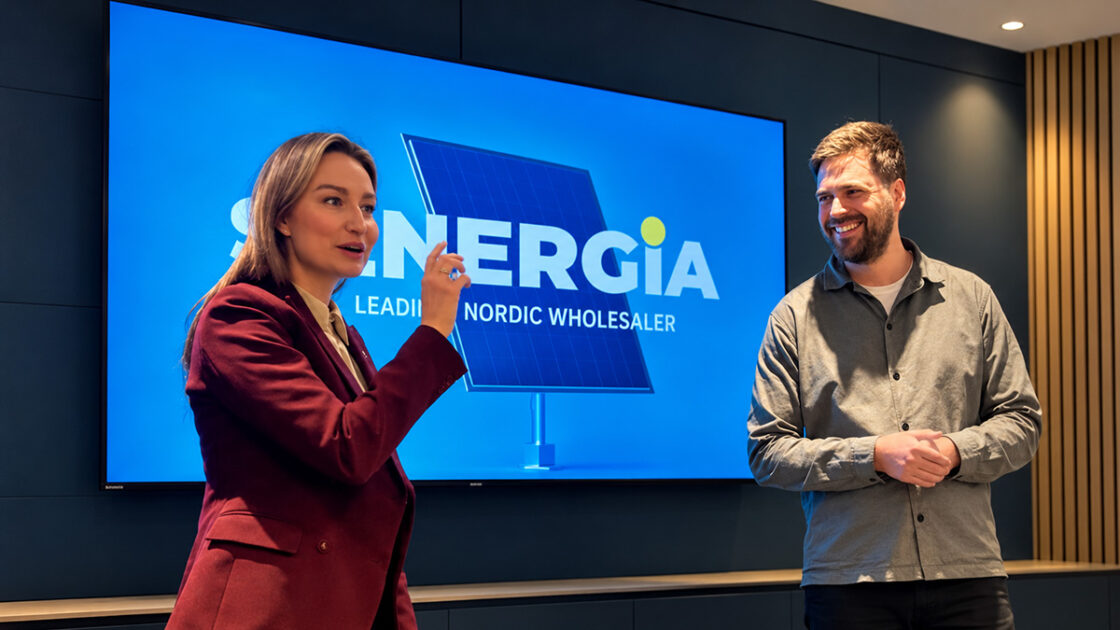
Open letter to the Deputy Prime Minister and Minister for Energy, Ebba Busch.
Hi Ebba, you may not remember me? But we met the other year and had the opportunity to discuss energy policy in general and solar energy policy in particular. I’ll be honest: it wasn’t at all like it is on TV, and you offered sharp analysis, strong rhetoric and showed a great understanding of the energy system as a whole. But party politics, the influence of the Tidö parties and the debate that follows are more concerned with individual types of energy generation than with a systems perspective.
In this open letter, I want to share my view of what needs to be done, particularly in green investment, so that Sweden plc can retain jobs and competitiveness in the future, while also laying the foundations for the electrification and green industrialisation of the 21st century. We must seriously consider what we will do for a living in Sweden in the years ahead. What work will we do? What goods and services can we compete globally with? The world around us, with the US at one end and China at the other, is becoming increasingly self-centred and trying to optimise what is best for themselves. Not for all the citizens of planet Earth. I believe in open trade, free competition and solidarity (with both people and the environment). As a country, we in Sweden must drive the green transition forward. This isn’t even about the environment. It’s about the jobs of the future, Sweden’s competitiveness and our jobs.
Looking back on the energy year 2024, it was a year in which Swedish industry and international investors gave way to the government’s ambition to favour fossil fuels and uranium. This has led to investment being halted, and numerous projects that would have driven the green transition forward have now been brought to a complete stop. For homeowners, this has mainly been felt through the scrapping of the fuel emissions reduction requirement, resulting in lower fossil fuel prices, and the abolition of support for electric cars. As Tomas Kåberger writes (LINK), the Government has managed the feat of increasing the tax on Swedish-produced carbon-free electricity from 36 öre/kWh to 42.8 öre/kWh, while over the same period cutting diesel tax from 44 öre/kWh to 41.9 öre/kWh. Surely it cannot be the Swedish government’s intention to tax Swedish renewable energy more heavily than Russian diesel?
The many wind power projects cancelled in 2024 will have a knock-on effect and affect Sweden as an industrial nation for many years to come. The energy they would have supplied is now putting fuel plants, fossil-free steel and battery factories at risk. These are investments that require large quantities of cheap, renewable energy.
Although I have spent my entire professional life working in the solar energy industry, I am no solar energy fundamentalist. Solar energy has a role to play in the energy system, but it is far from everything. Of course, we need an energy system that supplies electricity at all hours of the day, provides power when industry needs it and does so at competitive prices. The enormous expansion of renewables in general, and solar energy in particular, is not driven by environmental considerations; today it is driven by the fact that solar energy is the cheapest type of energy generation, and is scaling exponentially. We must completely change how we view the energy system. The old adage about running the washing machine at night is very likely to become irrelevant when, in the future, we are awash with cheap electricity from the sun during the day. One of the most eye-opening features I’ve seen on this subject is in this video (LINK) from RethinkX, where they describe the trends in solar, wind and batteries. It is remarkable to see how fundamentally we must change both how we produce electricity and how it is consumed if we are to succeed in the transition to renewables.
Solar energy in Sweden could account for 15% of electricity demand. That would mean around 30 TWh in 2023 and 45 TWh in 2045. Today, the figure is 4 TWh, having essentially grown from 0 to 4 in about four years. There are reports (LINK) showing that the potential for solar energy on façades and rooftops amounts to 50 TWh of solar electricity. The potential on land is even greater. If we used 0.1% of Sweden’s total area (40 million hectares of land), 30 TWh could be generated. If we can set aside more land, generation from ground-mounted installations alone could easily exceed 100 TWh. The conditions for solar energy in Sweden are just as good as in Germany, where solar energy already makes up 13% of the energy mix.
At school, I was taught that “when battery prices fall below 100 USD/kWh, we will see an electrification we could never have dreamed of”. This includes both the electrification of the transport sector and stationary energy storage to support the electricity grid. Today, battery cell prices are around 50 USD/kWh. The prices we are seeing for energy storage will only continue to fall as technology and manufacturing methods improve.
What needs to be done going forward, and what needs to change? The solar energy industry needs clearer rules of the game.
This is not about favouring one type of energy generation over another; quite the opposite. Let the different types compete against each other in an open market on equal terms. The industry also needs long-term stability. It is impossible for entrepreneurs and companies to plan their strategies for the future if politicians keep changing the rules of the game. Examples from just the past few years include:
- Replacing the 30% solar panel grant with a tax deduction (green technology) of 20%.
- The Government proposes reducing the green technology deduction from 20% to 15% (from mid-2025).
- The Government intends to remove the 60-öre deduction at the end of December 2025.
- The Swedish Tax Agency denied green technology deductions for batteries from January 2024 to June 2024.
Green technology
A clear, multi-year plan for green technology is needed.
How long does the Government intend to continue green technology support for private households?
| 2025 | 2026 | 2027 | 2028 | 2029 | 2030 | |
|---|---|---|---|---|---|---|
| Green technology, solar panels | 15% | 30% | 30% | 20% | 10% | 0% |
| Green technology, energy storage | 50% | 30% | 30% | 20% | 10% | 0% |
Proposal 1: Set out a clear plan for phasing out the green technology tax deduction by 2030.
Proposal 2: Harmonise the percentages so that no fraud can occur.
Proposal 3: Allow the green technology tax deduction to apply to a battery installation without solar panels installed.
Proposal 4: Offer additional support if the battery system includes support for island mode/off-grid operation.
Proposal 5: Future-proof support for electric vehicle charging by incorporating Vehicle to Grid functionality, and harmonise the percentages with those for solar panels and battery storage.
The grid issue
In a previous opinion piece (LINK), I listed 7 points to enable grid owners to connect more solar energy to the electricity grid and make better use of the infrastructure we already have:
- Dimensioning solar energy systems (DC/AC ratio)
- Dynamic export limitation & sharing grid capacity fairly
- Install a battery
- Implement a local EMS in the distribution transformer (dynamic export to the transformer station)
- Increase self-consumption with the help of smart controls
- Conditional subscriptions
- Implement energy communities
If the grid issue can be resolved, it would enable a fairer way of sharing and allow the electricity grid to be used even more efficiently. It would also reduce the need for investment in the grid and result in an energy system that is more beneficial to society and cost-effective. A system that is also more resilient thanks to being distributed and containing more energy storage.
Proposal 6: Develop national guidelines for conditional subscriptions. These agreements allow customers to use the transmission capacity that is available most of the time, while limiting usage during the hours when the electricity grid is under the greatest strain.
Proposal 7: Simplify the connection process for both small and large solar installations. Ensure that the regulations are implemented in a way that avoids unnecessary grid upgrades and unreasonable costs being imposed on those who want to invest in renewable energy (LINK).
Proposal 8: Require grid companies to report on flexibility solutions every time they receive a connection request, not only when there is a capacity shortage. (Source: LINK)
Proposal 9: Introduce capacity maps to show transparently where spare capacity is available in the grid (Source: LINK).
Proposal 10: Adjust revenue frameworks to make flexibility solutions more profitable for grid companies (Source: LINK).
Proposal 11: Increase the resources available to the Swedish Energy Markets Inspectorate to ensure that flexibility is always assessed before costly grid expansion (Source: LINK)
The proposals would require grid companies to make more efficient use of the electricity grid using modern technology as a first priority. They would also enable a more flexible and sustainable electricity system. The key is flexibility, for both producers and consumers.
Tariffs
Electricity network tariffs need to be harmonised. They should provide network operators with enough revenue to cover their costs, while giving network customers both reasonable prices and incentives to use the network efficiently. There are currently around 150 electricity network operators, each interpreting the Electricity Act and the Swedish Energy Markets Inspectorate’s guidelines in its own way. This makes things difficult not only for private individuals who have one tariff for their house and another for their holiday home. It also makes things difficult for service providers, for example those involved in controlling energy storage, who have to build unique models for every unique set of tariffs.
Proposal 12: Design tariffs to enable the use of large amounts of energy when it is available, while making the best possible use of the electricity network through capacity-based tariffs. Ensure that future tariffs enable smart use of electric vehicle charging, energy storage and solar power. Ask the Swedish Energy Markets Inspectorate to investigate the possibility of introducing a two-tariff system that offers lower transmission charges for electricity produced and consumed locally. This would further strengthen the incentives for local electricity production and consumption (LINK).
Proposal 13: Enable local use of electricity when there is a surplus, without penalising the user. It is both unreasonable and unnecessary for transmission charges, capacity tariffs, etc. to be extremely high when there is a local surplus of renewable energy—energy that may not even be used because of how the tariffs are designed.
Proposal 14: Harmonise the way tariffs are designed through clearer laws and guidelines. At the same time, ensure that flexible users who use the network when electricity is plentiful are not penalised, and that usage at inconvenient times is not penalised either.
Proposal 15: Digitalise the electricity network using open technology (for example, LF Energy – LINK) and require network operators to follow standardised protocols via an API (LINK & LINK) that represents all tariffs.
Today’s tariffs are too static and analogue (“non-digital”). Consumers receive too weak a price signal to adapt their behaviour in ways that are best for the system (and should be most beneficial to society as a whole). With the smart systems of the future, using HEMS (home energy management systems, or smart home systems), algorithms rather than people will control how electricity is used in a property. As properties of the future will have electric vehicles, stationary energy storage and solar power, there will be more opportunities than today to be a flexible electricity user without compromising one’s standard of living.
Batteries
Batteries are the Swiss Army knife of the electricity system: they can provide a wide range of services and be a resource for the system. Today, there are tens of thousands of small home batteries, and larger commercial batteries are also being installed at a rapid pace. There is currently around 1,000 MW of battery capacity—equivalent to a nuclear reactor. These batteries can help smooth electricity prices, support the frequency of the Nordic electricity system and increase the utilisation rate of the electricity grid.
The electricity system must be dimensioned to meet peak demand. This means the entire system is designed to cope with the roughly 100 hours each year when it is under heavy strain. Studies show that, over time, the electricity system is used on average at only around 10% of its maximum capacity. Expanding grid capacity is expensive and takes a long time. Energiforsk (LINK) has estimated that we need to invest around SEK 1,000 billion in the electricity grid by 2050. These astronomical sums are based on increasing maximum capacity. If, instead, we can reduce the load at these times by using smart technology such as smart controls and batteries, we stand to gain a great deal—both in monetary terms and in resources.
Proposal 16: Give the Swedish Energy Markets Inspectorate the task of standardising the design of local flexibility and establishing such markets in the networks of all grid operators.
Proposal 17: Prohibit grid operators from disadvantaging energy storage through charges and fees. There are currently examples of grid operators penalising owners of energy storage facilities for using their batteries to help support the electricity grid through ancillary services.
Proposal 18: Give the National Board of Housing, Building and Planning the task of developing harmonised guidelines for planning permission and fire safety regulations for solar energy installations. There is currently considerable local variation and uncertainty about how existing regulations should be interpreted. (From the Swedish Solar Energy Association’s solar energy policy programme – LINK).
Proposal 19: Remove electricity tax on battery storage. Batteries are neither a production unit nor a consumption unit, but solely a unit for intermediate storage.
Electricity tax
Electricity tax is a fiscal tax intended to raise revenue for the public purse (around SEK 32 billion in 2024). VAT is also charged on electricity tax. But regardless of the spot price, electricity tax is fixed. In 2025, electricity tax is 43.9 öre/kWh. This means that even if there is an enormous surplus of cheap electricity on the market, energy tax must always be paid by whoever uses the electricity.
Today, you pay no tax on self-consumed (self-produced) electricity if you have a solar installation of up to 500 kW. If you have a larger installation, you therefore pay tax on the electricity you produce yourself. This is just as silly as paying tax on carrots you grow yourself in your own garden. Get your act together, politicians!
Proposal 20: Reform electricity tax. Make the tax a proportion of the spot price (and remove VAT from the tax).
Proposal 21: Remove the 500 kW limit and abolish all tax on self-consumed energy behind your own meter, regardless of the size of the installation.
Proposal 22: Introduce specific tax relief for electricity produced and consumed simultaneously within energy communities, which would make them more attractive to both individuals and businesses (LINK).
Proposal 23: Facilitate co-owned electricity generation by adapting legislation so that co-owners of local solar and wind power installations can qualify for tax exemption on self-consumed electricity. This would give more people an incentive to invest in renewable energy (LINK).
Energy communities
Energy communities can be implemented in ways that make it easier for electricity grid owners to enable more solar capacity to be installed by promoting cooperation and the sharing of resources among different actors in a local area.
Proposal 24: Energy communities should be introduced as a legal organisational form in Sweden (LINK).
Proposal 25: Remove electricity tax on self-consumed electricity – allow more property owners and co-owners of solar parks to benefit from the electricity they produce themselves, without being hindered by today’s tax rules (LINK).
Proposal 26: Introduce a system of virtual connection points within properties, so that electricity can be shared between users without requiring costly alterations to the property’s electrical system. This would make energy communities more practical and financially attractive. (LINK).
Concluding remarks
If you made it through all 26 of my proposals for transforming the energy market, the energy system and the conditions for Sweden’s future competitiveness, I’m impressed. These are not just “good ideas” but opportunities for Sweden plc to emerge from the recession and invest its way into a leading position in green tech.
What would this lead to?
- Vast amounts of new TWh of renewable energy.
- Better use of our electricity grid and power system.
- Thousands of new jobs, both in the energy sector and in industry.
- The opportunity to eliminate carbon emissions in several different areas, such as:
steel production, cement production, the transport sector, biofuels, etc. - Clear rules of the game for participants in the electricity market, both grid owners and prosumers.
About me:
Tim Ljunggren is one of the founders of Senergia. He is a qualified electrical power engineer from KTH and holds a bachelor’s degree in economics from SU. Tim is a frequent speaker and trainer in the industry and has written two handbooks. From 2022 to 2024, he served on the Technical Committee of Svensk Solenergi, and in 2024 he was elected to the board of the industry association Svensk Solenergi.
Need help finding the right option?
We know it’s not always easy to know which product or solution is the best fit. Whether you have questions about our range, need guidance or want help finding a solution that suits your specific needs, we’re here for you. With our knowledge and experience, we’ll help you make the right choice.
Related posts
Senergia gains a long-term, financially strong principal owner.

Senergia’s incoming CEO Tim Ljunggren – This is where the energy industry of the future is being shaped