



New developments in China affect the price of solar panels and batteries in 2026
Introduction
Throughout 2025 and into 2026, the solar and battery market has been characterised by major market shifts, not least those linked to developments in China. In my year-in-review of the solar market in 2025 and outlook for trends in 2026, I highlighted how quickly pricing trends had changed, how overcapacity in Chinese production had squeezed margins globally, and how fierce competition was driving technological development while also creating uncertainty for manufacturers and installers.[1]
Back in September, I explored in greater depth how Sweden’s solar installers are affected by China’s new policy direction.[2] Among other things, the following points were emphasised:
- Solar panel prices fell sharply during 2023–2024, driven by overinvestment in production.
- Intense price pressure on global manufacturers, with the risk of consolidation and smaller players shutting down.
- Increased geopolitical risk, as tariffs, export restrictions and changes to subsidies in China can quickly affect European prices and supply chains.
With China’s new, clearer policy direction on tax rebates and export conditions, several of these scenarios are now beginning to materialise in practice. This will affect the price of both solar panels and batteries in 2026 – but in different ways for manufacturers, installers and end customers.
To put the timeline into perspective, the following dates are key:
- 9 January 2026: China’s Ministry of Finance and tax authorities announce that value-added tax (VAT) export tax rebates on solar and battery products are to be phased out.
- 1 April 2026: The VAT export tax rebate for solar products is abolished entirely.
- 1 April–31 December 2026: The VAT export tax rebate for battery products is reduced from 9% to 6%.
- 1 January 2027: The VAT export tax rebate for battery products is abolished entirely.
Price impact on solar panels
A key piece of the puzzle is China’s previous tax rebates linked to exports of solar components. These have helped Chinese manufacturers maintain highly competitive prices internationally. It has now been announced that export-related tax rebates on solar products will be phased out from April 2026, putting further pressure on the margins of export-oriented producers while prices for exports from China will reasonably need to rise to compensate for the lost rebates.[3,4]
In practice, this means that the extremely low prices we have seen for solar panels during 2023–2025 are likely to mark the bottom of the cycle. As subsidies are tightened, while several major Chinese manufacturers have already reported significant losses, it is becoming less sustainable to keep selling at minimal or negative margins.[4]
In addition to policy signals from China, solar panel prices are also affected by raw material prices. Aluminium is used in frames and mounting systems, silver in the cells’ conductive tracks, and copper in cabling and certain components. When prices for these metals rise, they set a floor on how cheap solar panels can become, even if cell manufacturing becomes more efficient. The sharp price falls in modules in recent years have therefore not been sustainable in the long term in relation to raw material costs, and some rebound is to be expected.[5]
At the end of 2025, Elbilsvaruhuset.se published a price comparison of several systems on the market, in which Senergia’s popular package featuring Solis and Dyness was the most cost-effective option available. Later in this post, we will see what has pushed these prices higher for 2026 and how a new price level will be established.
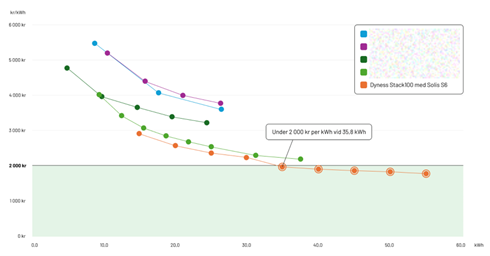
Overall, this suggests that in 2026, solar panels will move away from “sale prices” and back towards more normal margins for manufacturers. However, installers and end customers should understand that a moderate increase in panel prices does not necessarily mean that the cost of an entire solar installation will rise dramatically.
How do prices affect Swedish installers and end customers?
For a typical residential installation in Sweden today, this often means around 10–15 solar panels. The panel price is only one part of the total cost, which also includes the inverter, installation, design, travel, labour, administrative costs and sometimes supplementary control systems.
A price increase of a few per cent for solar panels—due to changes to tax rebates in China and slightly higher raw material prices—will therefore in many cases amount to just a few tens of kronor excluding VAT per panel. For an entire residential installation, this means a very limited increase in the total cost.
This should also be viewed in light of the fact that solar panel prices have fallen by around 70% over the past 36 months. After such an extreme price drop, a small rebound represents normalisation rather than a threat to the investment calculation. Solar power remains a strong proposition for end customers, while installers mainly need to keep an eye on price movements and ensure that quotes have a reasonable validity period.
Rising battery prices
Battery prices are also on the rise, but the drivers and timeframes differ somewhat from those for solar panels. In addition to China’s changed export conditions and general cost inflation, the main contributing factors are stricter recycling requirements, rising prices for lithium and other raw materials, and capacity constraints in certain parts of the value chain. Costs for BMS, certifications and transport safety are also increasing as regulatory requirements become stricter, meaning that the price increase for battery cells is significantly amplified in the finished pack. Overall, this is expected to lead to a more pronounced and faster price increase for stationary energy storage than for solar panels, particularly during 2026, when several new regulations and fee increases come into force. Two major developments in particular are affecting battery prices now, at the start of 2026.
Higher recycling fee
The new Battery Regulation and stricter recycling requirements for stationary energy storage mean, among other things, a clearly higher recycling fee, in the region of approximately SEK 200/kWh.[6] For a home battery of, for example, 10 kWh, this means an extra cost of around SEK 2,000 from this component alone. The aim is to cover the costs of collection, dismantling and recycling, and to encourage better material choices and circular flows.
Higher lithium prices
The price of lithium carbonate has risen steadily in recent months. For LFP (lithium iron phosphate) cells, the lithium raw material accounts for around 50% of the cell cost. If the price of lithium rises by approximately 50%, one can therefore roughly expect the price of a battery cell to rise by around 25%, assuming all other factors remain unchanged.
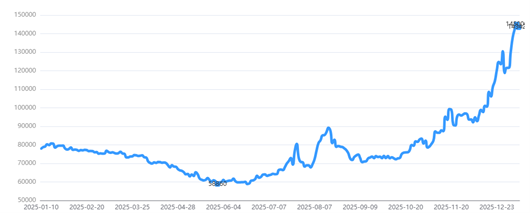
It is important to remember that the battery cell makes up most of the cost of a battery pack, but not all of it. In addition to the cells, there are costs for the casing, BMS (Battery Management System), electronics, cooling, certification, logistics, control system logic and installation. A 25% increase in costs at cell level therefore does not translate linearly into a 25% increase in the end-customer price of a complete battery pack, but it clearly pushes prices upwards.
Together, higher recycling fees and rising lithium prices mean that we are likely to see a more substantial price increase for stationary batteries than for solar panels in 2026.
Price impact of batteries for Swedish installers and end customers
For Swedish installers and end customers, the key message is to expect a gradual increase in the price of battery solutions over the course of the year. This is partly due to raw material prices and partly to China’s changing tax and industrial policies, which affect the cost base for global battery and cell producers.
For installers, this means, among other things:
- A need to update price lists and calculation tools more frequently.
- Greater importance attached to clearly stating the validity period in quotations, particularly for battery products.
- An opportunity to explain to customers that the price increase is fundamentally driven by higher sustainability requirements (recycling) and rising raw material costs, rather than “arbitrary” price rises.
For end customers, it is important to look at the overall picture: even with slightly higher prices, investing in battery storage is often highly profitable, particularly when combined with solar panels, variable electricity prices and capacity charges. The battery provides flexibility, increases self-consumption of solar power, makes it possible to reduce peak demand and gives users better control over their electricity costs.
Anyone who already knows that they are likely to need a battery in the next few years may have good reason not to wait too long, since both regulations and raw material prices point to a rising price trend rather than continued price falls.
Conclusions
China’s changing policy direction on tax rebates and industrial support is likely to drive the shift towards newer technology, higher efficiency and better use of raw materials in both solar panels and batteries. Greater demands for profitability will force out inefficient capacity, and the companies that remain will need to stay at the technological forefront.
At the same time, we should remember that China’s four largest solar cell manufacturers — including Longi, Trina Solar, Jinko and JA Solar — reported combined losses equivalent to around USD 1.54 billion in the first half of 2025.[7] Driving the world’s energy transition, rapidly expanding capacity and accepting major losses year after year is not sustainable either for the companies or for the Chinese state.
Over the past decade, China has used substantial support for both manufacturers and domestic projects to drive out much of the solar cell and battery production in the rest of the world. Now that it is raising profitability requirements and reducing certain forms of support, this is a sign that the sector is maturing — and that China believes it has a sufficiently strong grip on the value chains to prioritise returns.
The political dimensions are extensive and cannot be fully covered in this post, but they are important to revisit. Global politics affects the solar cell and battery markets every day, not least through tensions between China and the US, with Europe caught in the middle. Europe is highly dependent on Chinese technologies and components for its green transition, while also trying to build its own capacity and reduce vulnerabilities in its supply chains.
For Swedish installers and end customers, the conclusion is that:
- Solar panels are likely to become somewhat more expensive from their very lowest price levels, but the total cost of an installation will be affected only marginally.
- Batteries face a clearer price increase, driven by recycling requirements, raw material costs and industrial policy.
- Investment in solar panels and batteries remains compelling, but it is becoming increasingly important to follow market trends, take a proactive approach to pricing and be transparent with customers about why prices are changing.
References
[1] Ljunggren T. Year in review: The solar market in 2025 and trends to watch in 2026. LinkedIn; 2025. Available from: https://www.linkedin.com/pulse/årskrönika-solcellsmarknaden-2025-och-trendspaning-2026-tim-ljunggren-oz3wf/ [2] Ljunggren T. How will China’s new industrial policy affect Swedish solar installers? LinkedIn; 2025. Available from: https://www.linkedin.com/pulse/hur-påverkas-svenska-solcellsinstallatörer-av-kinas-nya-tim-ljunggren-nh0if/ [3] PV Magazine. China to abolish solar export tax rebates from April. PV Magazine; 2026. Available from: https://www.pv-magazine.com/2026/01/09/china-to-abolish-solar-export-tax-rebates-from-april/ [4] PV Europe. China’s solar rebate rollback signals squeezed margins. PV Europe; 2026. Available from: https://www.pveurope.eu/markets/chinas-solar-rebate-rollback-signals-squeeze-margins [5] Dagens industri. Commodity prices – aluminium, silver and copper (XAGUSD et al.). Dagens industri; 2026. Available from: https://www.di.se/ravaror/xagusd-4606817/ [6] Ljunggren T. The Batteries Regulation and the recycling of stationary energy storage systems. LinkedIn; 2025. Available from: https://www.linkedin.com/pulse/batteriförordningen-och-återvinning-av-stationära-tim-ljunggren-q49kf/ [7] PV Tech. China’s top four solar manufacturers suffer US$1.54 billion losses in H1 2025. PV Tech; 2025. Available from: https://www.pv-tech.org/chinas-top-four-solar-manufacturers-suffer-1-54-billion-losses-h1-2025/Need help finding the right option?
We know it’s not always easy to know which product or solution is best. Whether you have questions about our range, need guidance or would like help finding a solution that suits your specific needs, we’re here for you. With our knowledge and experience, we’ll help you make the right choice.
Related posts
Senergia gains a long-term, financially strong principal owner.

Senergia’s incoming CEO Tim Ljunggren – This is where the energy industry of the future is being shaped