




Fire 2 – How can fires be prevented and safety improved in solar PV installations?
The designer’s role in preventing fire
The designer plays an important role in designing safe solar PV installations, both in terms of component selection and how the installation is designed. As a designer, you need to be aware of the building’s fire safety characteristics. These may include, for example:
- Fire compartment design
- Escape routes
- Fire safety systems (for example, smoke vents and fire alarms)
- Fire rating and classification for potentially explosive atmospheres
Fire compartments
Fire compartments are parts of a building designed to prevent fire from spreading to an adjacent fire compartment. Examples include a flat, a terraced house or different areas in a factory.
Fire compartment according to BBR
“A fire compartment is a separate part of a building within which a fire can develop during all or part of a fire incident without spreading to other parts of the building or to other buildings. The fire compartment must be separated from the rest of the building by enclosing walls and floors, or equivalent, to ensure that the building can be evacuated and that people in adjoining fire compartments or buildings are protected during all or part of a fire incident.”
Distance between adjacent fire compartments
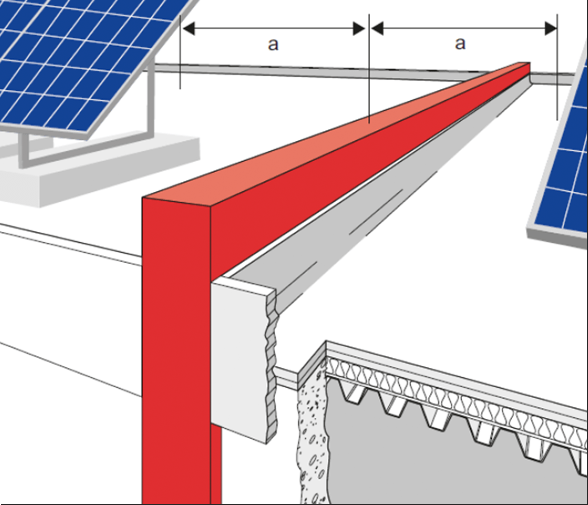
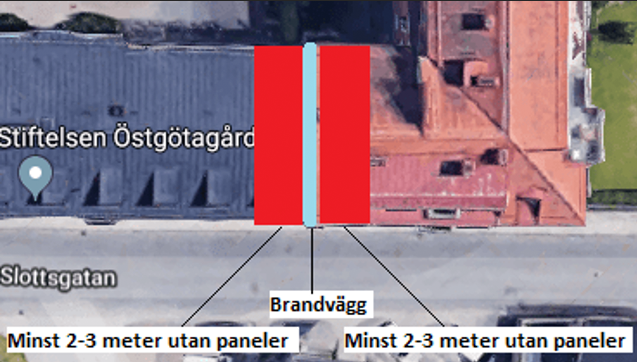
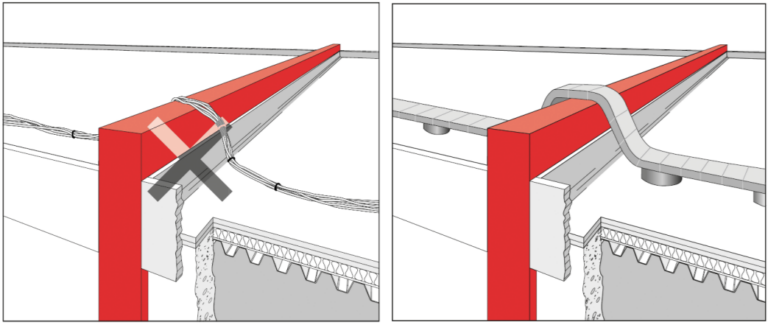
To prevent fire from spreading between fire compartments, the solar PV installation must be set back on both sides of the fire compartment boundary. This is to prevent fire from spreading between parts of the building and from one fire compartment to another. There is no defined minimum distance for the set-back, but some Swedish fire services recommend 2–3 m.
Partitioning
When an installation is built, it is often naturally divided into smaller sections to allow the aluminium to expand due to temperature fluctuations. The snow and wind load calculations specify which breaks must be made to accommodate thermal expansion. Fire safety can also be improved by carefully considering the layout of the installation and the positioning of the panels. The roof may be an escape route, and there may be several possible ladders that must not be blocked. There may also be areas on the roof intended for possible openings to release fire gases, or there may be smoke vents (or other fire safety systems) whose operation must not be impaired by the solar PV installation.
An installation should therefore have sufficiently wide walkways to allow people to escape from the roof quickly and to prevent fire spreading from one section to another. No specific values or requirements are given for l or a, but suitable values are: l = 25–35 m a = approx. 2–3 m <
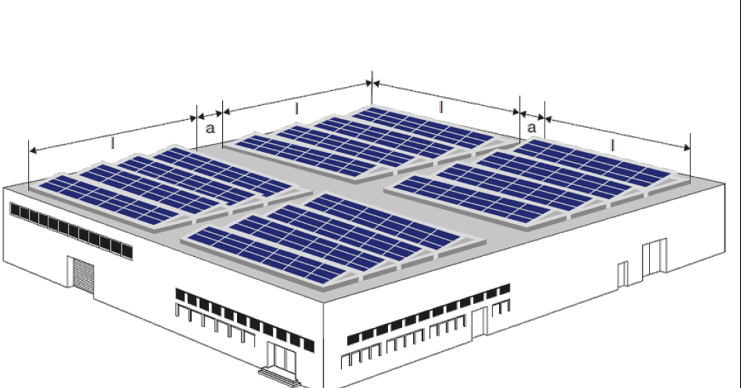
The designer must also ensure that there is sufficient distance between adjacent fire compartments to prevent fire from spreading between building sections and from one fire compartment to another. There is no defined distance requirement, but some Swedish fire services recommend 2–3 m. Partitioning is also important to prevent fire from spreading from one section to another. No specific values or requirements are defined for l or a, but suitable values are: l = 25–35 m and a = approx. 2–3 m.
Arc fault detection (AFCI)
So what is arc fault detection? It is a function used to detect arc faults in solar PV installations. What is an arc fault? It is a “flash” (a breakdown or continuous discharge) through the air, where the electrical voltage has ionised the air, making it conductive. Arc fault detection is often referred to in English-language literature as AFC (Arc Fault Current) or AFCI (Arc Fault Current Interrupter).
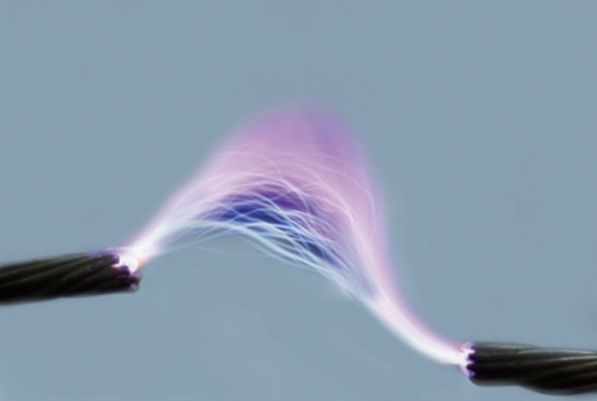
Arc fault detection provides peace of mind for the installation owner, whether it is an agricultural installation, a housing association, an industrial property or a detached house! The technology is now so good and mature that more people should be asking for it and it should be specified in tender documentation and procurement processes.
The peace of mind that arc fault detection provides is about more than just sleeping better at night. In the event of a fault, for example, Huawei’s new series of inverters can pinpoint exactly where the arc occurred and immediately send an alert to the installation owner and installer.
Need help finding the right one?
We know it’s not always easy to know which product or solution is best suited to your needs. Whether you have questions about our range, need guidance or would like help finding a solution that’s right for you, we’re here to help. With our knowledge and experience, we’ll help you make the right choice.
Related posts
Fire 1 – How common are fires involving solar PV systems?
Brand 3 – Firefighter switch, a solution or a problem?