



Battery Temperature Performance
Introduction and background
Temperature is often an underestimated factor when it comes to the performance of stationary battery energy storage systems, particularly in Nordic climates. To ensure that batteries perform as they should, it has become common to install energy storage systems indoors rather than outdoors. This is because battery cells in traditional energy storage systems perform best at temperatures between approximately 20 and 30 degrees Celsius. At both higher and lower temperatures, the battery’s ability to charge and supply energy decreases. In this post, we take a closer look at how temperature affects battery performance, and why new technologies—such as semi-solid-state LFP—can offer better performance in challenging climates.
What affects the temperature performance of a stationary energy storage system (of the LFP type)?
A battery’s temperature performance is largely determined by its internal chemistry and design. In a traditional LFP (lithium iron phosphate) battery, the electrolyte is liquid, which makes it sensitive to temperature changes. At low temperatures, the electrolyte becomes more viscous, reducing its ability to transport lithium ions between the battery’s electrodes. The result is poorer performance during both charging and discharging. A familiar example is when a mobile phone runs out of charge quickly on a ski slope – the cold makes the electrolyte work less effectively and the phone switches itself off. When you then come inside into the warmth, the battery recovers and works again. The chemical process can resume.
The same principle applies to stationary energy storage systems in Nordic climates. To avoid performance losses, batteries are often installed indoors, but even then, temperature variations can affect efficiency. The development of new battery technologies has therefore focused on improving temperature tolerance and ensuring high performance even at extreme temperatures.
It’s not just the cold that’s a problem – heat is too
It’s easy to focus on cold as the biggest challenge to battery performance in Nordic climates, but heat can be just as problematic – particularly on sunny days when batteries are in greatest demand. High temperatures impair a battery’s ability to supply and accept energy, and negatively affect the chemical stability of its cells. This can lead to faster ageing, reduced capacity and, in the worst cases, safety risks. Despite this, many battery systems lack advanced cooling systems, making them vulnerable during heat spikes. However, solutions are available: some systems are equipped with fan-assisted air cooling, while others use liquid cooling to keep the battery modules within an optimal temperature range. Managing heat is particularly important because it often coincides with high loads – precisely when the sun is shining and the battery is expected to supply the most energy. That’s why choosing an energy storage system with the right type of cooling system is crucial to ensure a long service life and reliable performance, even in hot conditions.
How does Semi Solid LFP differ from conventional LFP in terms of temperature performance?
Semi-solid-state LFP batteries represent a major step forward in terms of temperature performance. Unlike traditional LFP batteries, where the electrolyte is entirely liquid, semi-solid-state technology uses an electrolyte more like a gel or a porous sponge with a low proportion of liquid. This design allows the battery to supply energy efficiently even at low temperatures, since the electrolyte does not become as viscous as in traditional batteries.
This means that semi-solid LFP batteries can be charged and discharged at high performance across a wider temperature range – in both cold and warm climates. For users in the Nordic countries, where temperatures can vary greatly, this is a major advantage. The technology makes it possible to install energy storage systems outdoors or in less heated spaces without compromising performance. In addition, semi-solid-state technology performs better than traditional LFP batteries during both charging and discharging, providing greater flexibility and reliability for energy storage all year round.
In summary, semi-solid-state technology makes the battery less sensitive to temperature variations and able to deliver high performance even when the climate is challenging – a crucial feature for the energy storage systems of the future in Nordic conditions.
Semi-solid-state technology therefore has an advantage over traditional lithium-ion batteries with liquid electrolytes, both in cold and warm climates. Another advantage is that semi-solid-state technology performs better during both charging and discharging than a traditional LFP battery.
Charging and discharging as a function of SoC
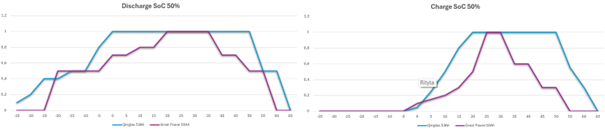
In addition to a wider temperature range, it is also important to take into account that a battery has physical limitations. When a battery is charged, it can deliver 1.0C from the battery module at 0–60% charge, but when the battery’s charge reaches 60% and above, the capacity tapers off from 0.6 to 0.5 and finally 0.2 before the battery is fully charged. It is therefore not possible to maintain the maximum charging rate from 0–100%. The exact same phenomenon can be seen in an electric car during rapid charging. From an empty battery to a little over half full, it charges at full speed, but then the charging rate decreases. This is because, chemically, the battery becomes saturated and its internal resistance increases (as do its internal heat losses). For safety and performance reasons, the charging power should therefore be reduced during the final third (70–100% SoC).

Similarly, the trend can be seen during discharge, where high power (discharge current) can be maintained at a high SOC. But when the battery starts to run low (at around 20% SOC), the discharge power decreases.

Example of how to think as a system designer
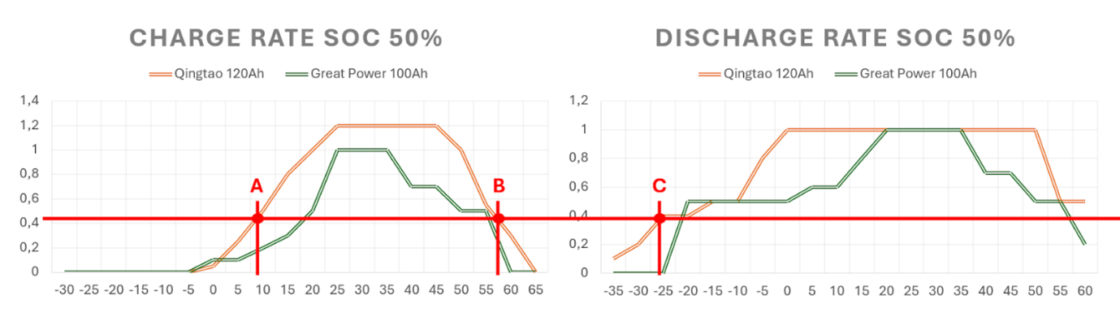
A clear trend visible in the temperature graphs is that a battery performs better at both low and high temperatures when the C-rate is not maximised. Let’s take an example of a 10kW Solis inverter with a 50A battery input. If we have a qapasity Arctic Series battery with 4 battery modules (21.68kWh), it can deliver 53A (because the battery cell is rated at 53Ah). The inverter cannot accept more than 10kW. This means the inverter will draw 10/21.68=0.46 (i.e. a C-rate of 0.46). Because the battery capacity is relatively high compared with the smaller inverter, the C-rate can be kept low, allowing the inverter to deliver its maximum output of 10kW while also achieving very good temperature performance.
Reading the graph at C=0.46, we can identify the following points and temperature data:
- Point A: lowest temperature at which the battery can charge: approx. 9 degrees Celsius.
- Point B: highest temperature at which the battery can charge: approx. 56 degrees.
- Point C: lowest possible temperature at which the battery can discharge: approx. -26 degrees.
- Point D (not visible in the graph) is the highest temperature at which the battery can discharge: this is specified as a maximum of 55 degrees by the cell manufacturer.
Let’s summarise the example:
High battery capacity (kWh) with a “smaller” inverter is recommended if high power output is required from a battery stack placed outdoors.
Use a lower C-rate, preferably 0.5 or below, for the best performance.
Semi-solid-state technology delivers very good performance in challenging temperature environments.
Built-in heating
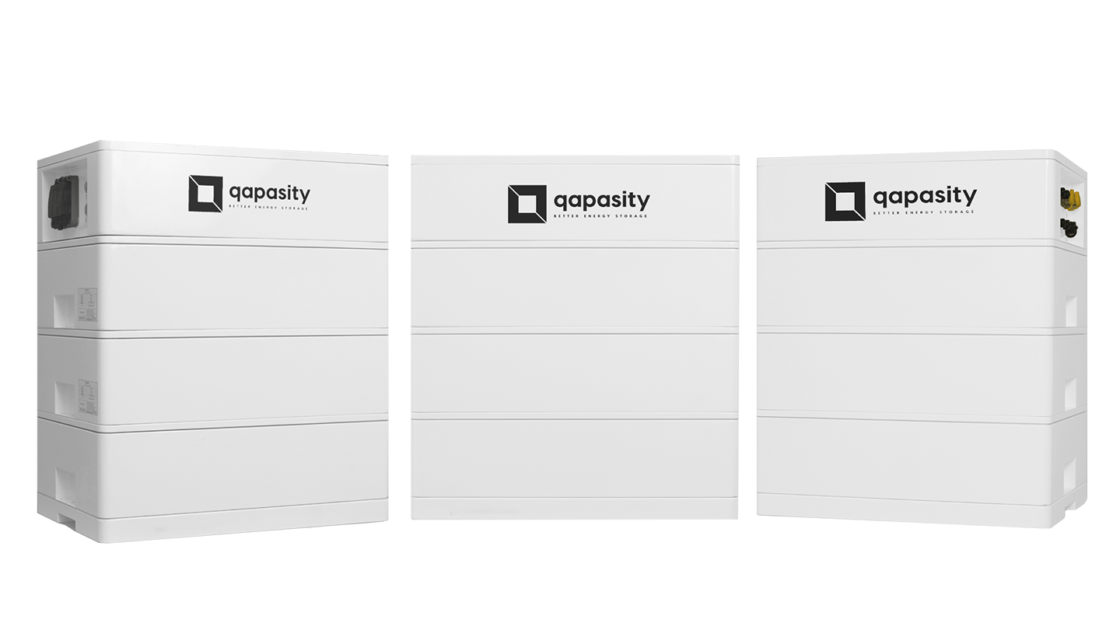
Qapasity Arctic Series is designed for the Nordic climate and to withstand extreme cold. Each battery module contains two heating plates, which are activated via the battery’s Battery Management System (BMS). This enables each battery module to control its own temperature. This means that charging and discharging can take place without compromising performance, even when the ambient temperature is very low. The battery module can therefore be installed outdoors and supply energy at temperatures as low as -25 degrees Celsius.
It will therefore be just as easy to switch EMS provider as it is to switch e-SIM provider. This will increase competition and drive technological development, while also protecting consumers’ interests: with new services and technologies, they can quickly switch direction rather than being locked into closed solutions with expensive hardware that cannot be replaced.
Summary
In summary, the cell technology (semi-solid-state LFP) works in combination with the built-in heating to ensure that the battery module always delivers in accordance with the demanding requirements qapasity places on our products. The product has undergone rigorous testing of the battery cells, the BMS unit and the battery module, as well as of the entire system, to ensure that we can keep our promises when it comes to performance.
Need help finding the right option?
We know it isn’t always easy to know which product or solution is best suited to you. Whether you have questions about our range, need guidance or would like help finding a solution that meets your specific needs, we’re here for you. We’ll help you make the right choice with our knowledge and experience.
Related posts
This is how a fire safety engineering design is carried out

The Salmon Project