




Battery cell balancing in lithium-ion batteries
Introduction
Lithium-ion batteries have quickly become a cornerstone of modern energy technology. Today, they are used in everything from electric cars and energy storage systems to mobile phones, computers and tools. Rapid technological development has led to constant improvements in battery capacity, safety and lifespan. But to truly take advantage of the potential of lithium-ion batteries, advanced control and monitoring are essential—and one of the most important functions in this regard is battery cell balancing.
Battery cell balancing is a technology that ensures all the cells in a battery pack operate within safe and optimal limits. Without proper balancing, battery performance may deteriorate, its lifespan may be shortened and safety risks may arise. In this blog post, we explore what battery cell balancing involves, why it is so important, the differences between various balancing methods, and practical advice for both commissioning and expanding battery systems.
What is battery cell balancing and why is it needed?
A lithium-ion battery consists of several individual cells connected in series and/or in parallel to achieve the desired voltage and capacity. Over time, and through repeated charging and discharging cycles, small differences arise between the cells.
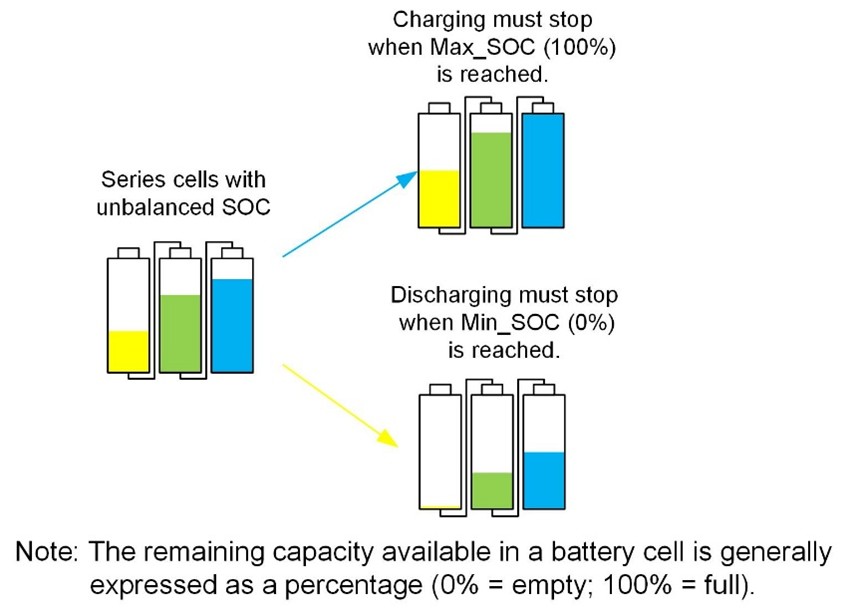
These differences can be caused by variations in manufacturing, ageing, temperature fluctuations or different loads during operation. As a result, some cells discharge faster, lose capacity or develop higher internal resistance than others. If these differences are not managed, individual cells may become overcharged or deeply discharged. An overcharged cell can overheat, swell or even catch fire, while a deeply discharged cell can be permanently damaged and lose capacity. Since the battery’s overall performance is often limited by its weakest cell, it is crucial to keep all cells as closely matched as possible in terms of state of charge (State of Charge, SoC). A lack of, or inadequate, battery cell balancing can lead to the following problems:
- Reduced battery capacity
- Shorter operating time
- Degraded performance
- Safety risks such as overheating or even fires
- Premature battery failure due to inconsistent voltage levels
- Energy loss from inefficient charging and discharging
Battery cell balancing is therefore the process of actively or passively equalising the state of charge between cells. By ensuring that all cells operate within the same voltage and charge range, the battery’s lifespan, safety and capacity can be maximised.
Batteries deteriorate over time, and individual cells in a battery pack charge or discharge at different rates. This imbalance can be caused by:
- Manufacturing defects – Small variations in cell capacity from the factory.
- Temperature differences – Heat affects cell performance and causes uneven discharge rates.
- Variations in self-discharge – Some cells naturally lose charge faster than others.
- Ageing effects – Cells deteriorate at different rates, leading to inconsistencies.
Without proper battery cell balancing, these discrepancies can increase, causing inefficiency and even battery failure.
What is the difference between active and passive battery cell balancing? An overview of how it works
There are two main methods of cell balancing: passive and active. Both aim to even out the charge level between the cells, but they do so in different ways and with different levels of efficiency.
Passive cell balancing
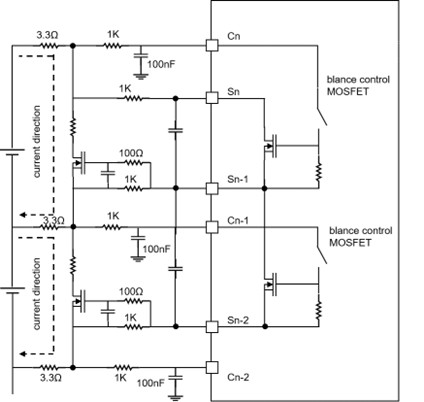
Passive cell balancing is the most widely used and simplest method. Here, excess energy from the most highly charged cells is dissipated as heat through resistors. When a cell reaches its maximum voltage during charging, a resistor is connected in parallel with the cell. The resistor dissipates the excess energy until the cell's voltage drops to the same level as the other cells.
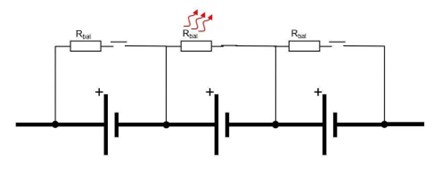
The advantage of passive balancing is that it is easy to implement and has a low cost. The disadvantage is that the energy removed is lost as heat, which means the method is less energy-efficient and can be slow if the imbalances are large. Passive balancing is best suited to smaller systems or where energy loss is not critical.
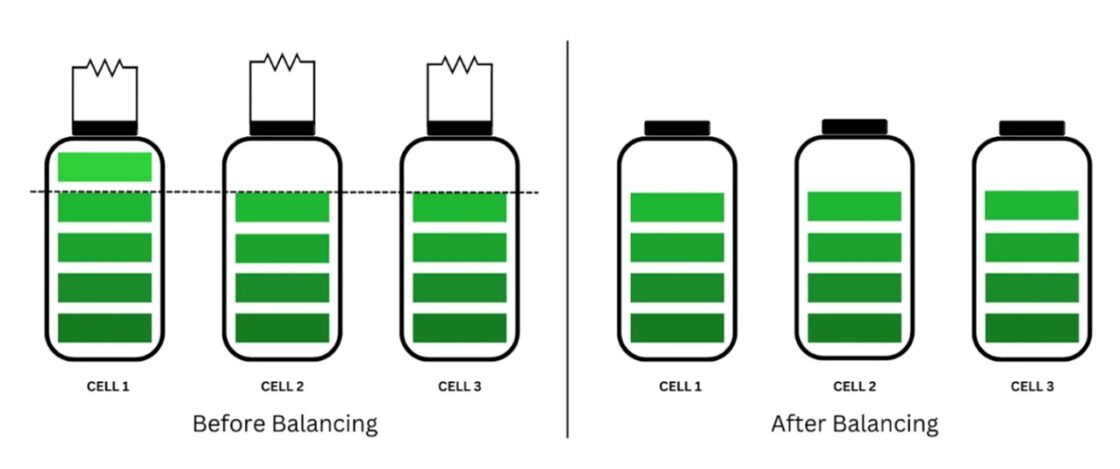
In-depth – Passive battery cell balancing
Passive cell-balancing algorithm:
Balancing activation conditions:
- There are no alarms except for the excessive voltage difference alarm
- The individual cell temperature meets the requirement (-20℃ ~ 55℃)
- The balancing resistor temperature meets the requirement (below 85℃)
- The individual cell voltage is within the upper and lower limits for balancing protection voltage (2800mV ~ 3600mV)
- The maximum individual cell voltage meets the balancing activation voltage (above 3000mV)
- The voltage difference to activate balancing is 20mV;
The main switch balancing function is enabled;
The voltage difference to deactivate balancing is 10mV.
Active battery cell balancing
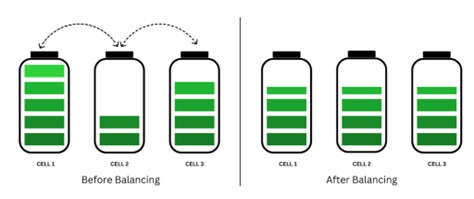
Active battery cell balancing is a more advanced and efficient method. Instead of dissipating surplus energy as heat, energy is transferred from the most highly charged cells to the less charged ones. This is usually done using inductors, capacitors or DC/DC converters, which temporarily store and redistribute the energy between the cells.
Active cell balancing
Active balancing minimises energy losses and allows charge levels to be equalised more quickly. However, the method is more complex and expensive to implement, so it is mainly used in larger battery packs or in applications where efficiency and a long service life are particularly important, such as electric vehicles or stationary energy storage systems.
The choice between active and passive balancing depends on the application’s requirements for efficiency, cost and system size.
Table - Summary of differences:
| Feature / Criterion | Passive balancing | Active balancing |
|---|---|---|
| Heat generation and safety | Resistors generate significant heat during equalisation, requiring additional heat dissipation design. | No significant heat generation (no energy consumption in resistors), low heat dissipation load. |
| No complex energy conversion, no risk of component overload. | Many components and a high operating frequency, which can lead to a risk of electromagnetic interference. | |
| Impact on battery lifespan | Long-term reliance on energy loss during equalisation reduces the batteries' total available capacity. | Can minimise battery imbalances to the greatest extent possible, thereby extending the battery pack's total lifespan. |
| No additional battery charging/discharging cycles, no additional loss. | Frequent energy transfer can cause marginal cycle loss in batteries (negligible). | |
| Suitability for applications | Suitable for low-capacity, low-requirement equipment with high cost-effectiveness. | Suitable for high-capacity, high-reliability equipment, with long-term benefits. |
| Cannot meet the needs of high-capacity, long-life equipment. | When used in small equipment, the cost and benefits are not balanced. |
Deep dive – Active battery cell balancing
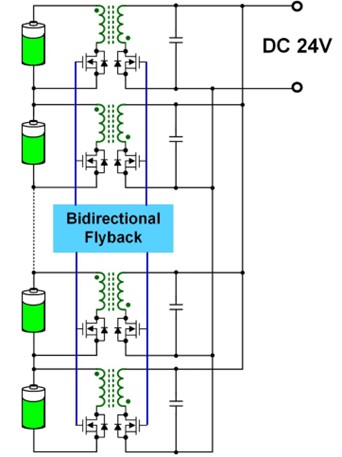
Algorithm for active cell balancing:
Each battery cell can be connected to a common terminal (e.g. 24 V) via a bidirectional flyback converter.
By controlling the switching of MOSFETs, the energy transfer between cells is regulated—energy is first transferred from cells with excess energy to the common terminal, and then redirected to cells with insufficient energy.
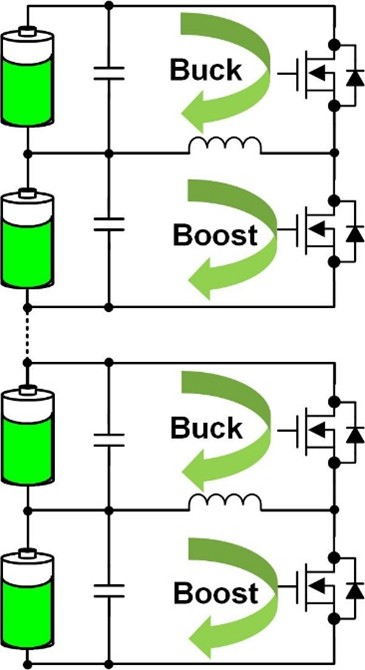
The DC/DC converter in active balancing operates in either “buck” mode, which lowers the voltage, or “boost” mode, which raises the voltage. By enabling a new alternative path for the current, the cells can be balanced. As direct current flows from high to low voltage, the current can always be directed to the battery cells that most or least need charging and discharging.
Tips for preventing cell imbalances
Preventing cell imbalances is essential for optimising battery performance and extending the lifespan of your battery system. How can you optimise battery performance with battery cell balancing? To ensure that your battery system performs at its best, follow these best practices and tips to help you prevent and manage cell imbalances.
-
Choose the right balancing method
Choose active balancing only if you are building extremely high-performance systems with large budgets and requirements for maximum efficiency.Passive balancing is the best choice for energy storage products and most commercial systems, offering reliability without overengineering. -
Choose the right BMS
Use a high-quality battery management system (BMS)
A good BMS monitors charge levels and ensures even distribution.
It prevents overcharging, overheating and excessive wear on the battery cells.
Maximise battery lifespan: the importance of accurate estimation and strategies for improving State of Health (SoH). -
Monitor the temperature
Maintain optimal temperature control. Uneven heat distribution can lead to imbalances.Use cooling systems or thermal management solutions to ensure an even temperature across the cells. -
Monitor battery health regularly
Periodic voltage and temperature checks help prevent imbalances.
Use diagnostic tools to track cell performance over time.
If you experience problems with your battery – try balancing it
Imbalances are something that will always occur in battery systems that lack optimisers in each battery module. These imbalances can make it difficult for the BMS to estimate the battery’s SOC (charge percentage). This is because the voltage (which is the most important parameter) used to estimate SOC varies depending on the load, temperature and how the battery is used. When different voltage levels exist in the same series connection (i.e. there is an imbalance), the following faults may occur:
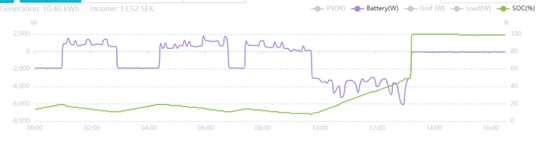
It is entirely natural, and a normal part of lithium-ion batteries, that they need to be balanced. It can take a varying number of cycles to resolve the problem, and cell balancing usually sorts itself out, but sometimes you can give your system a helping hand.
If you want to balance your system manually, follow these steps.
Discharge the battery at approximately 8 A until you reach the lower end of your DoD (often approximately 10–20%)
Wait one hour
Charge the battery at approximately 8 A until you reach 100% SoC
Wait one hour
Repeat approximately 5–7 times
For example, if you have a 20 kWh battery, it would take approximately 12 hours to charge the battery from 0–100%, and just as long to discharge it from 100–0%. This means that cell balancing can take approximately one day (24 hours) with just a single cycle.
Things to consider when commissioning a new system for battery cell balancing and when expanding it with additional battery modules
Introducing a new lithium-ion battery system or expanding an existing one requires careful planning around cell balancing. Here are a few important points to bear in mind:
When commissioning a new system:
- Initial balancing: Before the system is put into operation, all cells should be at the same state of charge (SoC). This ensures that no cell is overcharged or undercharged from the outset, which could otherwise lead to accelerated ageing or safety issues.
- BMS configuration: The battery management system (BMS) must be correctly configured for the battery type and balancing method in question. Check that the BMS monitors all cells and can safely handle both charging and discharging.
- Documentation: It is advisable to record the individual voltage and temperature of each cell at start-up. This makes it easier to troubleshoot and monitor the system’s health over time.
When expanding the system with additional battery modules:
- Balancing new modules: New modules should always be balanced against the existing modules before being connected to the system. If the modules have different SoCs, large equalisation currents may occur, potentially damaging both the cells and the electronics.
- BMS capacity: Ensure that the BMS can monitor and balance the increased number of cells and modules. Larger systems may require more advanced balancing to maintain safety.
- Parallel connection: When connecting modules in parallel, it is particularly important that all modules have a similar SoC. Significant differences can cause high currents between the modules when they are connected, which may result in damage.
- Mixed batteries: Connecting batteries from different manufacturers, of different ages or with different chemistries increases the risk of imbalances. In this case, it is particularly important to monitor the system closely and be prepared to balance it more frequently.
By taking care with these steps, many of the most common problems when commissioning and expanding lithium-ion battery systems can be avoided.
Conclusion and summary
Battery cell balancing is a crucial technology for maximising the lifespan, safety and performance of lithium-ion batteries. Without balancing, the battery’s capacity and safety may deteriorate, and in the worst case this can lead to serious damage to both the battery and the surrounding equipment. Passive balancing is simple and cost-effective but involves energy losses, whereas active balancing is more advanced and efficient but requires more complex electronics and a higher investment.
Regardless of the method used, it is important to be thorough both when commissioning and expanding battery systems. By ensuring that all cells and modules are correctly balanced and that the BMS is properly configured, many problems can be avoided and the maximum benefit can be obtained from the lithium-ion battery system.
Need help finding the right one?
We know it isn’t always easy to know which product or solution is best. Whether you have questions about our range, need guidance or would like help finding a solution that suits your specific needs, we’re here for you. With our knowledge and experience, we’ll help you make the right choice.
Related posts
This is how a fire safety engineering design is carried out

The Salmon Project