



Load management of EV chargers and how EV charging affects the electricity grid
Electric vehicle charging from a grid perspective
Many people believe that as the number of electric vehicles increases, this will put unhealthy strain on an electricity grid that is already under pressure. There is talk almost every day of capacity shortages, in an increasingly alarmist tone. The fact is, they are right: if charging is not managed properly, or if future electric vehicle owners do not receive the right price signals from the market, this could lead to reduced network capacity and slow down the transition to electrifying the transport sector.
Getting electric vehicle owners to charge in the way that is best for the electricity grid will not happen by itself. Owners will need to receive price signals from the market that encourage them to charge when capacity is available and avoid charging when the grid is heavily loaded. Today, most charging takes place without regard to the electricity grid itself, and is instead based on the capacity of the property. New technologies, such as new battery chemistries and control systems, as well as artificial intelligence (AI) and 5G, will open up new opportunities, both technical and commercial. In the future, charging will take place when prices are low and there is capacity available in the electricity grid, but it will also be possible to discharge an electric vehicle and provide capacity. This can be for your home, through so-called vehicle-to-home, where the car’s battery becomes a resource for the home, or through vehicle-to-grid, where the car’s battery becomes a resource for the electricity grid and can both charge and discharge depending on demand. The Technology Blog definitely plans to cover V2H and V2G in more detail in a future post!
The electricity grid is becoming more constrained. In other words, we have access to, for example, hydroelectric power in the north and the reservoirs are full, but we do not have enough transmission capacity to transport the electricity down to southern Sweden. This is a problem for Sweden’s competitiveness, but also for how quickly we can electrify the transport sector. However, the way we charge our electric vehicles can place more or less strain on the electricity grid. There are significant opportunities to manage charging smartly, shifting it to times when electricity is cheap or reducing the need to charge when capacity is needed for other things. On average, a Swede drives only a few Swedish miles a day, and an electric vehicle uses around 2 kWh per Swedish mile. So the need to charge quickly for commuting and everyday journeys is relatively small. The need for the electricity grid (and your own wallet) is much greater!
As the number of electric vehicles increases, so does the need for both power and energy. The biggest challenge is supplying enough power. In fact, we pay more for our electricity grid and the transmission of electricity than we spend on generating electricity! Since the electricity grid is designed to meet the highest demand during the year, careless use of electricity can force us to upgrade it more than necessary. And, as mentioned, building electricity grids is expensive! For example, simulations in New England (USA) have shown a 19% increase in peak demand. This would mean that more transmission capacity and greater generation capacity would be needed. With 100% electric vehicles in Scandinavia and Germany by 2050, the net load curve would increase by 20%, from 127 GW to 152 GW. However, if V2G is implemented, the curve could be smoothed out, resulting in a 7% reduction, from 127 GW to 118 GW [1]. There are therefore significant savings to be made at system level!
When talking about smart charging of electric vehicles, it is important to remember to ask: smart for whom? Of course, it is good to charge as efficiently as possible if you live in a detached house or charge in the garage of a housing association. But how smart is it really to charge without knowing the status of the electricity grid as a whole? Even if your housing association’s charging points are perfectly sized and optimise charging according to the property’s requirements, if the Swedish (Nordic) electricity grid is under heavy strain, you could reduce that strain by turning down your charging speed for a few hours. This is known as demand-side flexibility and is a relatively new concept. New markets and revenue opportunities are being developed for electricity users who can be flexible, such as a factory that can pause production for a few hours or electric vehicle owners willing to charge more slowly (or discharge their electric vehicle) to help meet system-wide needs. This can bring benefits such as freeing up capacity, managing the balance between generation and consumption, minimising bottlenecks and helping maintain voltage. Of course, you will be paid for all these services, either directly or through an aggregator that coordinates smaller generation and consumption facilities (such as electric vehicle chargers and solar power installations)!
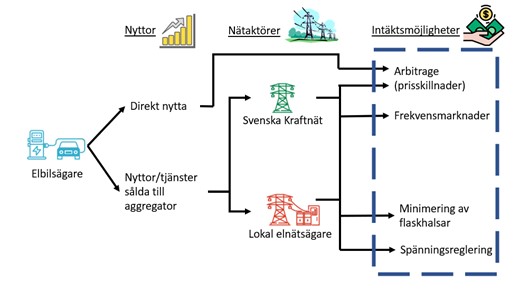
Most smart chargers are designed to receive an external control signal and allow their grid operator or aggregator to reduce (or increase) the charging power, in return for compensation, of course. For example, the Stockholm Flex project was launched as a flexibility market in Stockholm.
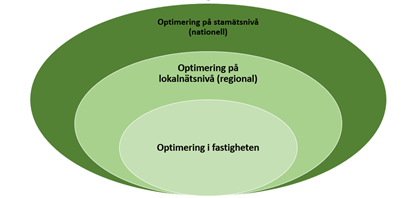
Different ways of managing EV charging
After this helicopter-view overview of how electric vehicle charging works at grid scale, and the opportunities and challenges involved, it is now time for Senergia’s Technology Blog to dive into specific examples of how EV chargers can be managed (and not managed). We’ll cover everything from a single unmanaged socket to coordinating several charging points with solar power and batteries!
A charging post – without load management
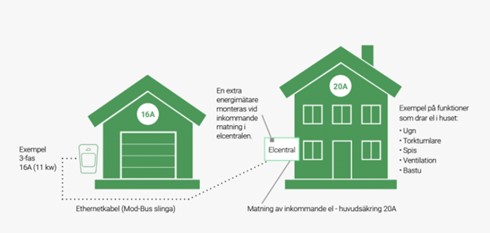
A charging post without load management works like a standard socket. If, for example, you have a 20 A main fuse and a charging post connected to three-phase power at 16 A, all it takes is for you to have something switched on in the house, such as the oven, for the main fuse to become overloaded and trip. This would leave the entire house without electricity. Installations like this are, of course, uncommon, but it happens all too often that new electric car owners don’t realise they need a smarter charging post.
One charging point – static load reduction
The next step towards the example above is to statically reduce the charging power at the charging point. That is, for example, only drawing 8A from a charging point capable of supplying three-phase 16A. This leaves more capacity for the rest of the household and reduces the likelihood of the main fuse tripping. However, since there is no load management, all it takes is for the sauna to be running while you are cooking and charging the electric car for the lights to go out at home again.
A charging point – dynamic load management
The solution to the two examples mentioned above is to have a charging point with a power monitor, or what is known as dynamic load management. The charging point has an energy meter in the house’s electrical distribution board that continuously monitors the household’s electricity consumption. It then calculates how much capacity is available and allocates it to the charging point. This means you never risk a fuse blowing because of EV charging. However, it’s worth remembering that the charging point always gives itself the lowest priority, so if there isn’t much capacity available when you’re using a lot of electricity in the house, the EV won’t charge particularly quickly. But as soon as consumption drops, capacity is freed up for the EV to use for charging. It’s especially convenient when you get home from work and plug in the EV, then start the washing machine and cook dinner. The dynamic load management then makes sure that, as soon as the food is ready and the washing is done, the charging speed increases so the car finishes charging overnight. All without you having to lift a finger. The car will be fully charged just in time for your morning coffee!
Dynamic control with solar power
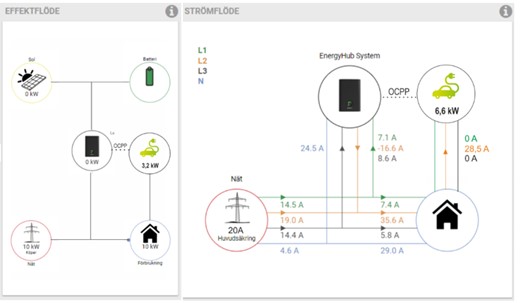
If a property has a solar PV system (and possibly battery storage), there are more tools available. This is because more energy is available locally, behind the electricity network operator’s meter. For example, this enables Ferroamp’s Energy Hub, together with Ctek’s charging point, to act as a metering and control system for the charger [2]. It then communicates the locally available power, rather than just a static main fuse rating. This means charging can take place faster using local solar power, while Ferroamp’s phase-balancing technology frees up network capacity. A battery storage system can also make charging even faster, without risking the main fuse tripping. We call this Solar Power 2.0!
Please note that the image below is an illustration of what visualisation could look like in the future. There is currently no graphical view of the integration. The communication and control capability is in place and can be activated from late 2020.
Managing a group of chargers
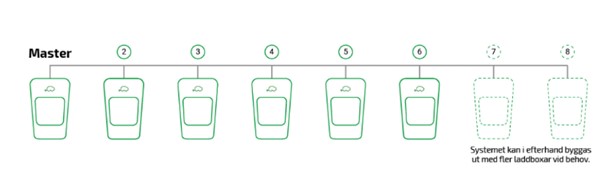
For applications where several charging points are to be installed, for example in a housing association, coordination between multiple chargers is required to prevent any fuse from blowing. This is made possible by having a master charger that allocates capacity between the charging points. With load management enabled, EV charging will be limited to the maximum permitted current. If the power is turned down, charging will take a little longer, but no fuse will blow. Load management can be set at charging-station level, which means that some charging points can operate at full power while selected ones can have limited power.
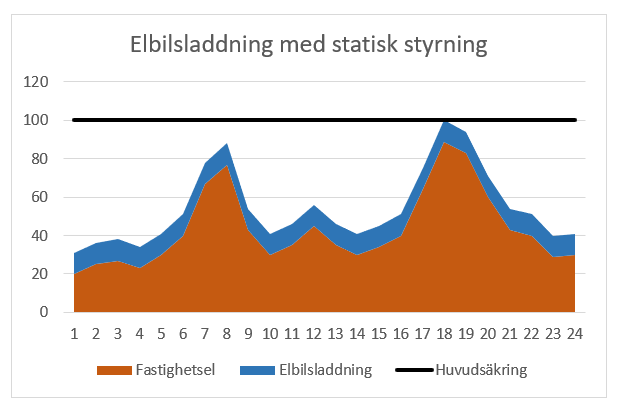
In the image illustrated below, you can see a static bottleneck. The available capacity is calculated based on a worst-case scenario, i.e. the peak load up to the main fuse rating. In this case, approximately 12 A across three phases, i.e. around 8 kW. This clearly shows that capacity needs to be freed up and charging needs to be managed smartly, rather than increasing the property's fuse rating at a higher monthly cost.
Dynamic load management for a group of chargers
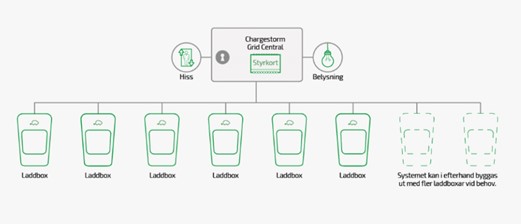
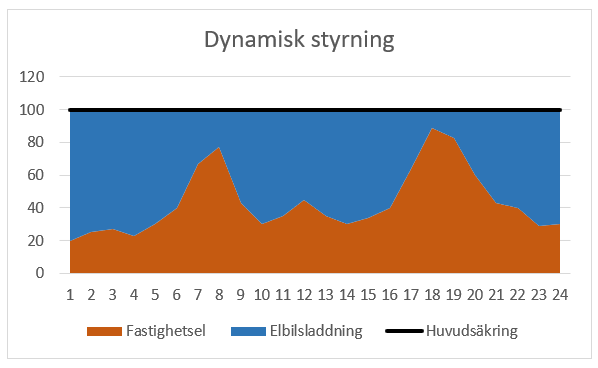
As in the example above with dynamic load management, charging can of course also be orchestrated across a group of chargers. An external control unit monitors the loads in the property, and the remaining capacity is allocated to the charging units. This ensures that lifts, lighting, ventilation, etc. are always prioritised, and that the charge points are always controlled based on how much spare capacity is available in the property.
The charging units are automatically queued if minimum capacity cannot be guaranteed, and as soon as one charging session is complete, the next can begin. The system always ensures charging at maximum speed without affecting the property’s other amenities.
Dynamic control with solar power
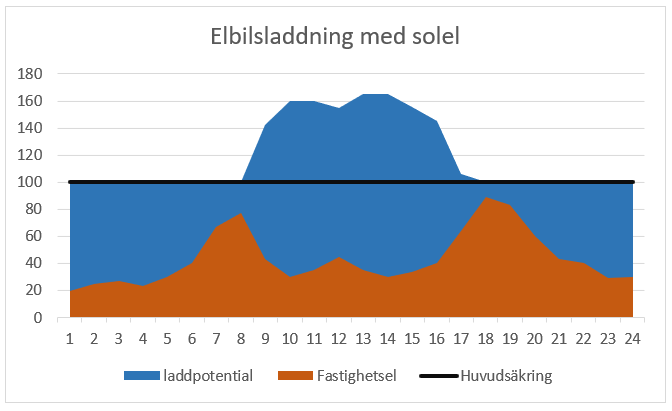
If several charging points need to be controlled and the property has solar panels on the roof, there are several smart ways to manage EV charging, for example in a housing association. The chargers need to be informed of the available power for the property, including solar power. This means that the solar panel system and EV chargers must be integrated and connected to work together.
In larger installations, Chargestom Grid Central can be replaced with a Ferroamp Energy Hub. The available capacity is monitored by current transformers on the incoming service cable, where phase balancing also takes place. The available power is communicated to the charging stations via Ferroamp’s API, directly to the stations. This means that when solar power (and/or stationary batteries) is available, the chargers always get the maximum possible capacity for fast and safe charging, while placing as little load as possible on the building’s main fuse, saving the property owner money. Add to this the option of fast charging via DC in Ferroamp’s Nano Grid or in Power Share applications, where several properties are connected in a DC network (see post 13 on DC networks on the Technology Blog).
Conclusions
After this post, it is clear that managing your electric vehicle charging is very important, not only because it is the most cost-effective approach. It also enables the greatest number of electric vehicles (and chargers) per property! As the proportion of electric vehicles increases, there will be greater demands on how we charge them. Teknikbloggen’s advice is to give some extra thought to the future and how you can future-proof your installation.
When you also take into account the future external control of charging points at a regional or national level, flexibility can pay off. Being able to delay charging your electric vehicle or even sell capacity back to the electricity grid from your charged electric vehicle will be important functionality.
We should move away as soon as possible from seeing our properties and electric vehicles as static load points on the electricity grid. If we broaden our perspective and see them as flexible resources that can both supply and draw electricity, new opportunities open up. Opportunities for a more environmentally friendly and resource-efficient energy system that is also cost-effective!
References
[1] M. Taljegard, ”The impact of an Electrification of Road Transportation on the Electricity system in Scandinavia,” Charmers University of Technology, Gothenburg, 2017. [2] Ferroamp, ”Press release – Ferroamp and CTEK launch new integration solution for Chargestorm Connected and EnergyHub,” Stockholm, 2020.https://investor.ferroamp.com/pressmeddelanden/ferroamp-och-ctek-lanserar-ny-integrationslosning-for-charge-78372
Need help finding the right option?
We know it is not always easy to know which product or solution is best suited to you. Whether you have questions about our range, need guidance or would like help finding a solution that suits your specific needs, we are here for you. With our knowledge and experience, we can help you make the right choice.
Related posts